What Certifications Matter For Current Sensors And Power Components
What Certifications Matter For Current Sensors And Power Components
When purchasing current sensors, voltage sensors, IGBT modules, SiC MOSFETs, DC-link capacitors, snubber capacitors, and other power components, certifications and compliance documents are important for safety, market access, project approval, and long-term reliability. For industrial buyers, the question is not only whether a product has a certificate, but whether the certificate matches the real application, target market, voltage level, and equipment standard.
This guide explains which certifications and documents matter most for current sensors and power components, how to review CE, UL, IEC/EN, RoHS, REACH, ISO, and test reports, and what engineers and procurement teams should check before confirming a supplier.
Quick Answer
For current sensors and power components, buyers should check product safety certification, EMC compliance, environmental compliance, material compliance, factory quality system certification, and application-specific test reports. CE, RoHS, REACH, UL/cUL, IEC/EN safety standards, EMC test reports, ISO 9001, IATF 16949, insulation test reports, dielectric strength tests, temperature rise tests, and reliability test data may all be relevant depending on the target market and application. The most important point is to match the certification scope with the actual product model, voltage rating, current rating, and final equipment requirement.
1. Understand Certification Is Not Just A Sales Label
In power electronics procurement, certifications are often used as trust signals. However, not every certificate has the same value. Some certificates are product-level approvals, some are factory management system certificates, some are material compliance declarations, and some are test reports for specific samples. Buyers should understand the difference before making a sourcing decision.
For current sensors and voltage sensors, certification may relate to electrical safety, insulation performance, EMC performance, environmental compliance, and measurement reliability. For power components such as IGBT modules, SiC MOSFETs, DC-link capacitors, and snubber capacitors, buyers may need to review voltage withstand, temperature rise, flame retardancy, ripple current capability, thermal performance, and reliability test data.
A common mistake is to ask only whether the supplier has CE or UL. In many cases, the more important question is whether the certificate covers the exact model, product family, voltage rating, and intended application. A certificate for one series may not automatically apply to another series. A factory ISO certificate does not replace product safety testing. A material compliance declaration does not prove electrical performance.
For OEM projects, buyers should also consider the final equipment certification. Even if a component has its own compliance documents, the final inverter, charger, control cabinet, or energy storage system may still need complete system-level testing. Therefore, component certification should support the final certification process, not be treated as a complete substitute for system approval.
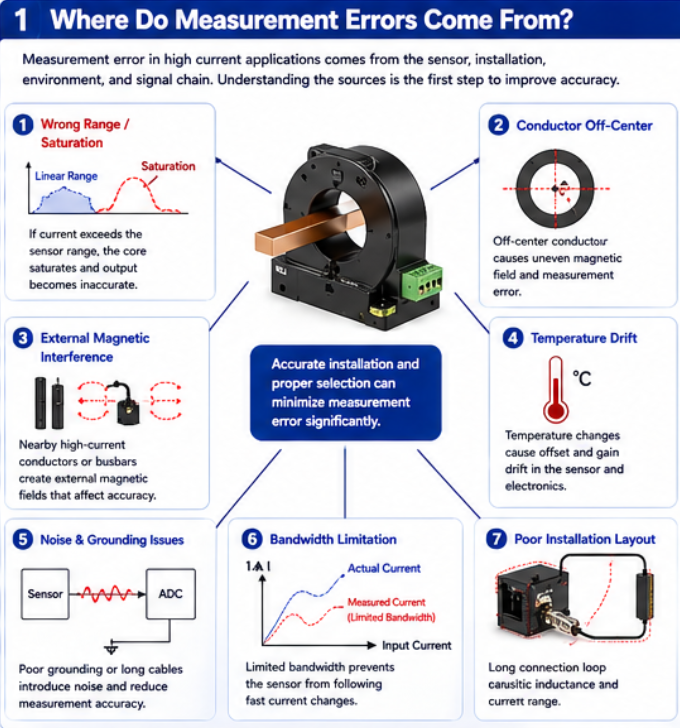
Key Questions Before Reviewing Certifications
Is the certificate for the exact product model or only for a general product family?
Does the certificate cover the required voltage, current, and insulation level?
Is the product used in industrial control, EV charging, solar inverter, railway, UPS, or energy storage equipment?
Which target market does the project serve: Europe, North America, Asia, or global export?
Is the document a product certification, test report, declaration, or factory system certificate?
Does the final equipment require additional system-level certification?
Can the supplier provide datasheets, test reports, and traceable quality documents?
2. Common Certifications And Compliance Documents To Check
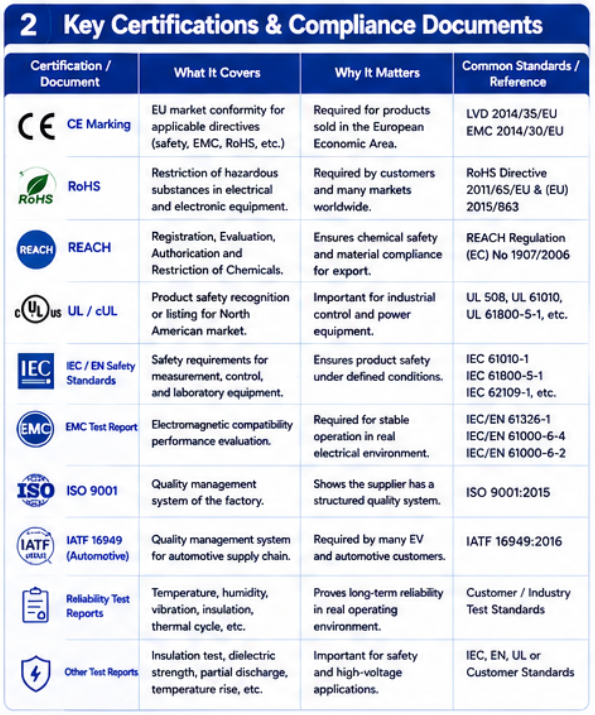
CE marking is commonly required for products sold in the European market when the product falls under applicable EU directives. For current sensors and power components, CE-related compliance may involve safety, EMC, RoHS, and other applicable requirements depending on the final product category. Buyers should ask for the Declaration of Conformity and understand which standards are listed in the declaration.
RoHS and REACH are important for material and environmental compliance. RoHS focuses on restricting certain hazardous substances in electrical and electronic equipment. REACH relates to chemical substance management and material declarations. For export projects, many customers will request RoHS and REACH documents before approving electronic components or power components for use in their equipment.
UL or cUL certification may be important for North American projects, especially when components are used in industrial control panels, power conversion equipment, EV charging equipment, or safety-related electrical systems. Buyers should check whether the component has UL recognition or listing, and whether the file number and model scope match the supplied product.
IEC and EN standards are often used for safety and EMC evaluation. For sensors used in measurement, control, and laboratory-related equipment, IEC/EN 61010 may be relevant. For EMC performance, IEC/EN 61326 or related EMC standards may be considered depending on the equipment category. For drives and power conversion systems, standards related to power drive systems and industrial equipment may also be relevant at the final equipment level.
Factory quality system certifications such as ISO 9001 are useful because they show the manufacturer has a structured quality management system. For automotive or EV-related supply chains, IATF 16949 may be required by some customers. However, these factory certifications do not replace product-level testing. They should be used together with product datasheets, inspection reports, reliability test data, and batch traceability records.
| Certification / Document | What It Usually Supports | Buyer Checkpoint |
|---|---|---|
| CE Declaration | European market compliance for applicable directives | Check listed standards, product model, and declaration scope |
| RoHS | Restriction of hazardous substances in electrical and electronic products | Ask for RoHS declaration or test report for the supplied product |
| REACH | Chemical substance compliance and material declaration | Confirm material compliance for export and customer approval |
| UL / cUL | North American safety recognition or listing | Check file number, model scope, rating, and component category |
| IEC / EN Safety Standards | Safety evaluation for measurement, control, and electrical equipment | Confirm applicable standard based on final equipment use |
| EMC Test Report | Electromagnetic compatibility performance | Review test standard, test condition, and model coverage |
| ISO 9001 | Factory quality management system | Use as supplier quality reference, not as product approval proof |
| Reliability Test Report | Temperature, humidity, vibration, aging, insulation, and load testing | Check whether tests match the actual application environment |
Product Certification vs Factory Certification
Product certification or product test reports focus on the performance and compliance of a specific product or product series. Factory certification focuses on the manufacturer’s management system. Both are useful, but they are not the same. A strong supplier should provide both reliable quality management and product-level technical documents.
3. Match Certification Requirements With Real Applications
Different applications require different certification priorities. For industrial control cabinets, buyers may focus on CE, UL/cUL, EMC, insulation performance, and industrial control compatibility. For EV charging equipment, buyers may place more importance on safety, insulation, temperature rise, RoHS, REACH, EMC, and customer-specific approval. For solar inverters and energy storage systems, long-term reliability, thermal performance, insulation, and environmental compliance are especially important.
For current sensors and voltage sensors, key documents may include datasheets, insulation test reports, dielectric strength tests, accuracy test data, temperature drift data, EMC reports, RoHS/REACH declarations, and CE-related documents. If the sensor is used in safety-related monitoring, leakage current detection, railway systems, or high-voltage equipment, additional application-specific testing may be required.
For power components such as IGBT modules, SiC MOSFETs, DC-link capacitors, and snubber capacitors, buyers should review voltage rating, temperature rating, reliability test data, thermal cycling, humidity test, vibration test, flame retardancy, and batch traceability. In high-power systems, component failure can cause serious equipment damage, so test data and supplier quality control are very important.
For global export projects, procurement teams should ask the customer or project owner which certifications are mandatory before ordering. Some projects only need material compliance and basic test reports. Others may require UL-recognized components, CE declarations, third-party lab reports, or full customer approval documents. Confirming these requirements early can prevent delays during mass production or final equipment certification.
The best approach is to create a certification checklist before supplier selection. This checklist should include target market, application, required standards, product model, rated voltage, rated current, environmental requirements, required test documents, and whether third-party certification is required. This helps avoid misunderstanding between engineers, purchasing teams, suppliers, and final customers.
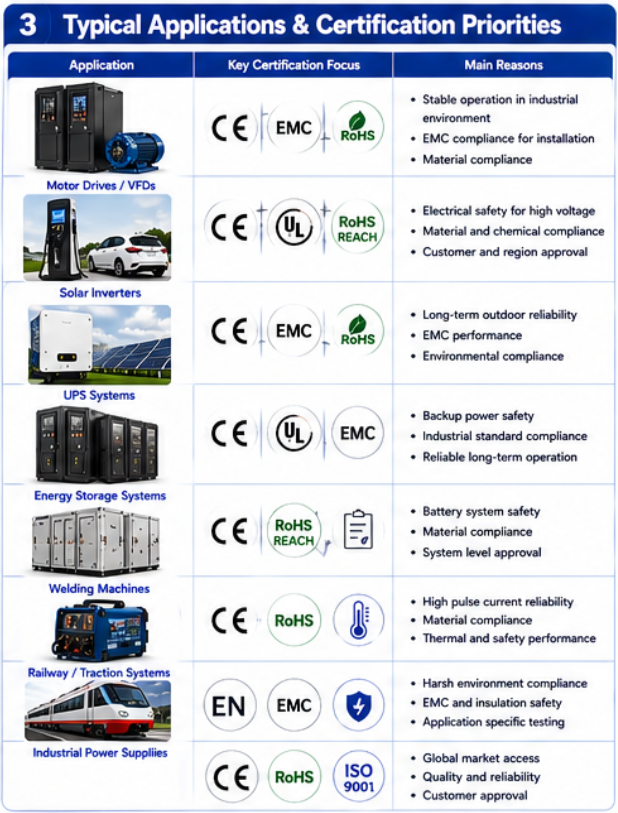
Application Matching Reference
| Application | Main Compliance Concern | Recommended Document Check |
|---|---|---|
| Motor Drives / VFDs | Safety, EMC, insulation, thermal reliability | CE, EMC report, insulation test, datasheet, quality certificate |
| EV Charging Stations | Electrical safety, material compliance, high-voltage reliability | RoHS, REACH, CE-related documents, insulation and temperature test data |
| Solar Inverters | Long-term reliability, thermal stability, EMC, environmental compliance | EMC report, RoHS, REACH, reliability test, thermal performance data |
| UPS And Energy Storage | Battery-side safety, DC bus reliability, insulation performance | Safety report, insulation test, temperature rise test, quality traceability |
| Railway Power Systems | Vibration, insulation, EMC, harsh environment reliability | Application-specific test reports, EMC data, vibration and thermal data |
| Industrial Control Panels | Control equipment compatibility and market access | UL/cUL if required, CE, EMC, datasheet, installation instructions |
Common Mistakes To Avoid
Accepting a certificate without checking whether it covers the exact product model.
Confusing factory ISO certification with product safety certification.
Assuming CE, RoHS, REACH, and UL mean the same thing.
Ignoring whether the certificate matches the required voltage and current rating.
Using a supplier declaration when the project requires a third-party test report.
Not checking certificate validity, issuing body, report number, and test scope.
Waiting until mass production to confirm certification requirements.
Conclusion
Certifications for current sensors and power components should be reviewed according to the product model, target market, application, voltage rating, current rating, and final equipment requirement. CE, RoHS, REACH, UL/cUL, IEC/EN safety standards, EMC reports, ISO 9001, IATF 16949, reliability tests, and insulation test data may all matter depending on the project.
For industrial buyers, the best supplier is not only the one that can show certificates, but the one that can provide correct, traceable, and application-matched technical documents. A complete certification and test document review can reduce procurement risk, support customer approval, simplify export compliance, and improve long-term equipment reliability.
FAQ
1. Is CE certification enough for current sensors?
Not always. CE may support European market compliance, but buyers should still check the listed standards, model scope, safety test data, EMC report, RoHS compliance, and final equipment requirements.
2. What is the difference between RoHS and REACH?
RoHS focuses on restricted hazardous substances in electrical and electronic equipment. REACH relates to chemical substances and material compliance. Export customers may request both documents.
3. Does ISO 9001 prove product performance?
No. ISO 9001 shows the supplier has a quality management system, but it does not replace product testing, safety certification, or reliability verification for a specific current sensor or power component.
4. When is UL certification important?
UL or cUL may be important for North American projects, especially when the component is used in industrial control equipment, power conversion systems, or safety-related electrical assemblies.
5. What documents should I request before ordering?
You should request datasheets, product certificates, CE declaration if applicable, RoHS/REACH documents, UL file information if required, EMC or safety test reports, insulation test data, reliability reports, and quality system certificates.
Contact Us For Current Sensor And Power Component Selection Support
If you are selecting current sensors, voltage sensors, IGBT modules, SiC MOSFETs, DC-link capacitors, snubber capacitors, or other power components for industrial equipment, send us your application, target market, voltage rating, current rating, certification requirement, and test document needs. Our team can help you match a suitable solution.
Contact Us Get Quote