How To Compare Current Sensor Models Beyond Price Alone
How To Compare Current Sensor Models Beyond Price Alone
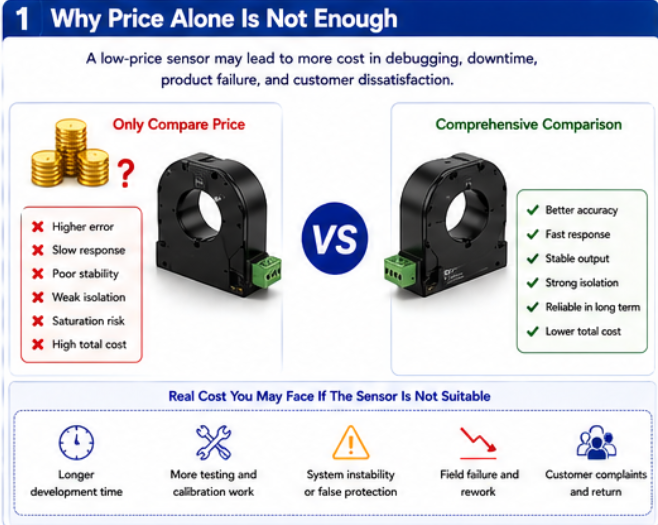
When purchasing current sensors for industrial power electronics, comparing only the unit price can lead to wrong model selection, unstable measurement, poor compatibility, and higher long-term project cost. A low-price current sensor may look attractive at the quotation stage, but if it has poor accuracy, unstable output, weak isolation, unsuitable response time, or limited reliability, it may create more problems during installation, testing, and mass production.
This guide explains how engineers and procurement teams should compare current sensor models beyond price alone. It covers accuracy, current range, response time, bandwidth, isolation voltage, output signal, temperature drift, installation structure, certifications, reliability, supplier support, and total cost of ownership.
Quick Answer
To compare current sensor models properly, buyers should evaluate more than price. Important factors include current range, accuracy, linearity, offset, temperature drift, response time, bandwidth, isolation voltage, output signal, aperture size, installation method, operating temperature, certifications, reliability test data, supplier experience, customization support, and delivery stability. The best current sensor is not always the cheapest one. It is the model that matches the application, reduces integration risk, and supports stable long-term system performance.
1. Why Price Alone Is Not Enough For Current Sensor Selection
Current sensors are used in many critical power electronics applications, including motor drives, EV chargers, solar inverters, UPS systems, energy storage converters, welding machines, railway power systems, and industrial control equipment. In these systems, the sensor output may affect current feedback, overload protection, battery control, inverter regulation, safety monitoring, and fault detection. A small model difference can have a large impact on system performance.
If buyers compare models only by price, they may miss important differences in measurement accuracy, response speed, temperature stability, insulation performance, and output compatibility. A lower-cost sensor may be acceptable for simple monitoring, but it may not be suitable for closed-loop control, high-voltage systems, fast protection circuits, or precision DC measurement.
The real cost of a current sensor includes more than its purchase price. If the wrong model causes testing delays, redesign work, unstable readings, field failure, or customer complaints, the total cost becomes much higher. For OEM projects and export equipment, poor model selection can also affect certification, delivery schedule, and customer approval.
A better comparison method is to evaluate current sensor models according to the real application. The same sensor that works well in a basic monitoring cabinet may not work well in a high-frequency inverter. The same low-cost sensor that is acceptable for load monitoring may not be suitable for EV charging safety control or battery current feedback.
Key Questions Before Comparing Models
Is the sensor used for monitoring, feedback control, protection, or precision measurement?
What are the rated current, peak current, and overload current?
Does the system measure AC, DC, pulse, leakage, or bidirectional current?
What accuracy, response time, and bandwidth does the application require?
What output signal does the controller, PLC, ADC, or monitoring system accept?
What isolation voltage and safety margin are required?
What reliability, certification, and supplier support does the project need?
2. Compare Technical Performance Before Comparing Cost
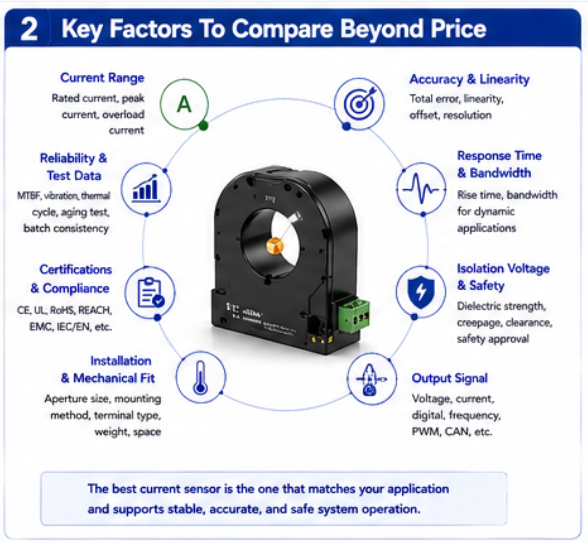
The first comparison area is electrical performance. Buyers should check current range, accuracy, linearity, offset, temperature drift, response time, and bandwidth. These parameters determine whether the sensor can deliver reliable data under real operating conditions. A model with better price but poor temperature stability may create errors in high-power cabinets or outdoor inverter systems.
Current range should be selected according to normal current, peak current, and overload current. A cheaper model with insufficient range may saturate during startup or fault conditions. A model with a range that is too large may lose measurement resolution at normal current. Buyers should compare range suitability instead of simply choosing the lowest quoted price.
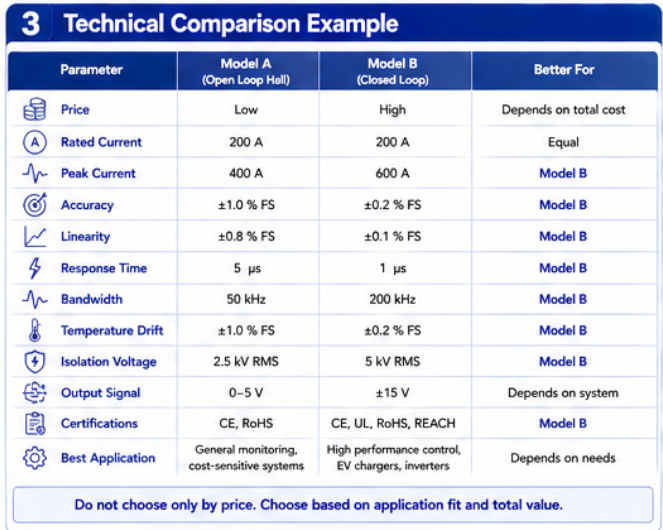
Accuracy and linearity should be matched to the application. For simple current monitoring, standard accuracy may be enough. For motor drive feedback, EV charger current control, battery charge and discharge monitoring, or precision inverter control, higher accuracy and better linearity may be necessary. Closed loop current sensors often cost more than open loop sensors, but they can provide better performance in demanding systems.
Response time and bandwidth are important when the current changes quickly. In motor drives, welding machines, inverters, UPS systems, and protection circuits, a slow sensor may delay feedback or miss transient current events. If the signal is used for dynamic control or fast protection, buyers should compare response performance carefully.
Isolation voltage and safety design should also be reviewed. In high-voltage power electronics, the current sensor must protect the low-voltage control circuit from the high-current primary side. A low-cost model with weak insulation may create safety risk or fail certification requirements. For EV charging, railway, solar inverter, and energy storage projects, isolation performance should be treated as a key selection factor.
| Comparison Factor | Why It Matters | What Buyers Should Check |
|---|---|---|
| Current Range | Affects saturation risk and measurement resolution | Rated current, peak current, overload current, normal working range |
| Accuracy | Affects monitoring, control feedback, and protection decisions | Accuracy class, full-scale error, actual test condition |
| Linearity | Determines whether output remains proportional across the range | Linearity data across low, medium, and high current points |
| Temperature Drift | High temperature can change offset and gain | Operating temperature range and drift data |
| Response Time | Important for fast control and protection circuits | Response time, bandwidth, waveform tracking ability |
| Isolation Voltage | Protects low-voltage control circuits and supports safety design | Isolation voltage, working voltage, creepage, clearance, dielectric test |
| Output Signal | Determines controller and PLC compatibility | Voltage output, current output, digital output, alarm output |
| Mechanical Fit | Affects installation success and layout compatibility | Aperture size, mounting holes, terminal type, body size, conductor fit |
Low Price vs Total Cost
A low unit price is useful only when the sensor also meets the technical and reliability requirements. If a cheaper model causes redesign, calibration difficulty, field failure, false alarms, customer rejection, or certification delays, the total cost becomes much higher. For industrial projects, total cost should include testing time, engineering support, delivery stability, quality consistency, and after-sales risk.
3. Evaluate Reliability, Supplier Support, And Project Fit
After comparing technical specifications, buyers should evaluate reliability and supplier support. Current sensors used in industrial power systems may operate for many years under heat, vibration, electrical noise, and continuous load. A model that works in a short sample test may still fail if it lacks long-term stability or quality consistency.
Reliability documents may include temperature test data, aging test data, vibration test data, insulation test data, dielectric strength test reports, EMC data, and batch inspection records. For export projects, buyers may also need RoHS, REACH, CE-related documents, UL information, ISO 9001 certification, or customer-specific approval documents. These documents help reduce procurement risk and support final equipment approval.
Supplier support is especially important when the project involves customized output signals, special aperture sizes, limited installation space, high-voltage requirements, or model replacement. A professional supplier should help engineers confirm current range, output compatibility, installation structure, operating environment, and test requirements before mass production.
Delivery stability should also be compared. A low-cost model with unstable lead time or inconsistent quality may disrupt production. For OEM equipment manufacturers, stable supply, traceable batches, clear datasheets, and responsive technical communication are often more valuable than a small price difference.
The final decision should be based on application fit. For basic monitoring, a cost-effective open loop sensor may be enough. For high-accuracy control, a closed loop sensor may be worth the higher price. For leakage current safety monitoring, a dedicated leakage current sensor should be selected instead of a general load current sensor. For retrofit projects, a split core design may save installation cost even if the sensor price is higher.
Application Matching Reference
| Application | Main Selection Priority | Model Comparison Focus |
|---|---|---|
| Motor Drives / VFDs | Fast current feedback and overload protection | Response time, bandwidth, current range, linearity |
| EV Charging Stations | Stable AC/DC current measurement and safety monitoring | Accuracy, isolation voltage, output signal, certification documents |
| Solar Inverters | Long-term stability and temperature performance | Temperature drift, EMC performance, insulation, reliability data |
| UPS And Energy Storage | Battery current accuracy and DC stability | Offset, DC accuracy, low drift, long-term reliability |
| Retrofit Power Monitoring | Easy installation and minimal downtime | Split core structure, aperture size, output compatibility |
| Electrical Safety Monitoring | Leakage or residual current detection | Dedicated leakage sensor type, sensitivity, response, alarm output |
Common Mistakes To Avoid
Choosing the lowest price without checking whether the model fits the application.
Comparing accuracy values without checking test conditions and temperature drift.
Ignoring response time and bandwidth in dynamic control applications.
Selecting a model with the wrong output signal for the controller or PLC.
Ignoring aperture size, conductor size, and installation space.
Using a general current sensor for leakage current safety monitoring.
Not reviewing certification documents, reliability tests, and supplier quality control.
Conclusion
Comparing current sensor models beyond price alone helps buyers reduce procurement risk and improve system reliability. Important comparison factors include current range, accuracy, linearity, response time, bandwidth, temperature drift, isolation voltage, output signal, mechanical fit, certifications, reliability data, supplier support, and delivery stability.
The right current sensor is not simply the cheapest model. It is the model that matches the electrical design, installation structure, safety requirement, controller interface, application environment, and long-term reliability target. A well-selected current sensor can reduce testing problems, improve measurement quality, support safer operation, and lower total project cost.
FAQ
1. Why should buyers not compare current sensors by price alone?
Because current sensors affect accuracy, control feedback, safety protection, and system reliability. A cheaper model may create higher total cost if it causes testing delays, unstable readings, redesign, or field failures.
2. What technical parameters matter most?
Important parameters include current range, accuracy, linearity, offset, temperature drift, response time, bandwidth, isolation voltage, output signal, aperture size, and operating temperature.
3. When is a more expensive current sensor worth choosing?
A higher-performance sensor may be worth choosing when the application requires high accuracy, fast response, low drift, strong isolation, reliable safety monitoring, or stable long-term operation.
4. How can I compare suppliers more effectively?
Compare datasheets, test reports, certification documents, sample consistency, technical support, customization capability, lead time, batch traceability, and after-sales response, not only unit price.
5. What information should I provide before requesting a quote?
You should provide the application, current type, rated current, peak current, accuracy target, response requirement, output signal, isolation requirement, conductor size, installation space, certification need, and expected order quantity.
Contact Us For Current Sensor Model Selection Support
If you are comparing current sensor models for motor drives, EV chargers, solar inverters, UPS systems, energy storage systems, railway power systems, or industrial control equipment, send us your current range, accuracy target, output signal, isolation requirement, installation structure, and certification needs. Our team can help you choose a suitable model beyond price alone.
Contact Us Get Quote