How To Reduce Measurement Error In High Current Applications
How To Reduce Measurement Error In High Current Applications
High current measurement is widely used in motor drives, EV charging stations, solar inverters, UPS systems, energy storage converters, welding machines, railway power systems, and industrial power supplies. In these applications, even small measurement errors can affect control accuracy, protection reliability, energy monitoring, thermal management, and long-term system safety.
This guide explains the main causes of measurement error in high current applications and shows how engineers can reduce errors through proper current sensor selection, installation layout, conductor positioning, temperature control, shielding, calibration, and signal processing.
Quick Answer
To reduce measurement error in high current applications, engineers should choose the correct current sensor range, avoid magnetic saturation, center the conductor inside the sensor aperture, minimize external magnetic interference, control temperature drift, use proper shielding and grounding, match output signal with the controller, and calibrate the system under real operating conditions. For precision high current measurement, closed loop current sensors or high-accuracy Hall effect current sensors are usually preferred because they offer better linearity, faster response, lower offset, and stronger stability.
1. Understand Where High Current Measurement Error Comes From
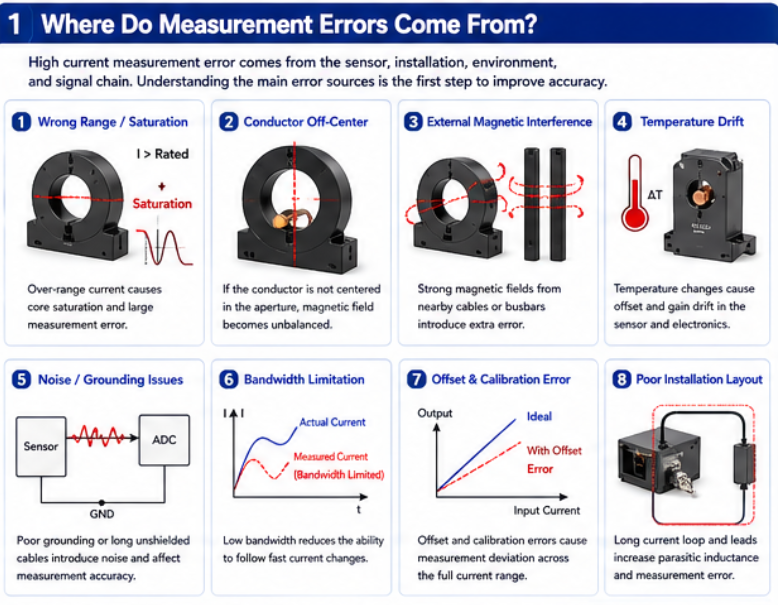
High current measurement error can come from the sensor itself, the installation method, the surrounding electrical environment, and the signal processing circuit. Many engineers focus only on the sensor accuracy value in the datasheet, but real system accuracy depends on many other factors. A high-accuracy sensor can still produce poor results if it is installed incorrectly or exposed to strong interference.
One common source of error is incorrect current range selection. If the sensor range is too small, the magnetic core or internal circuit may saturate during peak current or overload conditions. If the range is too large, the normal operating current may use only a small part of the output range, reducing measurement resolution. The selected range should cover rated current, peak current, and overload current while still keeping good signal resolution during normal operation.
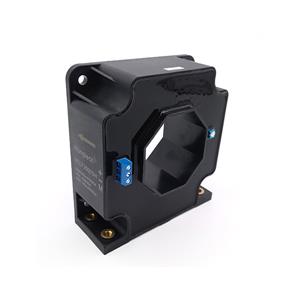
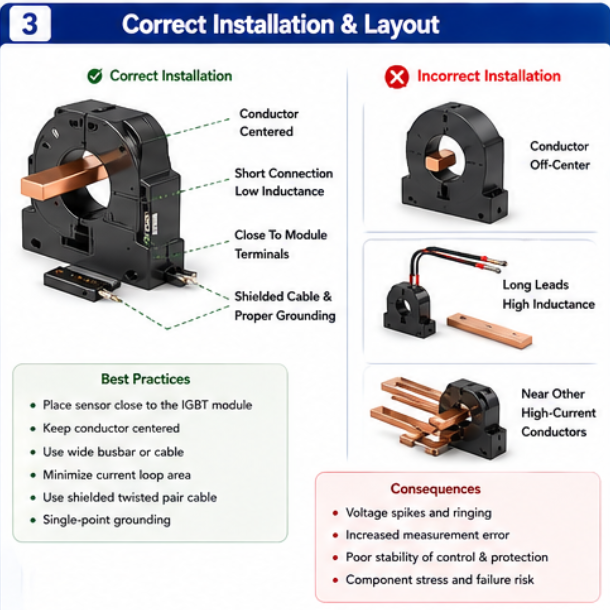
Conductor position also matters. In many through-hole current sensors, the conductor should be placed as close to the center of the aperture as possible. If the conductor is too close to one side, magnetic field distribution may become uneven and measurement error may increase. For busbar installation, engineers should check conductor shape, orientation, and spacing from nearby high-current conductors.
Temperature drift is another important factor. High current systems often generate heat. Motor drive cabinets, EV chargers, welding machines, inverters, and energy storage systems may operate in high-temperature environments. Sensor offset, gain, and output stability may change with temperature. Choosing a low-drift sensor and designing proper thermal management can help maintain measurement consistency.
Common Error Sources
Incorrect sensor range selection
Magnetic core saturation during peak current
Conductor not centered inside the sensor aperture
External magnetic field interference from nearby busbars or cables
Temperature drift caused by high-current operation
Output signal noise, grounding issues, or long cable transmission
Poor calibration under real operating conditions
2. Choose The Right Sensor And Installation Method
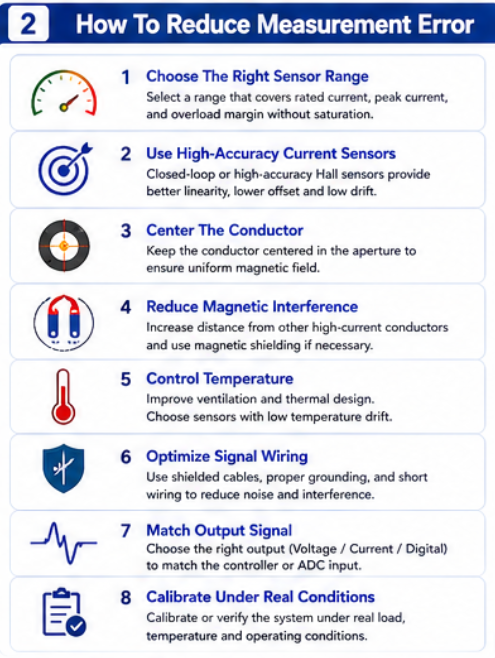
Reducing measurement error starts with selecting the right current sensor. For general high current monitoring, an open loop Hall effect current sensor may provide enough accuracy and good cost performance. For precision feedback, fast control, or demanding power electronics systems, a closed loop current sensor is usually a better choice because it provides better accuracy, linearity, response time, and temperature stability.
The current range should be selected according to the real operating profile. Engineers should confirm rated current, maximum continuous current, peak current, overload current, and fault current. The sensor should not saturate under expected peak conditions, but the range should not be unnecessarily oversized. A properly matched range improves both safety margin and measurement resolution.
Installation layout is equally important. The primary conductor should be positioned correctly inside the sensor aperture. Nearby high-current conductors should be kept away from the sensor when possible, because their magnetic fields may affect measurement accuracy. If the system uses multiple busbars, engineers should review busbar direction, spacing, and current flow direction to reduce magnetic coupling errors.
Signal output should also be matched carefully. Voltage output may be suitable when the sensor is close to the controller or ADC. Current output, such as 4–20mA, may be better for longer cable distances and industrial environments. Digital output may be useful for smart monitoring systems, but protocol compatibility and data rate must be confirmed. A correct output choice helps reduce transmission error and signal noise.
| Error Control Item | Why It Matters | Recommended Action |
|---|---|---|
| Sensor Range | Affects saturation risk and measurement resolution | Match rated current, peak current, and overload margin |
| Sensor Type | Different technologies provide different accuracy and drift levels | Use closed loop sensors for precision feedback and demanding control |
| Conductor Position | Off-center conductors can increase magnetic measurement error | Keep cable or busbar centered in the sensor aperture |
| Magnetic Interference | Nearby high-current conductors may disturb the sensor field | Increase spacing or optimize busbar layout |
| Temperature Drift | High temperature changes offset and gain stability | Choose low-drift sensors and improve thermal design |
| Output Signal | Incorrect output type may cause signal mismatch or transmission error | Match voltage, current, or digital output with controller input |
| Shielding And Grounding | Poor signal routing can introduce noise | Use proper shielding, grounding, and cable routing |
| Calibration | Factory accuracy may differ from installed system accuracy | Calibrate or verify under real operating conditions |
Open Loop Or Closed Loop For Error Reduction?
Open loop current sensors are practical for many cost-sensitive high current monitoring applications. Closed loop current sensors are better when the system requires higher accuracy, faster response, better linearity, lower offset, and lower temperature drift. If measurement error directly affects motor torque, inverter control, EV charging current, or battery protection, closed loop technology is usually the safer selection direction.
3. Apply Error Reduction Methods In Real High Current Systems
Different high current applications have different error control priorities. In motor drives, current measurement accuracy affects torque control, overload protection, and drive stability. In EV chargers, measurement error may affect charging current regulation, safety monitoring, and system diagnostics. In energy storage systems, inaccurate current measurement may affect charge and discharge control, battery protection, and energy management.
For motor drives and servo systems, fast response, good linearity, and proper sensor range are especially important. The sensor should follow dynamic current changes accurately without saturation. For solar inverters and UPS systems, stable long-term output, low temperature drift, and good isolation are important because the system may operate continuously for long hours.
For welding machines and high pulse current equipment, peak current capability and response time should be checked carefully. Strong pulse current may cause magnetic saturation, thermal stress, and signal distortion if the sensor is not properly selected. In these applications, engineers should confirm peak current, pulse duration, duty cycle, and overload tolerance.
For railway, traction, and heavy industrial power systems, external magnetic interference and installation layout are often major concerns. Large busbars, high current conductors, and compact cabinet structures can influence sensor accuracy. Proper conductor positioning, shielding, and spacing should be considered early in the design stage.
When requesting a current sensor quote, buyers should provide the application, rated current, peak current, overload condition, conductor size, aperture requirement, accuracy target, output signal, cable distance, operating temperature, and installation layout. This information helps suppliers recommend a more suitable sensor and reduces the risk of measurement error after installation.
Typical Application Matching Reference
| Application | Main Error Risk | Error Reduction Focus |
|---|---|---|
| Motor Drives | Dynamic current changes, torque feedback error | Fast response, correct range, high linearity |
| EV Charging Stations | Current regulation error and safety monitoring error | Accuracy, isolation, stable DC measurement |
| Solar Inverters | Temperature drift and inverter switching noise | Low drift, noise immunity, proper shielding |
| UPS And Energy Storage | Battery current measurement error and long-term drift | Stable DC sensing, calibration, thermal control |
| Welding Machines | High pulse current and saturation risk | Peak current capacity, response time, overload tolerance |
| Railway Power Systems | Large busbar interference and harsh environment | Installation layout, isolation, anti-interference design |
Common Mistakes To Avoid
Choosing the sensor only by rated current and ignoring peak current
Using an oversized sensor range and losing normal-current resolution
Installing the conductor off-center inside the sensor window
Placing the sensor too close to other high-current cables or busbars
Ignoring temperature drift in high-power cabinets
Using long unshielded signal cables in noisy environments
Not verifying actual system accuracy after installation
Conclusion
Reducing measurement error in high current applications requires both correct sensor selection and proper system installation. Engineers should review current range, peak current, sensor type, conductor position, external magnetic fields, temperature drift, output signal, shielding, grounding, and calibration before finalizing the design.
For applications such as motor drives, EV charging stations, solar inverters, UPS systems, energy storage converters, welding machines, railway systems, and industrial power supplies, accurate high current measurement helps improve control performance, protection reliability, energy monitoring, and system safety. A well-matched current sensor and a well-designed installation layout can significantly reduce measurement error and improve long-term equipment reliability.
FAQ
1. What causes measurement error in high current sensors?
Common causes include wrong sensor range, magnetic saturation, conductor misalignment, external magnetic fields, temperature drift, signal noise, grounding problems, and poor calibration.
2. Is a higher current range always better?
No. A higher range can prevent saturation, but an oversized range may reduce measurement resolution during normal operation. The range should match both rated and peak current.
3. Why does conductor position affect accuracy?
If the conductor is off-center inside the sensor aperture, the magnetic field may not be evenly detected. This can increase measurement error, especially in high current applications.
4. Which sensor type is better for reducing error?
Closed loop current sensors are usually better for reducing error in precision applications because they offer better accuracy, linearity, response time, and temperature stability.
5. What information should I provide before requesting a quote?
You should provide the application, rated current, peak current, overload condition, accuracy target, sensor type, output signal, conductor size, aperture requirement, cable distance, temperature range, and installation layout.
Contact Us For High Current Sensor Selection Support
If you are selecting current sensors for high current applications such as motor drives, EV chargers, solar inverters, UPS systems, welding machines, railway systems, or energy storage converters, send us your current range, peak current, accuracy target, output signal, conductor size, and installation layout. Our team can help you match a suitable current sensor solution.
Contact Us Get Quote