Voltage Sensor And Current Sensor Matching Guide For Power Conversion Equipment
Voltage Sensor And Current Sensor Matching Guide For Power Conversion Equipment
Power conversion equipment usually requires both voltage sensors and current sensors to monitor system status, support feedback control, protect power modules, and improve equipment safety. EV chargers, energy storage PCS cabinets, solar inverters, UPS systems, motor drives, railway power systems, DC power supplies, and industrial converters all depend on stable voltage and current measurement.
For OEM buyers and power electronics engineers, selecting voltage sensors and current sensors separately is not enough. The two sensors should match the same system voltage, current range, output signal, controller input, isolation requirement, response time, accuracy level, wiring method, and installation environment. A correct matching plan can reduce sample testing risk and improve long-term system reliability.
Quick Answer
To match voltage sensors and current sensors for power conversion equipment, buyers should confirm the application, DC bus voltage, maximum voltage, transient voltage, rated current, peak current, current direction, output signal, supply voltage, controller input, isolation voltage, accuracy, response time, aperture size, wiring distance, EMC environment, and installation space. The voltage sensor and current sensor should provide signals that the same controller can read correctly and safely under real operating conditions.
1. Why Voltage And Current Sensors Must Be Matched Together
In power conversion equipment, voltage and current are usually measured together. The controller uses voltage data to understand DC bus condition, battery voltage, inverter DC-link voltage, charging output voltage, or system overvoltage risk. At the same time, current data helps the controller monitor output current, charge and discharge current, phase current, overcurrent protection, and power calculation.
If voltage and current sensors are selected with different signal standards, different response speeds, or incompatible isolation levels, the system may display wrong power data, trigger false protection, or fail during sample testing. For example, a voltage sensor with 0-10V output and a current sensor with 0-5V output may require different controller input channels. A slow voltage sensor and a fast current sensor may create timing differences during fault detection.
For EV chargers, BESS systems, PCS cabinets, solar inverters, and industrial converters, sensor matching should be considered during early design, not after cabinet wiring is finished. This helps reduce controller redesign, wiring changes, sample failure, and delayed mass production.
Typical Power Conversion Applications
EV charger DC bus voltage and output current monitoring.
BESS cabinet voltage and bidirectional current measurement.
PCS cabinet DC bus voltage and charge/discharge current feedback.
Solar inverter DC-link voltage and phase current monitoring.
UPS system DC voltage and battery current measurement.
Motor drive DC bus voltage and phase current feedback.
Industrial DC power supply voltage and output current monitoring.
2. Match Voltage Range And Current Range With Real System Conditions
The first step is to confirm the real operating voltage and current. Buyers should not only provide nominal values. Power conversion systems may experience transient voltage, peak current, overload current, startup current, regenerative current, and fault current. The voltage sensor and current sensor should have enough measurement margin without losing useful resolution.
For example, an EV charger may use a 1000V DC voltage sensor for DC bus monitoring and a 500A current sensor for output current feedback. A BESS PCS cabinet may need a 1500V DC bus voltage sensor and a 1000A bidirectional DC current sensor. A solar inverter may need voltage feedback for DC-link voltage and current feedback for input, output, or phase current.
If the selected voltage range is too low, the voltage sensor may saturate or be damaged during transient overvoltage. If the selected current range is too low, the current sensor may saturate during peak current. If both ranges are too high, system resolution may become poor during normal operation.
| System Type | Voltage Sensor Focus | Current Sensor Focus |
|---|---|---|
| EV Charger | DC bus voltage, output voltage, overvoltage protection | Output current, charging current feedback, overcurrent protection |
| BESS Cabinet | Battery voltage, DC bus voltage, system voltage monitoring | Bidirectional charge and discharge current measurement |
| PCS Cabinet | DC bus voltage feedback and protection | Battery-side current and PCS control feedback |
| Solar Inverter | PV input voltage and DC-link voltage | PV input current, phase current and output current |
| Motor Drive | DC bus voltage and fault protection | Phase current feedback and overload protection |
3. Match Output Signals With The Same Controller Platform
Output signal matching is one of the most important checks when selecting voltage and current sensors together. Both sensors may send signals to the same controller, ADC input, PLC, BMS, PCS controller, inverter control board, or monitoring system. If one sensor uses 0-5V output while another uses 4-20mA or RS485, the controller must support all required input channels.
Common output signals include 0-5V, 0-10V, ±5V, 4-20mA, CAN, RS485, and customized output. For compact power electronics control boards, 0-5V or ±5V output may be preferred. For industrial PLC monitoring, 0-10V or 4-20mA may be more suitable. For smart energy equipment, CAN or RS485 may be used for digital monitoring.
For bidirectional DC current measurement, buyers should also confirm zero-current output. For voltage measurement, buyers should confirm output scaling. If the scaling of voltage and current signals is not clear, the controller may calculate wrong power, energy, protection threshold, or fault status.
| Signal Item | Voltage Sensor Check | Current Sensor Check |
|---|---|---|
| Output Type | 0-5V, 0-10V, 4-20mA, CAN, RS485 or custom | 0-5V, 0-10V, ±5V, 4-20mA, CAN, RS485 or custom |
| Output Scaling | Voltage range corresponding to full-scale output | Current range corresponding to full-scale output |
| Zero Point | Usually starts from 0V or custom offset | Midpoint, bipolar output or custom zero-current output |
| Controller Input | ADC, PLC, BMS, PCS, inverter controller or monitor | ADC, PLC, BMS, PCS, inverter controller or monitor |
| Signal Ground | Grounding and shielding method | Grounding, shielding and reference signal method |
4. Match Isolation Voltage And Safety Requirements
Voltage sensors and current sensors in power conversion equipment both need proper isolation. The voltage sensor directly measures high-voltage bus or battery voltage, while the current sensor is usually installed around a high-current conductor. Both sensors must safely separate the high-voltage or high-current side from the low-voltage controller side.
Buyers should confirm working voltage, isolation voltage, creepage distance, clearance distance, pollution degree, altitude, cabinet environment, and insulation requirement. A voltage sensor with sufficient isolation but a current sensor with lower isolation may still create system safety risk.
For high-voltage systems such as 1000V DC bus, 1500V DC bus, EV chargers, PCS cabinets, and solar inverters, isolation should be checked at system level. Buyers should avoid selecting sensors independently without considering the whole cabinet safety design.
| Isolation Item | Why It Matters | Buyer Should Confirm |
|---|---|---|
| Working Voltage | Defines long-term insulation requirement | DC bus voltage, battery voltage and maximum system voltage |
| Isolation Voltage | Protects low-voltage controller and signal circuit | 2.5kV, 4kV, 6kV, 10kV or project-specific requirement |
| Creepage And Clearance | Important for high-voltage cabinet safety | Voltage level, pollution degree, altitude and layout distance |
| Cabinet Environment | Heat, humidity and dust affect insulation reliability | IP level, temperature, humidity, dust and cooling condition |
5. Match Response Time, Accuracy And Protection Logic
Voltage and current sensors may be used for different functions. Some systems use them only for display and monitoring. Others use them for closed-loop feedback, fast protection, fault shutdown, power calculation, SOC estimation, energy management, or inverter control. The required accuracy and response time depend on the function.
If the voltage sensor responds slowly but the current sensor responds quickly, the controller may receive mismatched data during transient conditions. If the current sensor has large offset drift, power calculation may become inaccurate even if the voltage sensor is stable. If the voltage sensor accuracy is poor, overvoltage thresholds may not be reliable.
Buyers should define whether each sensor is used for monitoring, feedback control, protection, or precision measurement. This helps the supplier recommend the correct sensor technology and performance level.
| Function | Voltage Sensor Requirement | Current Sensor Requirement |
|---|---|---|
| Display / Monitoring | Stable output and suitable accuracy | Stable output and suitable range |
| Feedback Control | Good accuracy and response time | Good response, low drift and controller-compatible output |
| Protection | Fast overvoltage and undervoltage detection | Fast overcurrent and fault current detection |
| Power Calculation | Stable voltage data | Stable current data and correct direction |
| Energy Storage Control | Reliable DC bus and battery voltage data | Bidirectional DC current and low offset drift |
6. Check Installation Layout, Wiring Distance And EMC Environment
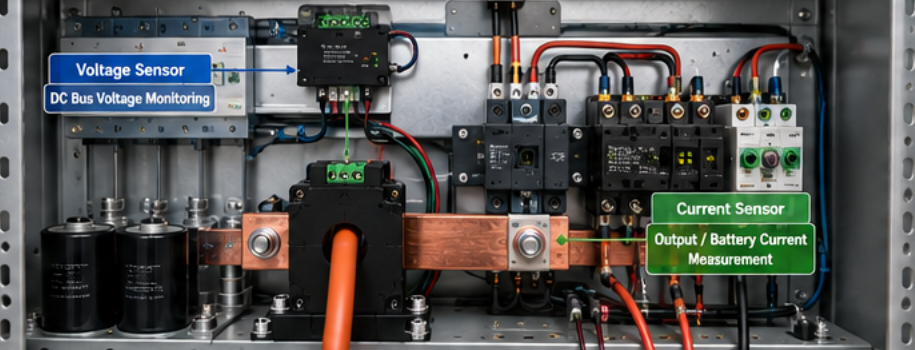
Power conversion cabinets usually contain high-voltage cables, copper busbars, DC-link capacitors, contactors, relays, fans, IGBT modules, SiC devices, control boards, communication wiring, and grounding points. Voltage and current sensor wiring should be arranged carefully to reduce noise and improve measurement stability.
For voltage sensors, buyers should confirm wiring distance from the DC bus, terminal connection, insulation distance, shielding, grounding, and signal cable routing. For current sensors, buyers should confirm aperture size, busbar or cable dimensions, mounting direction, signal cable direction, and distance from strong electromagnetic interference sources.
If the cabinet has strong switching noise, long signal cables, poor grounding, or dense wiring, the sensor output may become unstable. Buyers should test both voltage and current sensors under real cabinet conditions before mass production approval.
| Installation Item | Voltage Sensor Check | Current Sensor Check |
|---|---|---|
| Connection Point | DC bus, battery terminal, DC-link or output side | Busbar, cable, phase line or DC output path |
| Mechanical Fit | Terminal space, mounting space and wiring clearance | Aperture size, busbar size, cable diameter and mounting holes |
| Signal Wiring | Cable length, grounding and shielding | Cable direction, signal ground, shielding and connector |
| EMC Risk | Noise from switching modules and high-voltage wiring | Noise from high-current conductors and power modules |
| Temperature | Cabinet heat may affect output drift | Heat near busbar and power modules may affect drift |
7. What Buyers Should Send Before Requesting A Quote
To receive an accurate recommendation, buyers should provide complete information for both voltage sensors and current sensors. The supplier needs application, system voltage, maximum voltage, transient voltage, current range, peak current, current direction, output signal, supply voltage, isolation requirement, controller input, installation method, wiring distance, cabinet environment, sample quantity and annual demand.
If the project is a replacement request, buyers should also provide the original voltage sensor and current sensor model numbers, datasheets, wiring definitions, product photos, output scaling and installation dimensions. This helps the supplier evaluate whether a direct replacement, similar model or customized sensor solution is needed.
Example Matching Request:
Application: Energy storage PCS cabinet
Voltage sensor: 1500V DC bus voltage monitoring, 0-5V output, high isolation required
Current sensor: 1000A bidirectional DC current measurement, 0-5V midpoint output
Controller input: ADC input 0-5V
Supply voltage: +15V or project-specific requirement
Isolation requirement: 4kV or higher
Current installation: Copper busbar 60 × 8 mm
Function: Voltage and current feedback, protection and monitoring
Quantity: 20 sample sets first, estimated annual demand 3000 sets
Final Matching Checklist
Confirm the power conversion application and measurement positions.
Provide nominal voltage, maximum voltage and transient voltage.
Provide rated current, peak current and current direction.
Match voltage sensor and current sensor output signals with the controller input.
Confirm output scaling, zero-current output and signal ground.
Confirm supply voltage and pin definition for both sensors.
Check isolation voltage, working voltage, creepage and clearance.
Confirm current sensor aperture size, busbar size or cable diameter.
Review accuracy, response time, drift, EMC and operating temperature.
Test both sensors together under real cabinet conditions before mass production.
Conclusion
Voltage sensors and current sensors should be matched together when designing power conversion equipment. Buyers should not only compare single sensor specifications. Voltage range, current range, output signal, controller input, isolation voltage, response time, accuracy, EMC environment and installation layout should be reviewed as one system.
For EV chargers, BESS cabinets, PCS systems, solar inverters, UPS equipment, motor drives and industrial converters, a complete matching parameter list helps the supplier recommend the right voltage sensor and current sensor combination faster, reduce sample testing risk and support stable OEM production.
FAQ
1. Why should voltage sensors and current sensors be selected together?
Because both signals are usually read by the same controller and used for feedback, protection, monitoring or power calculation. Output signal, response time, isolation and accuracy should be compatible at system level.
2. What output signals are commonly used?
Common output signals include 0-5V, 0-10V, ±5V, 4-20mA, CAN, RS485 and customized output. The final selection should match the controller, PLC, BMS, PCS or inverter control board.
3. What should be checked for isolation?
Buyers should check working voltage, isolation voltage, creepage distance, clearance distance, pollution degree, altitude and cabinet environment for both voltage and current sensors.
4. What is important for current sensor installation?
Buyers should confirm aperture size, busbar width, busbar thickness, cable outer diameter, mounting direction, available cabinet space, signal wiring and EMC environment.
5. What should buyers provide before requesting a quote?
Buyers should provide application, voltage range, maximum voltage, current range, peak current, output signal, controller input, supply voltage, isolation requirement, installation details, sample quantity and annual demand.
Request Voltage And Current Sensor Matching Support
If you need voltage sensors and current sensors for EV chargers, BESS cabinets, PCS systems, solar inverters, UPS equipment, motor drives or industrial power conversion projects, send us your voltage range, current range, output signal, controller input, isolation requirement, aperture size, sample quantity and annual demand. Our team can help you match a suitable sensor solution for OEM production.
Contact Us Get QuoteRelated Rongtech Sensor Pages
For voltage sensor and power conversion monitoring, buyers often compare rated current or voltage, aperture size, output signal, insulation level, response time, drift, installation space and project documentation in the same RFQ. The following Rongtech pages connect this article with related sensor categories and quotation paths on the same website.
- Products
- Open Loop Current Sensor
- Close Loop Current Sensor
- Voltage Sensors
- Flux Gate Current Voltage Sensors
- Sensor ICs
- Leakage Current Sensors
- High Precision Shunt Resistor
- High Voltage Current Voltage Transformers
- Contact Rongtech
Inquiry Information To Prepare
A clear inquiry should include rated current or voltage, power supply, output signal, aperture or package size, accuracy class, insulation requirement, working temperature, connector preference, expected quantity and the target equipment type. This makes the article more useful for technical buyers and gives the sales team a stronger route from reading to inquiry.