Leakage Current Sensor For EV Charger Safety Monitoring: Selection Guide
Leakage Current Sensor For EV Charger Safety Monitoring: Selection Guide
Leakage current sensors are important safety components in EV chargers, charging piles, DC fast charging stations, onboard charging systems, and power conversion equipment. They help detect abnormal leakage current, insulation problems, residual current, ground fault risk, and unsafe operating conditions before they become serious electrical safety issues.
For EV charger manufacturers and system integrators, selecting the right leakage current sensor is not only about sensitivity. The sensor must match leakage current type, detection range, response time, output signal, power supply, isolation requirement, installation position, cable structure, safety standard, and controller interface.
Quick Answer
To choose a leakage current sensor for EV charger safety monitoring, buyers should confirm the charger type, AC or DC leakage current detection requirement, residual current threshold, rated detection range, response time, output signal, supply voltage, aperture size, cable or conductor layout, insulation level, operating temperature, and safety standard requirements. For EV charging systems, the sensor should provide reliable leakage current detection, fast protection response, stable output, strong anti-interference performance, and compatibility with the charger controller or protection circuit.
1. Why EV Chargers Need Leakage Current Sensors
EV chargers operate with high voltage, high current, power conversion circuits, charging cables, connectors, insulation systems, and grounding structures. During operation, insulation aging, moisture, damaged cables, connector contamination, circuit faults, or abnormal grounding may cause leakage current. If leakage current is not detected in time, it may create electric shock risk, equipment damage, protection failure, or unsafe charging conditions.
A leakage current sensor detects residual current or leakage current between conductors and ground. In EV charger safety monitoring, the sensor can provide a signal to the controller, relay, protection circuit, or safety monitoring unit. When leakage current exceeds the defined threshold, the system can trigger warning, fault shutdown, relay disconnection, or charging interruption.
EV chargers may need to detect AC leakage current, DC leakage current, pulsating DC leakage current, or mixed leakage current depending on the charger design and safety requirements. A general current sensor cannot always replace a dedicated leakage current sensor because leakage detection requires higher sensitivity, stable zero-point performance, and suitable response behavior for safety monitoring.
Before requesting a quote, buyers should clearly describe the charger type, installation position, monitored conductors, leakage current threshold, output signal, controller input, and required safety standard. This helps the supplier recommend a suitable leakage current sensor instead of a general load current sensor.
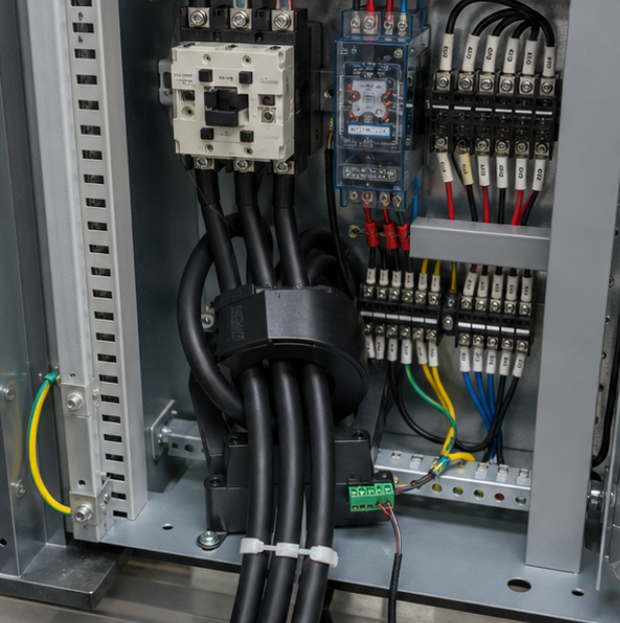
Typical Leakage Current Monitoring Positions
EV charger AC input side for residual current monitoring.
DC output side for DC leakage current detection.
Charging cable or connector side for safety protection.
Ground fault monitoring circuit inside charging piles.
Power conversion module protection circuit.
Insulation monitoring and safety shutdown system.
Charging station control cabinet safety monitoring unit.
2. Confirm Leakage Current Type, Detection Range And Response Time
The first parameter to confirm is the type of leakage current that must be detected. EV charger systems may involve AC residual current, DC residual current, pulsating DC current, or mixed leakage current. The selected leakage current sensor should match the leakage current type required by the charger design and safety protection strategy.
Detection range and threshold are critical. A leakage current sensor is different from a high-current load sensor. It usually needs to detect small abnormal currents accurately and quickly. Buyers should provide the leakage current detection threshold, alarm point, trip point, rated detection range, and required tolerance if available.
Response time is important for safety monitoring. If the leakage current rises quickly, the charger protection system should detect the abnormal condition and react in time. The required response speed depends on the safety standard, protection logic, charger topology, and controller processing time. Buyers should confirm whether the sensor signal is used for alarm, shutdown, relay control, or fault recording.
Stability and anti-interference performance should also be reviewed. EV charging systems contain contactors, relays, power modules, switching power supplies, communication circuits, and high-current cables. These components may generate electrical noise. A leakage current sensor should provide stable output under real charger operating conditions and avoid false alarms caused by noise or poor wiring.
| Selection Parameter | Why It Matters | What Buyers Should Provide |
|---|---|---|
| Leakage Current Type | Different sensors detect AC, DC, pulsating DC, or mixed residual current | AC leakage / DC leakage / AC + DC leakage / pulsating DC |
| Detection Range | Determines measurable leakage current level | Example: 0-30mA, 0-100mA, 0-300mA, or project-specific range |
| Alarm / Trip Threshold | Defines protection action point | Alarm current and shutdown current requirement |
| Response Time | Important for safety shutdown and fault protection | Required response time or protection logic requirement |
| Accuracy / Tolerance | Affects leakage current judgment and false alarm risk | Tolerance or acceptable measurement deviation |
| Anti-Interference Performance | EV chargers contain strong electrical noise | Charger topology, switching environment, cable layout, and EMC requirement |

Common Selection Mistakes
Using a general current sensor instead of a dedicated leakage current sensor.
Ignoring whether AC leakage, DC leakage, or mixed leakage must be detected.
Choosing a sensor without confirming alarm and trip thresholds.
Selecting a response time that is too slow for protection logic.
Ignoring false alarm risk caused by electrical noise and poor wiring layout.
Not testing the leakage current sensor under real charger operating conditions.
3. Output Signal, Power Supply And Controller Compatibility
The leakage current sensor output must match the EV charger controller or protection circuit. Common output forms may include analog voltage output, current output, relay output, switch output, digital output, or customized signal. The supplier should understand how the charger controller reads the leakage current signal and what action the system takes when the signal exceeds the limit.
Some EV charger designs require proportional analog output for leakage current monitoring. Some designs only need a fault signal or switch output when leakage exceeds a threshold. Other systems may use digital communication or customized output. Buyers should clearly provide the controller input type and protection logic before requesting a quote.
Supply voltage must also be confirmed. Leakage current sensors may use +5V, +12V, +15V, +24V, or other supply voltages depending on the design. If the sensor power supply does not match the charger control board, additional power conversion may be needed.
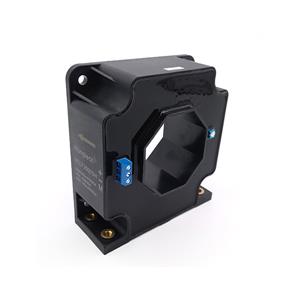
Installation position and aperture size must match the conductor layout. Some leakage current sensors need all monitored conductors to pass through the sensor aperture correctly so the residual current can be detected. If conductors are routed incorrectly, the sensor may not detect leakage accurately or may produce false readings.
| Output / Interface | Typical Use | Selection Notes |
|---|---|---|
| Analog Voltage Output | Continuous leakage current monitoring | Confirm scaling, zero point, and controller ADC range |
| Current Output | Industrial signal transmission | Useful for stronger signal stability over longer wiring distance |
| Relay / Switch Output | Fault signal or shutdown trigger | Confirm normally open, normally closed, and threshold logic |
| Digital Output | Smart charger monitoring system | Confirm protocol, data format, address, and communication speed |
| Custom Output | OEM EV charger safety monitoring | Provide controller input and protection logic before quotation |
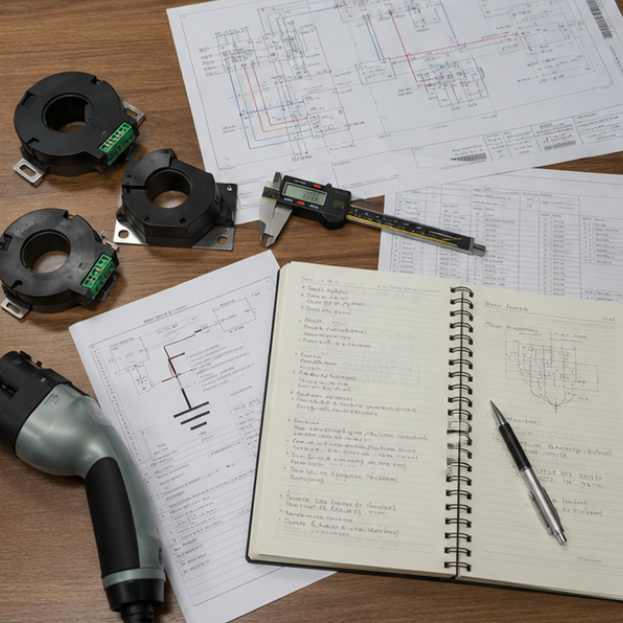
4. What Buyers Should Send Before Requesting A Leakage Current Sensor Quote
To get a fast and accurate quotation, buyers should provide complete safety monitoring requirements. A leakage current sensor quote should include charger type, leakage current type, detection range, alarm threshold, trip threshold, output signal, supply voltage, aperture size, monitored conductor layout, response time, operating temperature, safety standard, and quantity.
If the project is a replacement request, buyers should also provide the original leakage current sensor model number, datasheet, photos, wiring definition, installation dimensions, and fault logic. If the project is a new charger design, buyers should provide the charger topology, cable layout, controller input requirement, and protection strategy.
Example Quote Request:
Application: DC fast EV charger safety monitoring
Detection type: AC and DC leakage current
Detection range: 0-100mA
Trip threshold: Project-specific safety requirement
Output signal: Analog output + fault signal
Supply voltage: +12V or +24V
Installation: Charging cable passes through sensor aperture
Quantity: 30 samples first, estimated annual demand 5000 pieces

Final Selection Checklist
Confirm EV charger type: AC charger, DC charger, fast charger, or charging pile.
Confirm leakage current type: AC, DC, pulsating DC, or mixed residual current.
Confirm detection range, alarm threshold, and trip threshold.
Confirm response time and protection logic.
Match output signal with charger controller or safety monitoring circuit.
Confirm supply voltage and wiring definition.
Confirm aperture size and monitored conductor layout.
Check operating temperature, EMC environment, and false alarm risk.
Confirm safety standard, certification, sample quantity, and annual demand.
Conclusion
Selecting a leakage current sensor for EV charger safety monitoring requires careful review of leakage current type, detection range, alarm threshold, trip threshold, response time, output signal, supply voltage, aperture size, conductor layout, operating environment, safety standards, and controller compatibility.
For EV chargers, charging piles, DC fast charging stations, and power conversion equipment, the right leakage current sensor helps improve electrical safety, ground fault detection, protection response, and long-term system reliability. A complete parameter list allows suppliers to recommend the correct model faster and provide a more accurate quotation.
FAQ
1. What does a leakage current sensor do in an EV charger?
It detects abnormal leakage current, residual current, ground fault risk, or insulation problems and sends a signal to the charger controller or protection circuit for warning or shutdown.
2. Can a normal current sensor replace a leakage current sensor?
Usually no. Leakage current detection requires higher sensitivity, suitable residual current detection, stable zero point, fast response, and safety monitoring performance. A dedicated leakage current sensor is recommended.
3. What leakage current type should EV chargers detect?
It depends on the charger design and safety requirement. Some systems need AC leakage detection, some need DC leakage detection, and some need mixed AC/DC residual current detection.
4. What output signal should I choose?
The output should match the charger controller or protection circuit. Common options include analog voltage output, current output, relay output, switch output, digital output, or customized signal.
5. What information should I provide before requesting a quote?
You should provide charger type, leakage current type, detection range, alarm threshold, trip threshold, output signal, supply voltage, aperture size, conductor layout, response time, safety standard, sample quantity, and annual demand.
Request A Leakage Current Sensor Quote For EV Charger Safety Monitoring
If you need leakage current sensors for EV chargers, charging piles, DC fast chargers, safety monitoring systems, or ground fault protection circuits, send us your leakage current type, detection range, alarm threshold, output signal, supply voltage, aperture size, conductor layout, response requirement, and estimated quantity. Our team can help you match a suitable model and provide a practical quotation.
Contact Us Get Quote