Current Sensor With Custom Aperture Size For Busbar And Cable Installation
Current Sensor With Custom Aperture Size For Busbar And Cable Installation
In many power electronics projects, a standard current sensor may have the correct current range and output signal, but the aperture size may not fit the actual copper busbar or high-current cable. This is a common problem in EV chargers, battery energy storage systems, solar inverters, motor drives, UPS systems, welding machines, railway power systems, and industrial power cabinets.
A current sensor with custom aperture size can help buyers match busbar width, busbar thickness, cable diameter, installation direction, cabinet space, and mounting structure. This guide explains what buyers should confirm before requesting a custom aperture current sensor quote, and how to avoid installation mismatch during sample testing or mass production.
Quick Answer
To customize the aperture size of a current sensor, buyers should provide busbar width, busbar thickness, cable diameter, insulation layer thickness, conductor shape, installation direction, available cabinet space, mounting hole position, current range, peak current, output signal, supply voltage, isolation voltage, and quantity requirement. For busbar installation, rectangular aperture or larger window structure may be required. For cable installation, round aperture, split core structure, or flexible installation may be more suitable.
1. Why Aperture Size Matters In Current Sensor Selection
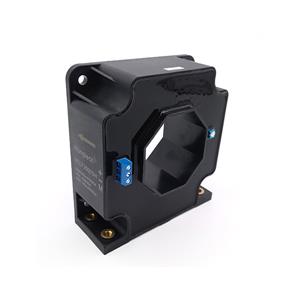
A current sensor measures current by allowing the conductor to pass through the sensor aperture or measurement window. If the aperture size is too small, the copper busbar or cable cannot pass through the sensor. If the aperture is too large, the sensor may still be installed, but the conductor position may affect measurement stability, installation consistency, and mechanical reliability.
In high-current power electronics equipment, conductors are often not standard round wires. They may be flat copper busbars, laminated busbars, insulated cables, parallel cables, or special-shaped conductors. Each structure requires a different aperture design. A sensor designed for a round cable may not fit a wide copper busbar. A sensor designed for a busbar may not be convenient for retrofit cable installation.
Custom aperture size is especially useful when the cabinet structure is already fixed. In OEM projects, the sensor must fit the designed busbar layout and mounting space. In replacement projects, the new sensor should match the existing cabinet without changing copper bars, cables, or mounting holes. If aperture size is ignored, even a technically correct sensor may fail during installation.
Before requesting a quote, buyers should not only ask for a “500A current sensor” or “Hall effect current sensor.” They should provide conductor dimensions, aperture requirement, current direction, installation photo, and cabinet drawing. This helps the supplier judge whether a standard model, custom aperture model, or split core model is more suitable.
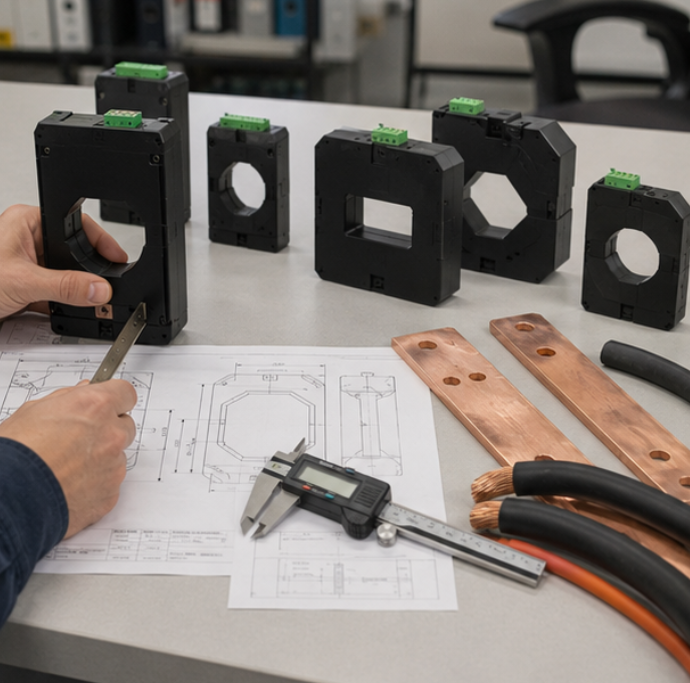
Common Aperture Fit Problems
The sensor aperture is too small for the copper busbar.
The cable insulation layer is thicker than expected.
The conductor passes through the sensor but cannot stay centered.
The sensor body is too large for the cabinet space.
The terminal direction conflicts with nearby wiring or components.
The mounting holes do not match the cabinet or busbar support structure.
The sensor cannot be installed without disconnecting existing cables.
2. Custom Aperture For Copper Busbar Installation
Copper busbars are widely used in EV chargers, BESS cabinets, inverters, UPS systems, DC power supplies, and high-current industrial cabinets. They may be flat, thick, laminated, insulated, or bent according to cabinet design. When selecting a current sensor for busbar installation, buyers should provide the busbar width, thickness, insulation layer, installation direction, and whether the busbar can be removed during installation.
For flat copper busbars, a rectangular aperture or wide window structure is often more practical than a round aperture. The sensor should allow enough clearance for the busbar and insulation while keeping the conductor position stable. If the busbar is too close to the edge of the aperture, measurement error or assembly difficulty may increase.
Buyers should also check current direction. Many current sensors have an arrow or direction mark. If the busbar passes through the sensor in the wrong direction, the output polarity may be reversed. This is especially important for bidirectional DC measurement, BMS current calculation, PCS control, EV charging current feedback, and protection systems.
Mounting method should be confirmed together with aperture size. Some sensors are fixed to the cabinet panel. Some are mounted directly near the busbar. Some need screws, brackets, or insulation support. If the sensor is close to high-voltage busbars, isolation distance, creepage, clearance, and wiring route should be reviewed carefully.
| Busbar Information | Why It Matters | Example To Provide |
|---|---|---|
| Busbar Width | Determines aperture width or window size | 30mm, 40mm, 50mm, 60mm, or custom width |
| Busbar Thickness | Determines aperture height and clearance | 5mm, 6mm, 8mm, 10mm, or custom thickness |
| Insulation Layer | May increase final conductor size | Bare copper, heat-shrink insulation, epoxy coated busbar |
| Conductor Position | Affects measurement consistency and installation reliability | Centered / offset / vertical / horizontal pass-through |
| Available Space | Determines sensor body size and terminal direction | Height, width, depth, nearby components, wiring route |
| Mounting Method | Helps match screw holes, bracket, or panel structure | Panel mount, base mount, busbar mount, custom bracket |
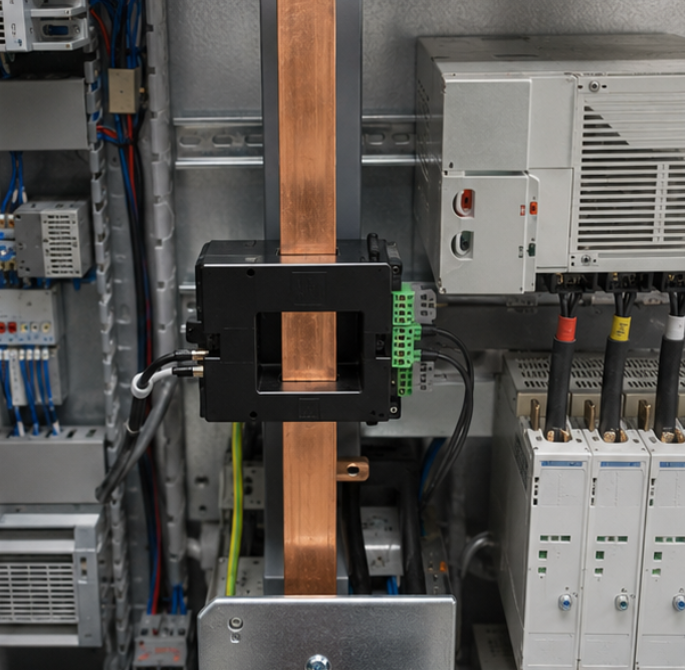
Busbar Installation Mistakes To Avoid
Providing only rated current without busbar dimensions.
Forgetting insulation layer thickness around the busbar.
Choosing a round aperture for a wide flat busbar.
Ignoring sensor body size and nearby cabinet components.
Installing the busbar too close to the sensor aperture edge.
Ignoring output polarity and current direction mark.
3. Custom Aperture For Cable Installation
Cable installation is common in retrofit projects, charging cabinets, welding machines, motor drives, UPS systems, and industrial control cabinets. Unlike copper busbars, cables are flexible and may have thick insulation, bending radius limitations, and routing constraints. The sensor aperture should fit the complete cable outside diameter, not only the conductor size.
For single-cable measurement, a round aperture is usually suitable. For multiple parallel cables, the sensor may need a larger aperture or a special window structure. If the project requires leakage or residual current detection, all monitored conductors must pass through the sensor correctly according to the sensing principle. For load current measurement, the supplier should confirm whether the sensor measures one conductor, one busbar, or multiple parallel conductors.
Split core current sensors may be considered when existing cables cannot be disconnected. This is useful for retrofit cabinets, field maintenance, or upgrade projects. However, split core design may have different accuracy, magnetic closure, and installation considerations compared with fixed through-hole sensors.
Cable routing and bending space should also be considered. Even if the cable can pass through the sensor aperture, the cabinet may not have enough space for bending and fixing. Buyers should provide cabinet photos, cable route, cable diameter, and installation direction before requesting a custom aperture quote.
| Cable Information | Why It Matters | Example To Provide |
|---|---|---|
| Cable Outer Diameter | Determines minimum aperture diameter | 20mm, 35mm, 50mm, or measured outside diameter |
| Number Of Cables | Affects aperture size and measurement method | Single cable, two parallel cables, three-phase cables, DC positive cable |
| Cable Can Be Disconnected | Determines fixed aperture or split core structure | Yes / No / retrofit installation required |
| Cable Bending Space | Ensures installation without cable stress | Cabinet depth, cable route, bending radius limit |
| Installation Direction | Affects terminal direction and wiring route | Vertical cable, horizontal cable, top entry, bottom entry |
| Application Type | Determines load current or leakage current sensing requirement | EV charger, welding machine, inverter, battery cabinet, retrofit cabinet |
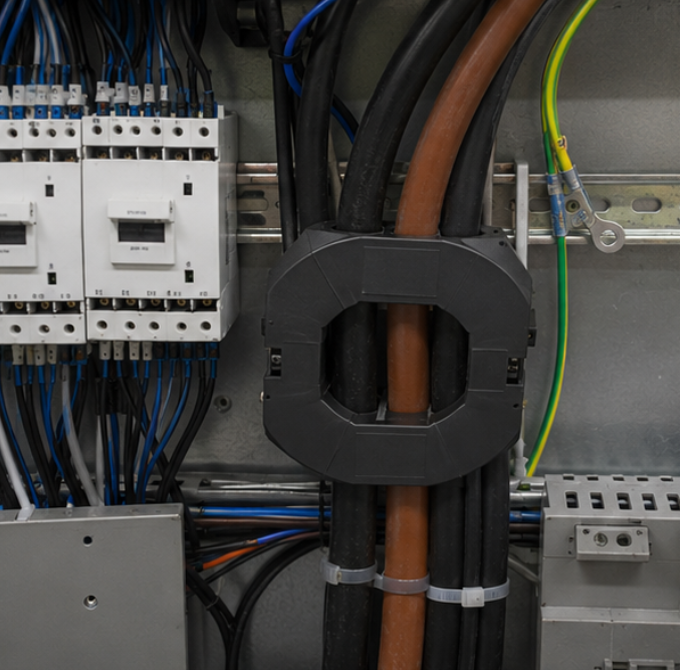
4. Electrical Parameters Still Matter After Aperture Customization
A custom aperture current sensor must still meet electrical performance requirements. Aperture size alone does not determine whether the sensor is suitable. Buyers should also confirm current range, measured current type, peak current, accuracy, response time, isolation voltage, output signal, and supply voltage.
For EV chargers and BESS applications, the sensor may need DC or bidirectional DC measurement. For motor drives and inverters, fast response and bandwidth may be more important. For welding machines, peak current and overload capability may be critical. For high-voltage systems, isolation voltage and insulation structure should be carefully reviewed.
Output signal must match the controller, ADC, PLC, BMS, PCS, or monitoring system. Common outputs include 0-5V, 0-10V, ±4V, ±5V, 4-20mA, CAN, RS485, or customized output. A custom aperture does not solve signal mismatch, so output and power supply must be confirmed before sample production.
Before requesting a quote, buyers should prepare a complete parameter list. This helps the supplier judge whether the project can use an existing model with suitable aperture, a modified standard model, or a fully customized current sensor.
Example Custom Aperture Quote Request:
Application: Battery energy storage cabinet
Measured current: Bidirectional DC current
Current range: 500A rated, 800A peak
Conductor: Copper busbar 40 × 6 mm with insulation
Aperture requirement: Rectangular window suitable for busbar installation
Output signal: 0-5V
Supply voltage: +15V
Isolation requirement: 4kV or higher
Quantity: 20 samples first, estimated annual demand 3000 pieces
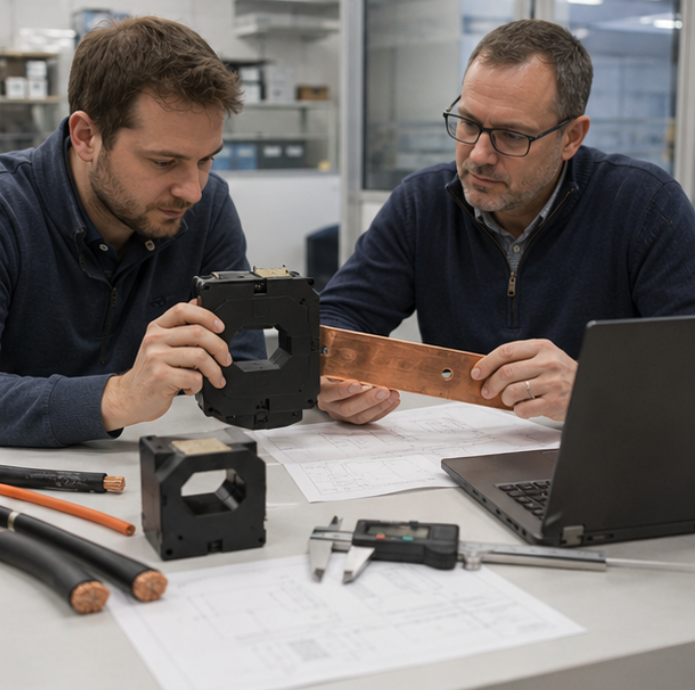
Final Custom Aperture Checklist
Confirm application: EV charger, BESS, inverter, motor drive, UPS, welding machine, or power cabinet.
Confirm conductor type: flat busbar, laminated busbar, insulated cable, parallel cable, or special conductor.
Provide busbar width, thickness, insulation layer, or cable outer diameter.
Confirm whether the conductor can be disconnected during installation.
Confirm aperture shape: round, rectangular, split core, or custom window.
Confirm available cabinet space, mounting holes, and wiring direction.
Confirm current range, peak current, output signal, and supply voltage.
Confirm isolation voltage, working voltage, and safety requirements.
Provide photos, drawings, sample quantity, annual demand, and delivery schedule.
Conclusion
A current sensor with custom aperture size is often needed when standard models cannot fit the actual copper busbar, cable diameter, cabinet layout, or mounting structure. For busbar installation, buyers should provide busbar width, thickness, insulation layer, conductor position, and mounting method. For cable installation, buyers should provide cable outer diameter, number of cables, cable routing, bending space, and whether the cable can be disconnected.
For EV chargers, BESS, solar inverters, motor drives, UPS systems, welding machines, railway power systems, and industrial power cabinets, aperture customization should be matched with electrical parameters such as current range, peak current, output signal, supply voltage, accuracy, response time, and isolation voltage. A complete parameter list helps suppliers recommend a practical and reliable custom current sensor solution.
FAQ
1. What is custom aperture size in a current sensor?
Custom aperture size means the sensor window or hole is designed to fit a specific busbar, cable, or conductor structure. It helps the sensor match the real installation layout of power electronics equipment.
2. What information is needed for a busbar current sensor quote?
Buyers should provide busbar width, thickness, insulation layer, current range, output signal, supply voltage, isolation requirement, mounting method, installation space, sample quantity, and annual demand.
3. What information is needed for a cable current sensor quote?
Buyers should provide cable outer diameter, number of cables, whether the cable can be disconnected, current range, output signal, supply voltage, installation direction, and available cabinet space.
4. Should I choose round aperture or rectangular aperture?
Round aperture is usually suitable for cables. Rectangular aperture or custom window structure is often better for flat copper busbars. The final choice depends on the conductor shape and installation space.
5. Can aperture size be customized without changing output signal?
Yes, in many cases the aperture structure can be customized while keeping the required output signal, supply voltage, current range, and isolation requirement. Buyers should confirm all parameters before sample production.
Request A Custom Aperture Current Sensor Quote
If you need current sensors with custom aperture size for copper busbar or cable installation, send us your busbar width, busbar thickness, cable diameter, current range, peak current, output signal, isolation requirement, installation drawing, and estimated quantity. Our team can help you match a suitable custom current sensor solution for EV chargers, BESS, inverters, motor drives, UPS systems, and industrial power cabinets.
Contact Us Get Quote