How To Select A Voltage Sensor For High Voltage DC Bus Monitoring
How To Select A Voltage Sensor For High Voltage DC Bus Monitoring
High voltage DC bus monitoring is essential in power conversion equipment such as solar inverters, EV chargers, energy storage converters, UPS systems, railway power systems, motor drives, and industrial power supplies. A properly selected voltage sensor helps monitor DC bus voltage, detect overvoltage or undervoltage conditions, protect power semiconductors, and support stable control of the entire power electronics system.
This guide explains how to select a voltage sensor for high voltage DC bus monitoring, what parameters matter most, and how engineers and buyers should compare voltage sensor models for safe, accurate, and reliable DC bus measurement.
Quick Answer
To select a voltage sensor for high voltage DC bus monitoring, first confirm the DC bus rated voltage, maximum voltage, transient voltage, isolation requirement, accuracy, response time, output signal, power supply, operating temperature, and installation method. For solar inverters, EV chargers, UPS systems, energy storage systems, and motor drives, the voltage sensor should provide reliable galvanic isolation, stable DC measurement, low temperature drift, good anti-interference performance, and compatibility with the controller, PLC, ADC, or monitoring system.
1. Understand The Role Of Voltage Sensors In DC Bus Monitoring
The DC bus is the central energy link in many power conversion systems. It connects rectifiers, batteries, DC sources, DC-link capacitors, inverter bridges, power modules, and control circuits. If the DC bus voltage becomes unstable, too high, or too low, the system may experience control errors, power module stress, protection shutdown, or equipment damage.
A voltage sensor monitors the DC bus and sends a safe low-voltage signal to the control system. This signal may be used for voltage feedback, overvoltage protection, undervoltage protection, DC-link capacitor monitoring, power conversion control, fault diagnosis, and system status reporting. In high voltage systems, the sensor must measure accurately while safely isolating the high-voltage bus from the low-voltage controller.
High voltage DC bus monitoring is common in solar inverters, EV charging modules, energy storage converters, UPS systems, traction systems, industrial inverters, and motor drives. Each application has different voltage levels, response requirements, and safety margins. For example, an EV charger may require fast and stable DC bus feedback during power conversion, while an energy storage system may focus more on long-term DC voltage monitoring and safety protection.
Before selecting a voltage sensor, engineers should define the measurement point, voltage range, signal purpose, isolation requirement, output interface, and real operating environment. Selecting only by rated voltage is not enough because DC bus systems may experience transient voltage, switching noise, regeneration voltage, and high-frequency interference.
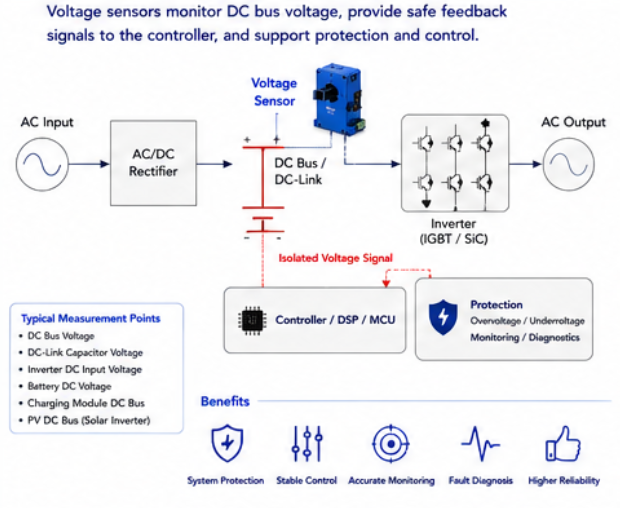
Key Questions Before Selection
What is the rated DC bus voltage?
What is the maximum DC bus voltage under abnormal or transient conditions?
Is the sensor signal used for monitoring, control feedback, protection, or diagnostics?
What isolation voltage and working voltage are required?
What accuracy and temperature drift level does the system need?
What output signal does the controller, PLC, ADC, or monitoring platform accept?
Will the sensor operate near switching devices, IGBT modules, SiC MOSFETs, or high EMI sources?
2. Check The Core Parameters For High Voltage DC Bus Voltage Sensors
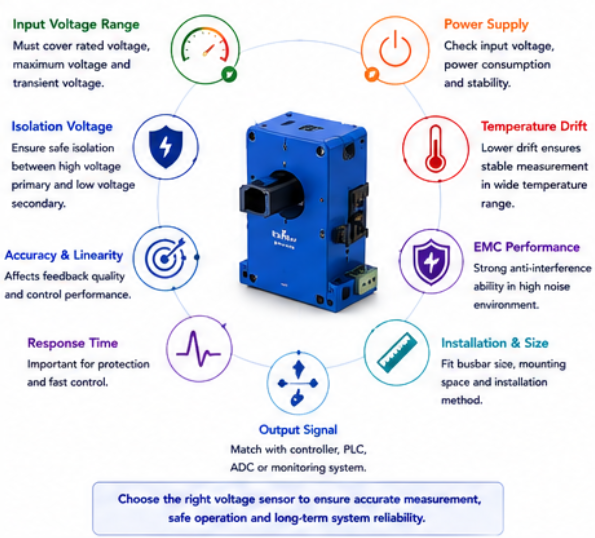
The first parameter to check is input voltage range. The sensor must cover the normal DC bus voltage and also provide enough margin for voltage fluctuation, transient overvoltage, regeneration voltage, and fault conditions. If the voltage range is too low, the sensor may be damaged or provide distorted output. If the range is too high, the system may lose measurement resolution during normal operation.
Isolation performance is one of the most important requirements in high voltage DC bus monitoring. The voltage sensor should safely separate the primary high-voltage side from the secondary low-voltage signal side. Buyers should check isolation voltage, working voltage, dielectric strength, creepage distance, clearance distance, and insulation structure. A sensor with weak isolation may create safety risks and may not support final equipment certification.
Accuracy and linearity affect the quality of DC bus feedback. For basic monitoring, standard accuracy may be acceptable. For inverter control, EV charging modules, battery energy storage systems, and high-performance power supplies, better accuracy and lower drift may be required. Temperature drift is especially important because power electronics cabinets can become hot during long-term operation.
Response time should match the system function. If the voltage sensor is used only for slow status monitoring, moderate response may be enough. If the signal is used for overvoltage protection, converter control, DC-link protection, or fault shutdown, faster response is important. The selected sensor must provide timely feedback without excessive signal noise.
Output signal compatibility should be confirmed before ordering. Common outputs may include analog voltage output, analog current output, or customized signal output. The output must match the controller input range, sampling method, and grounding design. A correct output signal reduces integration risk and avoids extra signal conditioning circuits.
| Selection Parameter | Why It Matters In DC Bus Monitoring | Recommended Checkpoint |
|---|---|---|
| Input Voltage Range | Determines whether the sensor can measure normal and abnormal DC bus voltage | Check rated voltage, maximum voltage, and transient voltage margin |
| Isolation Voltage | Protects low-voltage control circuits from high-voltage DC bus circuits | Confirm isolation voltage, working voltage, creepage, and clearance |
| Accuracy | Affects voltage feedback, control quality, and protection decisions | Match accuracy level with monitoring or control requirement |
| Linearity | Ensures output signal remains proportional across the voltage range | Review linearity data across low, normal, and high voltage points |
| Temperature Drift | High temperature can change sensor output and long-term stability | Choose low-drift sensors for high-power cabinets and outdoor systems |
| Response Time | Important for overvoltage protection and converter control | Use faster response for protection and dynamic power conversion |
| Output Signal | Determines compatibility with controller, PLC, ADC, or monitoring system | Confirm voltage output, current output, or custom signal requirement |
| EMC Performance | DC bus circuits often operate near switching power devices | Review shielding, grounding, filtering, and anti-interference performance |
Why Galvanic Isolation Is Critical
High voltage DC bus systems can carry dangerous voltage and stored energy. Galvanic isolation separates the high-voltage measurement circuit from the low-voltage control system. This protects controllers, ADCs, communication modules, PLCs, and operators. It also helps reduce ground loop problems and improves signal reliability in complex power conversion equipment.
3. Match The Voltage Sensor With Different DC Bus Applications
Different power electronics systems require different DC bus voltage sensing strategies. In solar inverters, the voltage sensor may monitor PV-side DC bus voltage, DC-link voltage, and inverter-side feedback. The sensor should provide stable DC measurement, good temperature performance, and reliable insulation for long-term operation.
In EV chargers, high voltage DC bus monitoring supports charging module control, power conversion safety, overvoltage detection, and fault protection. Because charging modules may operate at high power density, the sensor should provide fast response, strong isolation, compact installation, and good anti-interference performance.
In battery energy storage systems and PCS converters, voltage sensors help monitor the DC bus between battery packs and power conversion stages. The sensor should match the battery system voltage, insulation requirement, output interface, and operating temperature. Long-term stability is important because energy storage systems may operate continuously with frequent charge and discharge cycles.
In motor drives and industrial inverters, DC bus voltage sensors help monitor rectifier output, DC-link capacitor voltage, braking conditions, and inverter protection status. During regeneration or braking, the DC bus voltage may rise quickly, so the sensor range and response time should be selected with enough safety margin.
When requesting a voltage sensor quote, buyers should provide the application, rated DC bus voltage, maximum voltage, transient voltage, isolation requirement, output signal, accuracy target, response requirement, power supply, mounting method, and operating environment. This information helps suppliers recommend a model that fits both electrical performance and final equipment integration.
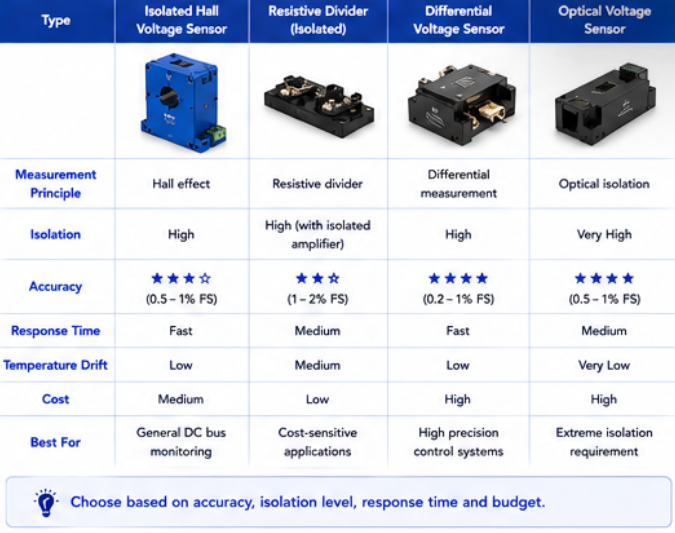
Typical Application Matching Reference
| Application | DC Bus Monitoring Purpose | Voltage Sensor Selection Direction |
|---|---|---|
| Solar Inverter | DC-link voltage monitoring, inverter control, overvoltage protection | Isolated DC voltage sensor with low drift and long-term stability |
| EV Charging Module | High voltage DC bus feedback, power conversion safety, fault protection | Fast-response voltage sensor with strong isolation and EMC performance |
| Energy Storage PCS | Battery-side DC bus monitoring and bidirectional converter protection | High-isolation DC voltage sensor with stable output signal |
| UPS System | DC bus status monitoring and inverter protection | Reliable isolated voltage sensor with good temperature performance |
| Motor Drive / VFD | DC-link voltage feedback, braking voltage monitoring, protection | Sensor range should cover regeneration and transient voltage conditions |
| Railway Power System | Traction DC bus voltage monitoring and safety diagnostics | High-reliability voltage sensor with strong insulation and anti-interference design |
Common Selection Mistakes To Avoid
Choosing the voltage sensor only by rated DC bus voltage and ignoring transient voltage.
Using insufficient isolation in high voltage DC systems.
Confusing test isolation voltage with continuous working voltage.
Selecting an output signal that does not match the controller or ADC input.
Ignoring temperature drift in high-power cabinets and outdoor inverter systems.
Using a slow-response sensor for fast overvoltage protection.
Not checking EMC performance near IGBT modules, SiC MOSFETs, or switching power circuits.
Conclusion
Selecting a voltage sensor for high voltage DC bus monitoring requires more than checking voltage range. Engineers should review rated voltage, maximum voltage, transient margin, isolation voltage, working voltage, accuracy, linearity, temperature drift, response time, output signal, EMC performance, and installation environment.
For solar inverters, EV chargers, energy storage converters, UPS systems, motor drives, railway power systems, and industrial power supplies, a properly selected voltage sensor helps improve DC bus safety, power conversion control, fault protection, and long-term equipment reliability. The best choice is the model that matches the real voltage stress, control requirement, and final system integration.
FAQ
1. Why is a voltage sensor needed for high voltage DC bus monitoring?
A voltage sensor monitors DC bus voltage and sends a safe feedback signal to the controller. It supports voltage regulation, overvoltage protection, fault diagnosis, and safe power conversion operation.
2. What voltage range should I choose?
The sensor range should cover the normal DC bus voltage, maximum operating voltage, transient overvoltage, and possible fault or regeneration conditions with enough safety margin.
3. Why is isolation important in DC bus voltage sensing?
Isolation separates the high-voltage DC bus from the low-voltage control circuit. It protects controllers, ADCs, PLCs, communication modules, and operators from high-voltage risks.
4. Is response time important for DC bus monitoring?
Yes. If the voltage signal is used for protection or converter control, fast response is important. For simple status monitoring, moderate response time may be acceptable.
5. What information should I provide before requesting a quote?
You should provide the application, rated DC bus voltage, maximum voltage, transient voltage, isolation requirement, output signal, accuracy target, response requirement, power supply, mounting method, and operating environment.
Contact Us For High Voltage DC Bus Voltage Sensor Selection Support
If you are selecting voltage sensors for high voltage DC bus monitoring, solar inverters, EV chargers, energy storage converters, UPS systems, motor drives, railway power systems, or industrial power supplies, send us your DC bus voltage, maximum voltage, isolation requirement, output signal, accuracy target, and application details. Our team can help you match a suitable voltage sensor solution.
Contact Us Get Quote