How Snubber Capacitors Protect IGBT Modules In High Power Circuits
How Snubber Capacitors Protect IGBT Modules In High Power Circuits
Snubber capacitors are important protection components in high power circuits using IGBT modules. They help suppress voltage spikes, reduce switching stress, absorb transient energy, limit ringing, and improve the reliability of inverter bridges, motor drives, welding machines, UPS systems, EV chargers, solar inverters, and industrial power conversion equipment.
This guide explains how snubber capacitors protect IGBT modules, what parameters matter most when selecting a snubber capacitor, and how engineers should match capacitor type, voltage rating, capacitance, ESR, ESL, ripple current, and installation layout with high power circuit requirements.
Quick Answer
Snubber capacitors protect IGBT modules by absorbing switching transients and reducing voltage overshoot caused by parasitic inductance in high power circuits. They are usually installed close to the IGBT module or across the DC bus / switching device terminals to reduce spike voltage, ringing, and electrical stress. When selecting a snubber capacitor, engineers should check voltage rating, capacitance value, pulse current capability, ESR, ESL, dv/dt performance, operating temperature, terminal structure, and mounting distance from the IGBT module.
1. Why IGBT Modules Need Snubber Capacitor Protection
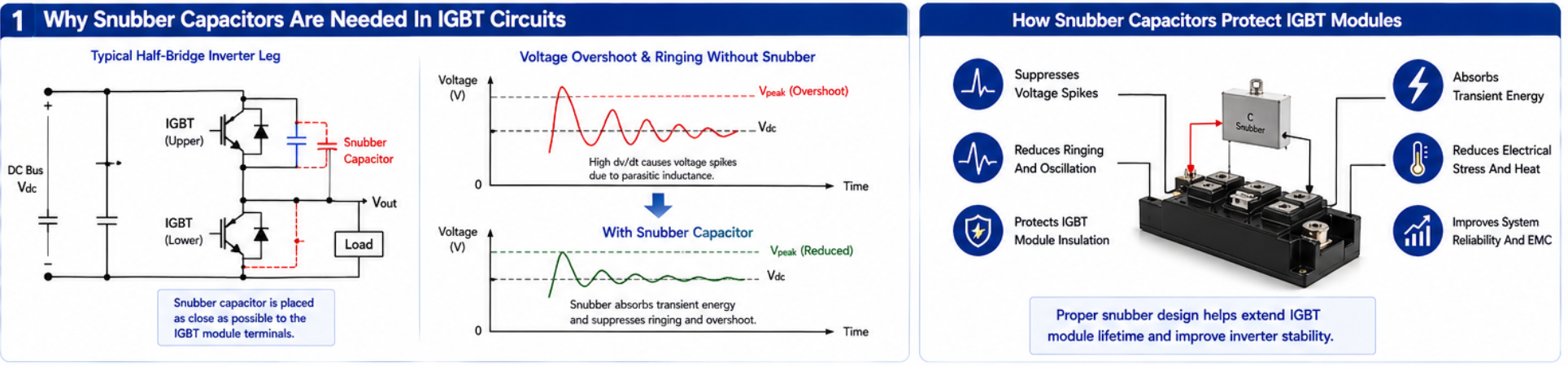
IGBT modules are widely used in high power switching circuits. During turn-on and turn-off, the current through the module changes rapidly. In real circuits, busbars, cables, module terminals, PCB traces, and internal connections all contain parasitic inductance. When current changes quickly through these inductive paths, voltage spikes can appear across the IGBT module.
These voltage spikes may exceed the safe operating margin of the IGBT module. Even if the device does not fail immediately, repeated overvoltage stress can reduce long-term reliability. It can increase junction stress, insulation stress, electromagnetic interference, and the risk of abnormal switching behavior. In severe cases, excessive voltage overshoot may damage the IGBT module, diode, gate driver, or nearby power components.
A snubber capacitor helps reduce this risk by providing a low-impedance path for high-frequency transient energy. It absorbs part of the switching spike and helps smooth the voltage across the power device. In high power inverter circuits, snubber capacitors are often used together with DC-link capacitors, laminated busbars, low-inductance layout, gate driver optimization, and proper thermal design.
For engineers and procurement teams, snubber capacitor selection should not be treated as a generic capacitor purchase. The capacitor must handle high dv/dt, pulse current, high-frequency ripple, thermal stress, and mechanical installation requirements. A wrong selection may fail to suppress transients effectively or may overheat during long-term operation.
Main Protection Functions
Suppresses voltage spikes during IGBT switching.
Reduces ringing caused by parasitic inductance and capacitance.
Absorbs high-frequency transient energy.
Reduces electrical stress on IGBT modules and freewheeling diodes.
Helps improve EMC performance in high power converters.
Supports longer reliability of power semiconductor modules.
2. Key Parameters For Selecting Snubber Capacitors
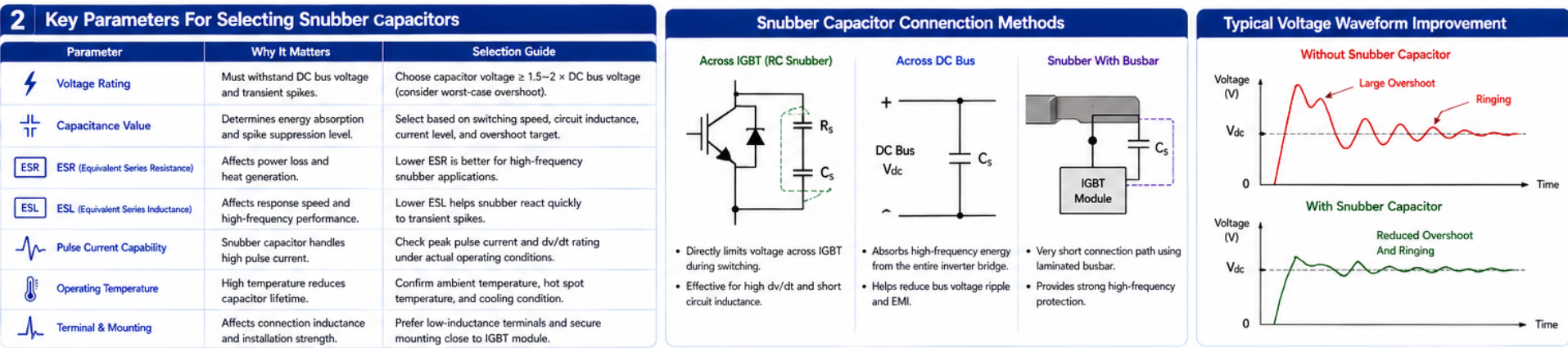
The first parameter to check is voltage rating. The snubber capacitor must withstand the DC bus voltage and switching transients with enough safety margin. In high power circuits, voltage spikes may be much higher than the nominal DC bus voltage, so engineers should evaluate the maximum expected voltage across the capacitor under real switching conditions.
Capacitance value affects how much transient energy the capacitor can absorb. A larger capacitance can provide stronger spike suppression, but it may also increase current stress, size, and cost. A smaller capacitance may be easier to install but may not reduce voltage overshoot enough. The correct value depends on switching speed, circuit inductance, current level, voltage spike target, and layout design.
ESR and ESL are especially important in snubber applications. Low ESR helps reduce heating and power loss during high-frequency operation. Low ESL helps the capacitor respond quickly to sharp voltage transients. If the capacitor has high inductance or is installed far from the IGBT module, its snubber effect may be weakened even if the capacitance value looks suitable on paper.
Pulse current and ripple current capability should also be reviewed carefully. Snubber capacitors may experience repeated pulse current during every switching cycle. If the capacitor cannot handle this stress, it may overheat, degrade, or fail early. Film capacitors are often used for snubber applications because they offer good pulse handling, low loss, self-healing behavior, and strong high-frequency performance.
Mechanical structure matters as much as electrical rating. Snubber capacitors should be installed as close as possible to the IGBT module terminals or the high-frequency switching loop. Terminal type, mounting style, busbar connection, lead length, insulation distance, and thermal environment all affect final protection performance.
| Selection Parameter | Why It Matters | Recommended Checkpoint |
|---|---|---|
| Voltage Rating | Must withstand DC bus voltage and transient spikes | Confirm maximum voltage including overshoot and safety margin |
| Capacitance Value | Affects transient energy absorption and spike suppression | Match value with switching current, layout inductance, and voltage target |
| ESR | Affects heat generation and high-frequency loss | Choose low ESR for high power switching applications |
| ESL | Determines how fast the capacitor reacts to voltage spikes | Use low ESL design and short connection path |
| Pulse Current Capability | Snubber capacitors face repeated high pulse current | Check pulse current and dv/dt ratings carefully |
| Operating Temperature | Heat reduces capacitor lifetime and reliability | Check cabinet temperature, module heat, and cooling conditions |
| Terminal Structure | Affects connection inductance and installation strength | Prefer short, wide, low-inductance connections |
| Mounting Distance | Long wiring weakens snubber performance | Install close to IGBT module terminals or switching loop |
Snubber Capacitor vs DC-Link Capacitor
A DC-link capacitor mainly stabilizes the DC bus and handles ripple current in the power conversion system. A snubber capacitor focuses more on suppressing fast switching transients and protecting power semiconductor modules from voltage overshoot. In many high power circuits, both components are needed, but they serve different functions and should not be treated as direct replacements.
3. Match Snubber Capacitors With High Power Applications
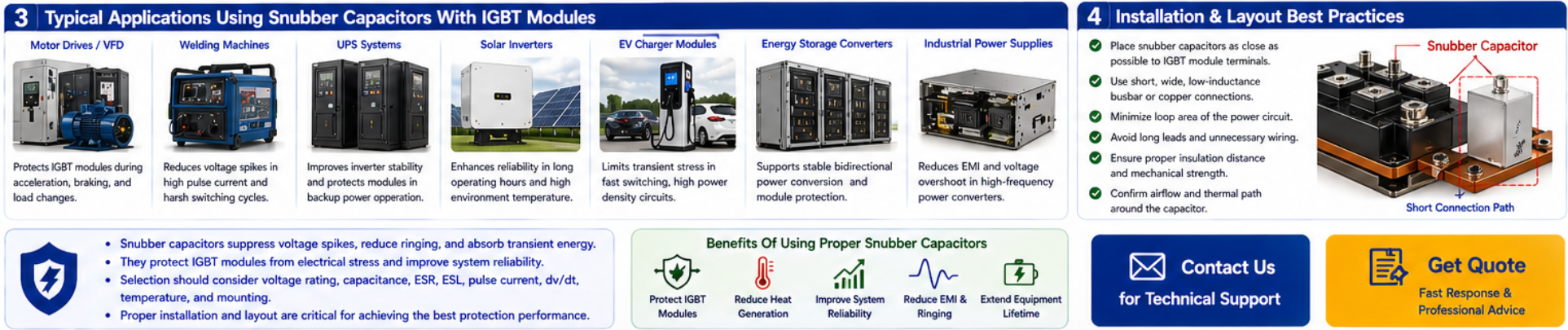
Snubber capacitors are used in many high power circuits where IGBT modules face switching stress. In motor drives and VFDs, they help protect inverter modules during rapid load changes, braking events, and motor current transitions. In welding machines, they support stable switching under high pulse current and harsh operating conditions. In UPS systems and industrial inverters, they help reduce transient stress and improve converter reliability.
In solar inverters and energy storage converters, snubber capacitors can help protect power modules from switching spikes in DC/AC or bidirectional conversion circuits. These systems often operate for long hours, so capacitor loss, temperature rise, and lifetime must be reviewed carefully. Proper snubber design can support more stable operation and reduce stress on IGBT modules or other power devices.
In EV charging modules and high-frequency power supplies, fast switching creates stronger layout sensitivity. Even a good capacitor may not work well if it is installed too far from the power module. Low-inductance busbar design, short connection distance, and proper terminal selection are critical. Engineers should consider snubber capacitors together with the full power loop layout.
For procurement teams, the best approach is to provide the supplier with the circuit application, DC bus voltage, switching frequency, IGBT module type, peak current, expected voltage overshoot, mounting structure, and temperature condition. This information helps select a snubber capacitor that fits both the electrical stress and mechanical layout.
Typical Application Matching Reference
| Application | Main Switching Stress | Snubber Capacitor Selection Focus |
|---|---|---|
| Motor Drive / VFD | Voltage spike during inverter switching and motor load changes | Low ESL, strong pulse current capability, close module mounting |
| Welding Machine | High pulse current and harsh switching condition | High pulse tolerance, robust insulation, thermal stability |
| UPS System | Inverter bridge transient stress and DC bus fluctuation | Reliable film capacitor with stable long-term performance |
| Solar Inverter | High-frequency switching and long operating hours | Low loss, long lifetime, temperature-resistant design |
| EV Charger Module | Fast switching, compact layout, high power density | Low-inductance terminal, compact size, high dv/dt capability |
| Energy Storage Converter | Bidirectional switching and high power cycling | Reliable pulse performance and stable thermal behavior |
Common Selection Mistakes To Avoid
Choosing only by capacitance value and ignoring pulse current capability.
Selecting insufficient voltage rating without considering switching overshoot.
Ignoring ESR and ESL in high-frequency transient suppression.
Installing the capacitor too far from the IGBT module.
Using long wires instead of short, low-inductance connections.
Not checking operating temperature and expected lifetime.
Assuming a DC-link capacitor can fully replace a dedicated snubber capacitor.
Conclusion
Snubber capacitors protect IGBT modules by reducing voltage overshoot, absorbing transient energy, suppressing ringing, and lowering switching stress in high power circuits. They are especially important in motor drives, welding machines, UPS systems, solar inverters, EV charging modules, energy storage converters, and industrial power conversion equipment.
A proper snubber capacitor selection should consider voltage rating, capacitance, pulse current, dv/dt capability, ESR, ESL, temperature, lifetime, terminal structure, and mounting distance. The best result comes from matching the capacitor with the IGBT module, switching frequency, busbar layout, and actual operating environment. Correct selection helps improve system reliability, protect power semiconductors, and reduce failure risk in demanding high power circuits.
FAQ
1. What does a snubber capacitor do in an IGBT circuit?
A snubber capacitor helps absorb switching transients, reduce voltage overshoot, suppress ringing, and protect the IGBT module from excessive electrical stress.
2. Where should a snubber capacitor be installed?
It should be installed as close as possible to the IGBT module terminals or the high-frequency switching loop. Short, low-inductance connections improve snubber performance.
3. Is a snubber capacitor the same as a DC-link capacitor?
No. A DC-link capacitor mainly stabilizes the DC bus and handles ripple current. A snubber capacitor mainly suppresses fast switching spikes and protects power semiconductor modules.
4. Why are ESR and ESL important?
Low ESR reduces heating and loss, while low ESL allows the capacitor to respond more effectively to high-frequency voltage spikes. Both are important for snubber performance.
5. What information should I provide before requesting a quote?
You should provide the application, DC bus voltage, IGBT module type, switching frequency, peak current, expected voltage spike, capacitance requirement, mounting space, terminal type, and operating temperature.
Contact Us For Snubber Capacitor Selection Support
If you are selecting snubber capacitors for IGBT modules, motor drives, welding machines, UPS systems, solar inverters, EV chargers, or energy storage converters, send us your DC bus voltage, IGBT module type, switching frequency, peak current, mounting space, and operating temperature. Our team can help you match a suitable capacitor solution.
Contact Us Get Quote