How To Choose Between Hall Effect Current Sensor And Shunt Resistor
How To Choose Between Hall Effect Current Sensor And Shunt Resistor
Hall effect current sensors and shunt resistors are both widely used for current measurement in power electronics. They can be found in motor drives, EV chargers, solar inverters, battery energy storage systems, UPS systems, welding machines, industrial power supplies, and control cabinets. However, they are not suitable for the same design priorities.
This guide explains the key differences between Hall effect current sensors and shunt resistors, including isolation, accuracy, power loss, heat, response time, cost, installation, safety, and application matching. It helps engineers and buyers choose the right current measurement solution for industrial and high-power systems.
Quick Answer
Choose a Hall effect current sensor when the application requires galvanic isolation, non-contact measurement, AC/DC current detection, high current measurement, safer installation, or lower power loss. Choose a shunt resistor when the application requires low cost, compact structure, simple DC current measurement, and high accuracy at lower current levels. For high-voltage, high-current, bidirectional, or safety-sensitive power electronics systems, Hall effect current sensors are usually preferred. For cost-sensitive low-voltage circuits, shunt resistors may be a practical choice.
1. Understand The Basic Difference
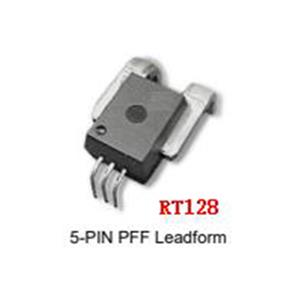
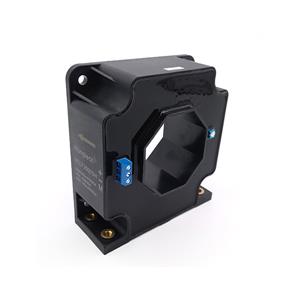
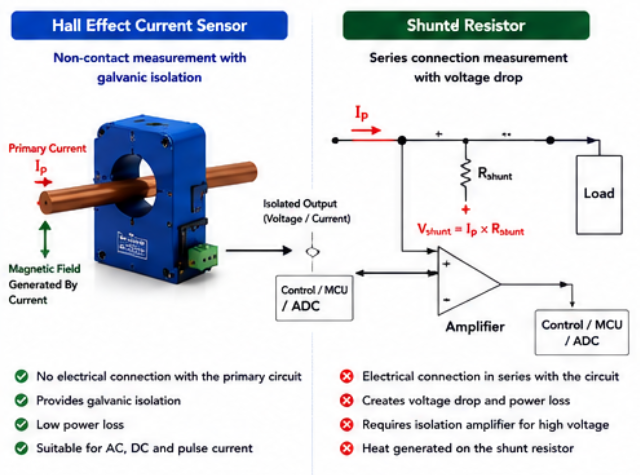
A Hall effect current sensor measures current by detecting the magnetic field generated around a conductor. The conductor usually passes through the sensor aperture or near the magnetic core. Because the sensor can measure current without direct electrical contact with the primary circuit, it can provide galvanic isolation between the high-current side and the low-voltage signal side.
A shunt resistor measures current by creating a small voltage drop across a precision resistor placed in series with the circuit. The current is calculated from the voltage drop. This method is simple, low cost, and accurate when properly designed. However, the shunt is part of the current path, so it creates power loss, heat, and usually requires additional isolation if used in high-voltage systems.
The key difference is isolation and power loss. Hall effect current sensors can measure current with electrical isolation and very low insertion loss. Shunt resistors are simple and cost-effective, but they consume power and generate heat because current flows directly through the resistor. In high-current systems, this heat can become a serious design issue.
Before choosing between them, engineers should define the system voltage, current range, measurement accuracy, isolation requirement, power loss limit, thermal design, response time, output signal, available space, and final equipment safety requirements. The best solution depends on the application, not only the component price.
Key Questions Before Choosing
Is galvanic isolation required between the power circuit and the control circuit?
What is the current range: low current, medium current, or high current?
Is the measured current AC, DC, pulse, or bidirectional?
How much power loss and heat can the system tolerate?
Is the signal used for monitoring, protection, billing, or control feedback?
What accuracy, response time, and bandwidth are required?
What output signal does the controller, ADC, PLC, or BMS require?
2. Compare Hall Effect Current Sensors And Shunt Resistors
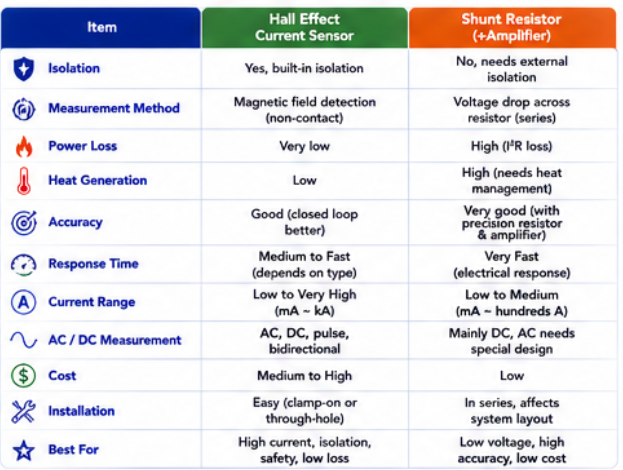
Hall effect current sensors are often selected for high-current and high-voltage systems because they provide isolation and do not require the measured current to pass through a sensing resistor. This helps reduce power loss and simplifies safety design. They are widely used in EV chargers, battery energy storage systems, solar inverters, motor drives, UPS systems, and welding machines.
Shunt resistors are often selected for low-voltage or cost-sensitive current measurement because they are simple, compact, and can provide good accuracy when temperature rise is controlled. They are commonly used in battery management circuits, low-voltage DC systems, power supplies, and electronic control boards. However, for high-current applications, the voltage drop and heat generated by the shunt must be carefully managed.
Accuracy comparison depends on the full system design. A good shunt resistor with a precision amplifier can provide excellent accuracy, especially at lower current levels. A Hall effect sensor may have offset drift, temperature drift, and magnetic interference considerations. However, in high-current isolated systems, Hall effect sensors can provide a more practical balance of safety, installation, and thermal performance.
Response time and bandwidth also need to be matched to the application. Shunt resistors can provide very fast electrical response when paired with a suitable amplifier. Hall effect sensors vary by technology; closed loop Hall current sensors usually provide faster response and better accuracy than many open loop Hall sensors. For dynamic motor control or inverter protection, response time should be reviewed carefully.
Thermal design is one of the biggest differences. A shunt resistor converts part of the measured current into heat. In high-current circuits, this heat can affect efficiency, nearby components, and measurement stability. Hall effect sensors usually have much lower insertion loss because they do not rely on a series voltage drop in the main current path.
| Comparison Item | Hall Effect Current Sensor | Shunt Resistor | Selection Advice |
|---|---|---|---|
| Isolation | Provides galvanic isolation | Usually requires extra isolation circuit | Choose Hall sensor for high-voltage and safety-sensitive systems |
| Power Loss | Very low insertion loss | Creates voltage drop and heat | Choose Hall sensor for high-current systems |
| Cost | Usually higher component cost | Usually lower component cost | Choose shunt for cost-sensitive low-voltage systems |
| Accuracy | Good, especially closed loop types | Can be very accurate with proper amplifier and thermal design | Compare complete measurement circuit, not only the component |
| Temperature Drift | Affected by Hall element, core, and electronics | Affected by resistor TCR and self-heating | Check drift data under real current and temperature |
| Response Time | Depends on open loop or closed loop design | Can be very fast with proper amplifier | Choose based on control and protection speed requirements |
| Installation | Conductor passes through sensor aperture or split core | Installed in series with the current path | Hall sensor is often easier for retrofit and high-current wiring |
| Best Fit | High-current, high-voltage, isolated AC/DC measurement | Low-voltage, compact, cost-sensitive DC measurement | Match the method with safety, current level, and cost target |
When Hall Effect Current Sensors Are Better
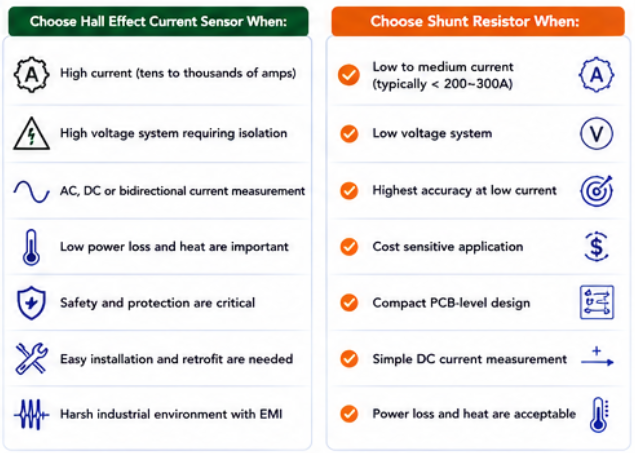
Hall effect current sensors are usually better when the system needs isolation, high current measurement, AC/DC current detection, bidirectional current measurement, lower power loss, safer signal output, or easier installation around a conductor. They are especially suitable for EV chargers, battery energy storage systems, solar inverters, motor drives, UPS systems, railway power systems, and welding equipment.
When Shunt Resistors Are Better
Shunt resistors are usually better when the system is low-voltage, cost-sensitive, compact, and mainly requires DC current measurement. They can be a good choice for PCB-level current measurement, low-current battery circuits, power supplies, and control electronics where heat, voltage drop, and isolation are manageable.
3. Match The Current Measurement Method With Real Applications
In motor drives and servo systems, Hall effect current sensors are widely used because they provide isolation and can measure high current without large insertion loss. Closed loop Hall sensors are often preferred when current feedback directly affects torque control, speed control, and protection response. Shunt resistors may be used in lower-power designs or inside control electronics where isolation and heat are easier to manage.
In EV charging stations and battery energy storage systems, isolation and bidirectional current measurement are often important. Hall effect current sensors are commonly selected for battery current, DC bus current, and charging current measurement. Shunt resistors may still be used in some BMS or low-voltage monitoring circuits, but high-current battery paths usually require careful thermal and safety design if shunts are used.
In solar inverters and UPS systems, Hall effect current sensors can support isolated AC/DC current monitoring and inverter feedback. Since these systems may operate continuously for long hours, low power loss and thermal stability are important. A shunt resistor may be suitable for specific low-current DC sensing points, but not always ideal for high-current power paths.
In welding machines, the current may be very high and pulse-like. Hall effect current sensors are often more practical because they avoid large shunt heating and provide isolation from the high-current welding output. For precision pulse current measurement, response time, peak current capability, and anti-interference performance must be checked carefully.
When requesting a quote, buyers should provide the application, current type, rated current, peak current, voltage level, isolation requirement, output signal, accuracy target, response requirement, available installation space, and whether the measurement is for monitoring, feedback control, protection, or energy calculation.
Application Matching Reference
| Application | Main Requirement | Recommended Direction |
|---|---|---|
| Motor Drive / Servo Drive | Fast feedback, isolation, dynamic current control | Closed loop Hall effect current sensor for precision control |
| EV Charging Station | High current, high voltage, safety, DC current measurement | Isolated Hall effect current sensor for charging current monitoring |
| Battery Energy Storage System | Bidirectional battery current and low drift | Bidirectional Hall effect or closed loop current sensor |
| Solar Inverter | AC/DC current feedback and long-term operation | Hall effect sensor for isolated inverter current measurement |
| Low-Voltage Control Board | Compact design and low cost | Shunt resistor with amplifier if heat and isolation are manageable |
| Welding Machine | High pulse current, isolation, low power loss | Hall effect current sensor with strong overload capability |
Common Selection Mistakes To Avoid
Choosing a shunt resistor for high current without calculating power loss and heat.
Ignoring galvanic isolation in high-voltage power electronics systems.
Comparing only component price and ignoring amplifier, isolation, thermal, and PCB cost.
Using an open loop Hall sensor where high precision closed loop feedback is required.
Ignoring offset drift and temperature drift in DC measurement applications.
Choosing a Hall sensor without checking aperture size and conductor fit.
Using a shunt resistor in applications where voltage drop affects system efficiency.
Conclusion
Hall effect current sensors and shunt resistors are both useful current measurement solutions, but they serve different design needs. Hall effect sensors are better for isolated, high-current, AC/DC, bidirectional, and safety-sensitive applications. Shunt resistors are better for compact, low-cost, low-voltage, and simple DC current measurement when power loss and heat are acceptable.
For EV chargers, BESS, solar inverters, motor drives, UPS systems, welding machines, and industrial power electronics, the final choice should consider isolation, current range, accuracy, drift, response time, power loss, heat, installation space, output signal, safety, and total system cost. The best current measurement method is the one that fits the complete application, not just the lowest component price.
FAQ
1. What is the main difference between a Hall effect current sensor and a shunt resistor?
A Hall effect current sensor measures current through the magnetic field around a conductor and can provide isolation. A shunt resistor measures current by detecting voltage drop across a resistor installed in series with the circuit.
2. Which option is better for high current measurement?
Hall effect current sensors are usually better for high current measurement because they provide isolation and avoid the power loss and heat generated by high-current shunt resistors.
3. Are shunt resistors more accurate than Hall effect sensors?
Shunt resistors can provide high accuracy in well-designed low-voltage circuits, but accuracy depends on resistor tolerance, temperature coefficient, amplifier design, layout, and heat. Closed loop Hall sensors can also provide high accuracy with isolation.
4. Which is better for EV chargers and BESS?
Hall effect current sensors are usually preferred for EV chargers and battery energy storage systems because these applications often require high current, high voltage, isolation, bidirectional measurement, and stable DC current monitoring.
5. What information should I provide before requesting a quote?
You should provide the application, current type, rated current, peak current, voltage level, isolation requirement, accuracy target, response requirement, output signal, installation space, and whether the system prefers Hall effect sensing or shunt-based sensing.
Contact Us For Current Measurement Solution Selection Support
If you are choosing between Hall effect current sensors and shunt resistors for EV chargers, battery energy storage systems, solar inverters, motor drives, UPS systems, welding machines, or industrial power electronics, send us your current range, voltage level, isolation requirement, accuracy target, output signal, and application details. Our team can help you choose the right current measurement solution.
Contact Us Get Quote