How To Choose A Current Sensor For Welding Machines
How To Choose A Current Sensor For Welding Machines
Welding machines require stable and accurate current measurement because welding current directly affects arc stability, welding quality, output control, overload protection, and equipment reliability. In inverter welding machines, resistance welding equipment, spot welders, plasma cutting systems, and industrial welding power supplies, the current sensor must handle high current, fast current changes, strong electrical noise, and harsh operating conditions.
This guide explains how to choose a current sensor for welding machines, what parameters matter most, and how engineers and buyers should select the right sensor for welding current feedback, output current monitoring, overload protection, and welding power control.
Quick Answer
To choose a current sensor for welding machines, first confirm the welding process, output current range, peak current, duty cycle, current waveform, response time requirement, accuracy target, isolation voltage, output signal, aperture size, installation space, and operating environment. Welding applications often require high overload capability, fast response, good anti-interference performance, strong insulation, and stable output under high pulse current. For precision welding current feedback, closed loop Hall effect current sensors or high-response current sensors are usually preferred.
1. Understand The Current Measurement Point In Welding Machines
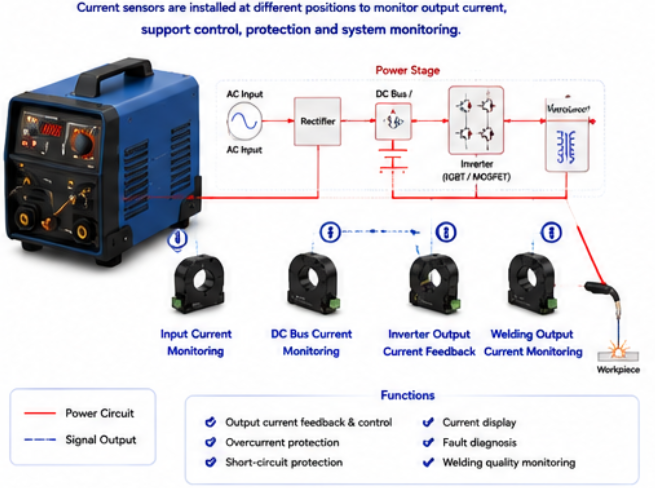
The first step is to define where the current sensor will be installed. Welding machines may require current sensing on the input side, DC bus side, inverter output side, transformer secondary side, welding output cable, or protection circuit. Each position has different current level, waveform type, frequency, and insulation requirement. Selecting a sensor without confirming the measurement point can easily lead to wrong range, poor response, or unstable output.
In inverter welding machines, current sensors are often used for output current feedback and control. The sensor helps the control board adjust welding output, maintain stable arc performance, and protect the power stage from overcurrent. Because inverter welders involve high-frequency switching and rapidly changing current, the current sensor should provide fast response and good noise immunity.
In resistance welding and spot welding systems, the current may be very high and pulse-like. The sensor must tolerate high peak current and repeated pulse stress without saturation or overheating. In these applications, peak current capability, response time, and mechanical installation structure are often more important than standard low-current accuracy.
For welding power supplies and industrial welding equipment, the sensor may also support overload protection, fault diagnosis, current display, process control, and quality monitoring. If the current data is used for welding quality control, the sensor must provide stable and repeatable output under real welding conditions.
Key Questions Before Selection
Is the sensor used for welding output current feedback, monitoring, display, or protection?
What type of welding machine is it: inverter welder, spot welder, resistance welder, plasma cutter, or industrial welding power supply?
What are the rated current, peak current, and short-time overload current?
Is the welding current DC, AC, pulse, or high-frequency waveform?
What response time and bandwidth are required for stable welding control?
What output signal does the control board, ADC, PLC, or monitoring system require?
What installation space, conductor size, and aperture size are available?
2. Check The Core Parameters For Welding Current Sensors
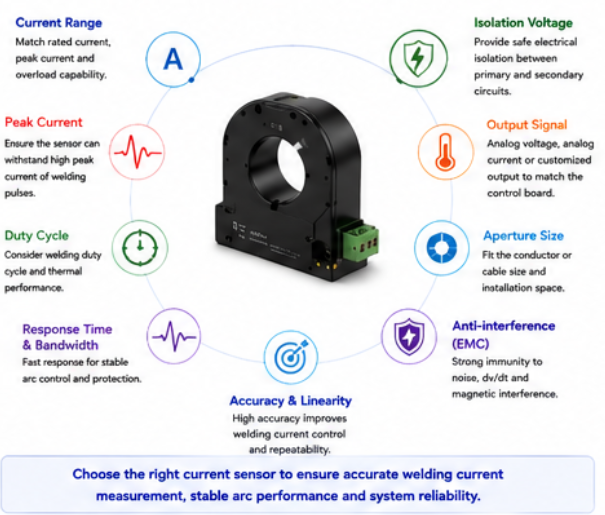
Current range is the first parameter to confirm. Welding machines may operate at high current and may experience short-time peak current during arc ignition, load changes, or pulse welding. The selected sensor must cover the maximum expected current without magnetic saturation. At the same time, the range should not be unnecessarily oversized, because this may reduce useful resolution during normal welding current measurement.
Peak current and overload capability are especially important for welding applications. A sensor that works well in a normal steady current test may still fail or distort output under repeated welding pulses. Engineers should check peak current, pulse duration, duty cycle, overload tolerance, thermal performance, and whether the sensor can handle real welding cycles.
Response time and bandwidth affect welding control quality. If the current sensor responds too slowly, the control system may not follow rapid welding current changes accurately. This can affect arc stability, current regulation, and protection response. For inverter welding machines, fast response and suitable bandwidth are important because the power stage switches quickly and output current can change rapidly.
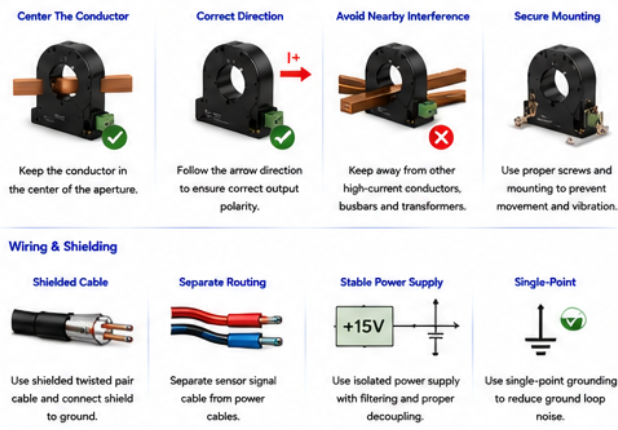
Anti-interference ability is another key factor. Welding machines generate strong electrical noise, switching interference, magnetic fields, and high pulse current. The sensor should provide stable output in a noisy environment. Proper shielding, grounding, cable routing, and installation distance from high-power conductors are also important.
Isolation voltage and insulation performance should be checked carefully. Welding equipment may involve high voltage, high current, and harsh working conditions. A suitable current sensor should safely isolate the primary current path from the low-voltage control circuit and help protect the controller, display module, PLC, and operator interface.
| Selection Parameter | Why It Matters In Welding Machines | Recommended Checkpoint |
|---|---|---|
| Current Range | Determines whether the sensor can measure normal welding current | Confirm rated current and normal working current range |
| Peak Current | Welding machines often produce short high-current pulses | Check peak current, pulse duration, and overload tolerance |
| Duty Cycle | Affects sensor heating and long-term stability | Review continuous and intermittent welding operation conditions |
| Response Time | Supports fast current regulation and protection | Use fast-response sensors for inverter welders and pulse welding |
| Bandwidth | Determines whether the sensor can follow fast current waveforms | Match bandwidth with switching frequency and current waveform |
| Accuracy And Linearity | Affects welding current control and repeatability | Use higher accuracy for process control and quality monitoring |
| Isolation Voltage | Protects low-voltage control circuits from high-current power circuits | Check isolation voltage, dielectric strength, and insulation structure |
| Output Signal | Must match the control board, ADC, display, or PLC | Confirm voltage output, current output, or customized output |
Open Loop Or Closed Loop For Welding Machines?
Open loop Hall effect current sensors may be suitable for cost-sensitive welding current monitoring and display applications. Closed loop current sensors are better when the welding machine requires accurate current feedback, fast response, better linearity, low drift, and stable control performance. For inverter welding machines, pulse welding systems, and high-performance industrial welders, closed loop or fast-response current sensors are often the stronger selection direction.
3. Match Current Sensors With Different Welding Applications
Different welding machines have different current sensing requirements. In inverter arc welding machines, the current sensor is often used for output feedback and current regulation. The sensor should provide fast response, good bandwidth, and stable output under switching noise. In these systems, sensor speed and anti-interference performance directly affect welding stability.
For resistance welding and spot welding machines, the current can be extremely high for a short time. The sensor should tolerate high peak current and repeated pulse operation. Engineers should not choose the model only by continuous rated current. Peak current, pulse width, duty cycle, and thermal stress are more important in this type of welding equipment.
For plasma cutting systems and high-power welding power supplies, current sensors may support output current control, fault protection, and system diagnostics. The sensor should have good insulation, high reliability, and stable signal output in high-noise environments. Mechanical installation should also be reviewed because power cables and busbars may be thick and installation space may be limited.
For automated welding equipment and robot welding systems, current measurement may be used for process monitoring and welding quality control. In these applications, repeatability, accuracy, and signal stability matter more. A stable current sensor helps maintain consistent welding output and supports better production quality control.
When requesting a welding current sensor quote, buyers should provide the welding machine type, current range, peak current, duty cycle, current waveform, output signal, response time requirement, aperture size, conductor size, mounting method, and operating environment. This helps the supplier recommend a suitable model and reduces sample testing risk.
Typical Application Matching Reference
| Welding Application | Current Sensing Priority | Sensor Selection Direction |
|---|---|---|
| Inverter Welding Machine | Fast feedback, stable arc control, output regulation | Fast-response current sensor with good bandwidth and noise immunity |
| Spot Welding Machine | High pulse current and short welding cycle | High peak current sensor with strong overload tolerance |
| Resistance Welding Equipment | Large current, repeatability, welding process control | High-current sensor with stable output and good thermal performance |
| Plasma Cutting System | Output current control and protection | Isolated current sensor with fast response and strong anti-interference ability |
| Robotic Welding System | Stable process monitoring and welding quality consistency | High-accuracy current sensor with good repeatability |
| Industrial Welding Power Supply | Reliable output control and overload protection | Robust sensor with high isolation, thermal stability, and long-term reliability |
Common Selection Mistakes To Avoid
Choosing a current sensor only by rated current and ignoring peak welding current.
Using a slow-response sensor in inverter welding or pulse welding applications.
Ignoring duty cycle and thermal stress during repeated welding operation.
Selecting a sensor with poor noise immunity in high-EMI welding equipment.
Not confirming whether the sensor output matches the control board or PLC.
Ignoring conductor size, aperture size, and installation space.
Using a general monitoring sensor where precision welding current feedback is required.
Conclusion
Choosing a current sensor for welding machines requires careful review of rated current, peak current, duty cycle, current waveform, response time, bandwidth, accuracy, isolation voltage, output signal, anti-interference performance, aperture size, and installation environment. Welding applications are demanding because they involve high current, fast current changes, heat, electrical noise, and repeated overload conditions.
For inverter welders, resistance welders, spot welding machines, plasma cutting systems, robotic welding equipment, and industrial welding power supplies, the right current sensor helps improve welding output stability, protection reliability, and long-term equipment performance. A suitable model should match both the electrical requirements and the real welding operating conditions.
FAQ
1. Why do welding machines need current sensors?
Current sensors help monitor welding current, support output current feedback, improve arc stability, protect the power circuit from overcurrent, and support welding quality control.
2. What current range should I choose for a welding machine?
The current range should cover normal welding current, peak current, and short-time overload current. It should also keep enough resolution during normal welding operation.
3. Is response time important for welding current sensing?
Yes. Fast response is important for inverter welders, pulse welding, overcurrent protection, and stable welding output control.
4. Should I choose open loop or closed loop current sensors?
Open loop sensors may be suitable for basic monitoring. Closed loop sensors are better for high-accuracy current feedback, fast response, low drift, and demanding welding control systems.
5. What information should I provide before requesting a quote?
You should provide the welding machine type, rated current, peak current, duty cycle, current waveform, response requirement, output signal, isolation requirement, aperture size, conductor size, and installation environment.
Contact Us For Welding Machine Current Sensor Selection Support
If you are selecting current sensors for inverter welders, spot welders, resistance welding equipment, plasma cutting systems, robotic welding systems, or industrial welding power supplies, send us your current range, peak current, duty cycle, waveform type, output signal, aperture size, and application details. Our team can help you match a suitable current sensor solution.
Contact Us Get Quote