How To Avoid Wrong Current Sensor Selection In High Power Equipment
How To Avoid Wrong Current Sensor Selection In High Power Equipment
Wrong current sensor selection is a common problem in high power equipment projects. A sensor may look suitable by rated current, but fail during installation, testing, or mass production because the output signal, peak current capability, aperture size, isolation voltage, response time, or controller interface does not match the real system.
This guide explains how buyers and engineers can avoid wrong current sensor selection for EV chargers, battery energy storage systems, solar inverters, motor drives, UPS systems, welding machines, railway power systems, industrial power supplies, and high-current control cabinets.
Quick Answer
To avoid wrong current sensor selection in high power equipment, buyers should not choose by rated current alone. They should confirm current type, rated current, peak current, overload duration, output signal, supply voltage, controller input, isolation voltage, response time, accuracy, drift, aperture size, busbar or cable dimensions, installation space, operating temperature, and real application conditions before requesting a quote or approving samples.
1. Do Not Select A Current Sensor Only By Rated Current
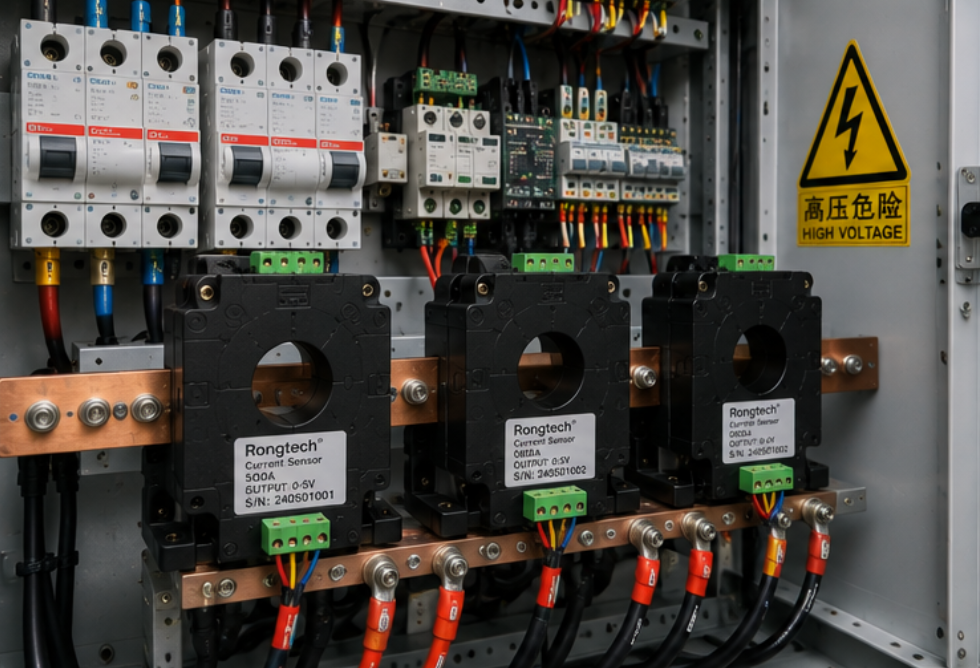
The most common mistake is choosing a current sensor only by rated current. For example, a buyer may ask for a 500A current sensor, but the real system may have 500A continuous current, 800A peak current, short-time overload, bidirectional DC current, or fast transient current. If these conditions are not confirmed, the selected sensor may saturate, output wrong data, or trigger false protection.
In high power equipment, current is rarely stable all the time. EV chargers may have charging current changes. BESS cabinets may have charge and discharge current. Motor drives may have acceleration, braking, and regeneration current. Welding machines may have pulse current. Railway and industrial power systems may have heavy transient loads. These real conditions must be considered before model selection.
A sensor with too small a range may saturate during peak current. A sensor with too large a range may lose resolution during normal operation. The correct range should balance measurement accuracy and safety margin. Buyers should provide rated current, peak current, overload current, fault current, current duration, and waveform information if available.
Current Range Questions Buyers Should Ask
What is the normal continuous current?
What is the maximum peak current?
How long does the peak current last?
Is the current AC, DC, pulse, leakage, or bidirectional?
Is the sensor used for monitoring, feedback control, protection, or safety shutdown?
Does the system have overload, startup, braking, or fault current conditions?
2. Check Output Signal And Controller Compatibility
Even if the current range is correct, the sensor can still be wrong if the output signal does not match the controller. High power equipment may use ADC input, PLC analog input, BMS, PCS, inverter controller, EV charger control board, motor drive controller, data acquisition system, or protection circuit. Each system may require a different signal format.
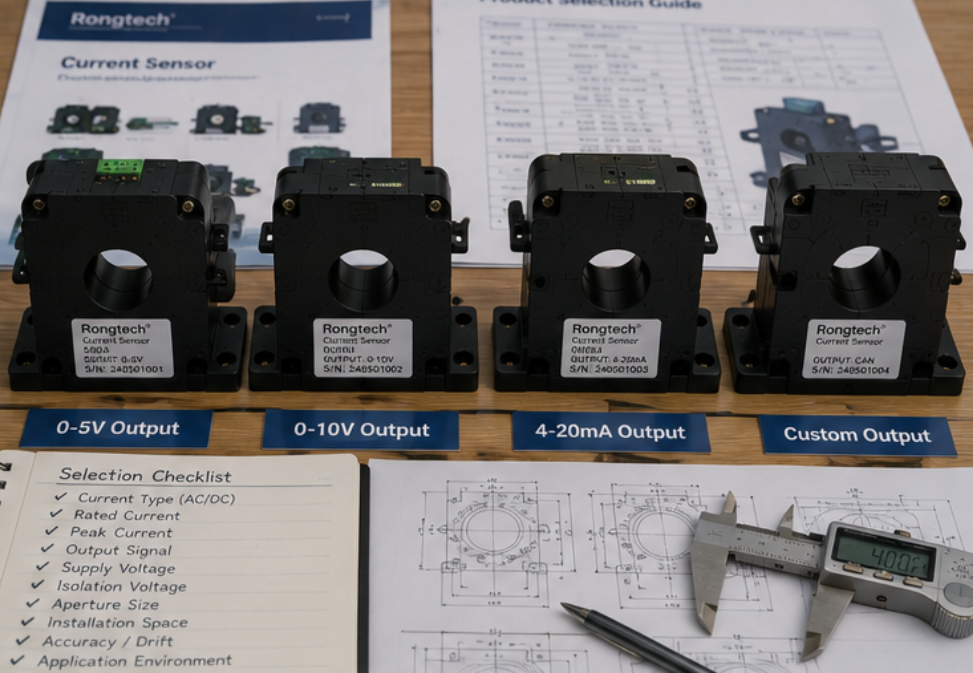
Common current sensor outputs include 0-5V, 0-10V, ±4V, ±5V, 4-20mA, CAN, RS485, relay output, switch output, or customized output. A 0-5V sensor cannot directly replace a 4-20mA sensor unless the control system supports both signal types. A 0-10V output may damage or overload a controller input designed for 0-5V.
For bidirectional DC current measurement, buyers should pay attention to zero-current output. Some sensors use 2.5V as the zero point in a 0-5V system. Some sensors use bipolar output such as ±5V. If the controller does not understand the zero point or polarity, the system may judge current direction incorrectly.
| Output Selection Item | Common Mistake | Correct Check |
|---|---|---|
| 0-5V Output | Used without confirming ADC input range | Confirm controller supports 0-5V and required zero point |
| 0-10V Output | Connected to a 0-5V control board | Confirm PLC or industrial controller input range |
| 4-20mA Output | Selected without checking loop power and load resistance | Confirm current input module, loop wiring, and signal scaling |
| Bidirectional Output | Zero-current point and polarity are ignored | Confirm zero point, current direction, and controller calculation logic |
| Custom Output | Requested without controller input details | Provide output range, scaling, pin definition, and original model data |
3. Do Not Ignore Isolation Voltage And High Voltage Safety
High power equipment often works with high voltage DC buses, battery packs, inverter power stages, charging modules, and high-current conductors. The current sensor must safely separate the high-current primary side from the low-voltage signal side. If isolation is insufficient, the controller, communication circuit, or operator safety may be at risk.
Buyers should not confuse isolation test voltage with continuous working voltage. A sensor may pass a short high-voltage test, but still need to be checked for system working voltage, creepage distance, clearance distance, insulation material, and cabinet installation environment.
EV chargers, BESS systems, solar inverters, UPS systems, railway power systems, and industrial DC power systems should pay special attention to isolation. Saving a small amount on sensor cost may create much higher risk if the insulation level does not match the real high-voltage system.
| Safety Parameter | Why It Matters | Buyer Should Provide |
|---|---|---|
| System Working Voltage | Determines long-term insulation requirement | Battery voltage, DC bus voltage, or AC system voltage |
| Isolation Voltage | Protects low-voltage control circuits | 2.5kV, 4kV, 6kV, 10kV, or project-specific requirement |
| Creepage And Clearance | Important for high-voltage insulation safety | Voltage level, pollution degree, cabinet layout, and spacing requirement |
| Installation Environment | Dust, humidity, heat, and altitude affect insulation safety | Operating environment and cabinet protection level |
4. Check Aperture Size, Installation Space And Mechanical Fit
Another common mistake is choosing a sensor before checking whether it can physically fit the conductor. High power equipment may use thick cables, flat copper busbars, laminated busbars, insulated conductors, or multiple parallel cables. The sensor aperture must match the real conductor size and installation structure.
For cable installation, buyers should provide the cable outer diameter, not only conductor cross-section. For busbar installation, buyers should provide busbar width, thickness, insulation layer, conductor position, and installation direction. A sensor with the correct electrical specification may still be unusable if the aperture is too small or the body is too large for the cabinet space.
If the cable cannot be disconnected, a split core current sensor may be considered. If the conductor is a flat busbar, a rectangular aperture or custom window structure may be more suitable. For OEM projects, drawings and installation photos help reduce sample mismatch risk.
| Mechanical Item | Common Mistake | Correct Check |
|---|---|---|
| Cable Diameter | Only conductor size is provided | Provide full cable outer diameter with insulation |
| Busbar Size | Width and thickness are not provided | Provide busbar width, thickness, coating, and position |
| Aperture Shape | Round aperture is selected for a flat busbar | Consider rectangular aperture or custom window |
| Installation Space | Only aperture size is checked | Check sensor body size, terminal direction, and wiring route |
| Mounting Method | Mounting holes are ignored | Confirm panel mount, PCB mount, busbar mount, DIN rail, or split core installation |
5. Do Not Forget Accuracy, Drift, Response Time And EMC
High power equipment usually contains switching devices, power modules, contactors, relays, high-current cables, cooling fans, and control boards. These parts may create heat and electrical noise. A current sensor must maintain stable output under real working conditions, not only in a simple bench test.
If the current signal is used for motor control, inverter feedback, EV charger regulation, or fast protection, response time and bandwidth are important. If the signal is used for BESS current calculation or precision DC measurement, offset drift and temperature stability are important. If the signal is used only for basic display, standard accuracy may be enough.
Buyers should define how the current signal is used. A monitoring sensor, feedback sensor, protection sensor, and precision measurement sensor may require different performance levels. This helps avoid both under-selection and over-selection.
Example Correct Quote Request:
Application: High power EV charging module
Measurement position: DC output current monitoring
Current type: DC current
Current range: 500A rated, 800A peak for 1 second
Output signal: 0-5V
Supply voltage: +15V
Isolation requirement: 4kV or higher
Installation: Copper busbar 40 × 6 mm
Quantity: 20 samples first, estimated annual demand 3000 pieces
Final Wrong Selection Prevention Checklist
Do not choose by rated current alone.
Confirm rated current, peak current, overload current, and duration.
Confirm current type: AC, DC, pulse, leakage, or bidirectional current.
Match output signal with controller, ADC, PLC, BMS, PCS, or monitoring system.
Confirm zero-current output and current direction for bidirectional measurement.
Check supply voltage and wiring definition.
Confirm isolation voltage, working voltage, creepage, and clearance.
Provide aperture size, cable diameter, busbar width, and busbar thickness.
Check response time, bandwidth, accuracy, offset drift, and temperature drift.
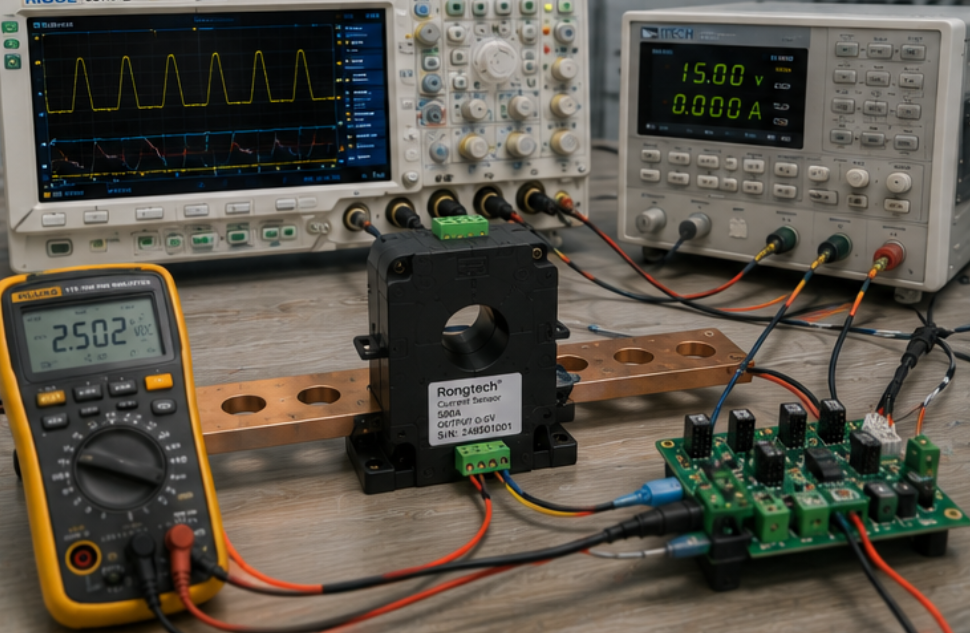
Test samples under real load, real wiring, and real operating temperature before mass production.
Conclusion
Wrong current sensor selection in high power equipment usually happens because buyers only compare rated current and price. In real projects, current type, peak current, output signal, controller compatibility, isolation voltage, aperture size, installation structure, response time, accuracy, drift, and operating environment all matter.
For EV chargers, BESS, inverters, motor drives, UPS systems, welding machines, railway power systems, and industrial power cabinets, a complete parameter list helps suppliers recommend the correct current sensor faster, reduce sample testing risk, and avoid costly redesign during mass production.
FAQ
1. What is the most common current sensor selection mistake?
The most common mistake is choosing only by rated current while ignoring peak current, output signal, isolation voltage, aperture size, response time, and controller compatibility.
2. Why is peak current important?
Peak current may be much higher than normal operating current. If the sensor range is too small, it may saturate during startup, overload, braking, pulse current, or fault conditions.
3. What output signal should I choose?
The output signal should match the controller input. Common options include 0-5V, 0-10V, ± output, 4-20mA, CAN, RS485, relay output, switch output, or customized output.
4. Why is aperture size important?
Aperture size determines whether the sensor can fit the cable or copper busbar. Buyers should provide cable outer diameter or busbar width and thickness before requesting a quote.
5. What should I provide before requesting a quote?
Provide application, current type, rated current, peak current, output signal, supply voltage, isolation requirement, aperture size, busbar or cable dimensions, accuracy target, response time, sample quantity, and annual demand.
Avoid Wrong Current Sensor Selection In Your High Power Project
If you need current sensors for EV chargers, BESS, inverters, motor drives, UPS systems, welding machines, railway systems, or industrial power cabinets, send us your application, current range, peak current, output signal, isolation requirement, aperture size, busbar or cable dimensions, sample quantity, and annual demand. Our team can help you match a suitable current sensor solution and reduce selection risk.
Contact Us Get Quote