IGBT Module vs SiC MOSFET: Which Is Better For Power Conversion
IGBT Module vs SiC MOSFET: Which Is Better For Power Conversion?
IGBT modules and SiC MOSFETs are both widely used in power conversion systems, but they are not always suitable for the same design goals. IGBT modules are mature, cost-effective, and reliable for many medium-to-high-power inverter applications. SiC MOSFETs offer faster switching, lower switching loss, higher efficiency, and better performance in compact high-frequency power systems.
This guide explains the key differences between IGBT modules and SiC MOSFETs, compares their performance in power conversion, and helps engineers and purchasing teams choose the right power semiconductor for motor drives, solar inverters, EV chargers, UPS systems, energy storage converters, welding machines, and industrial power supplies.
Quick Answer
Choose an IGBT module when the project needs proven reliability, strong current handling, lower device cost, and stable performance in conventional inverter designs. Choose a SiC MOSFET when the project requires higher switching frequency, higher efficiency, lower switching loss, smaller magnetic components, compact design, and better thermal performance. For cost-sensitive industrial drives and traditional high-power systems, IGBT modules are often practical. For EV charging, high-efficiency solar inverters, compact converters, and advanced power electronics, SiC MOSFETs may provide stronger long-term value.
1. Understand The Basic Difference Between IGBT And SiC MOSFET
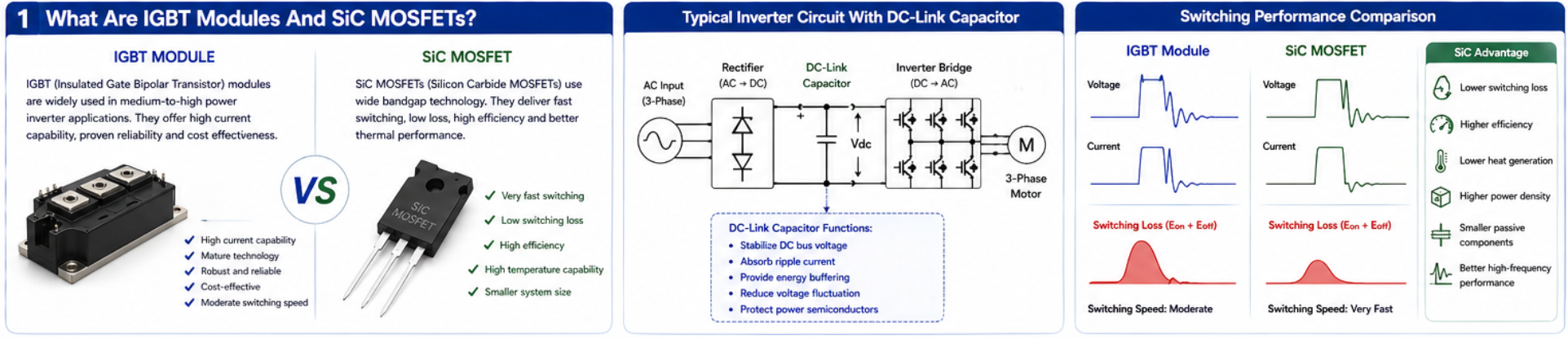
An IGBT, or insulated gate bipolar transistor, is a mature power semiconductor device widely used in industrial inverters, motor drives, UPS systems, welding machines, traction converters, and other medium-to-high-power applications. IGBT modules are popular because they provide strong current capability, proven reliability, good robustness, and relatively competitive cost in many industrial power conversion designs.
A SiC MOSFET uses silicon carbide material instead of traditional silicon. Compared with conventional silicon devices, SiC MOSFETs can usually support faster switching, lower switching loss, higher operating temperature capability, and better efficiency in many high-frequency power conversion systems. This makes SiC attractive for EV chargers, solar inverters, high-frequency power supplies, energy storage converters, and compact high-efficiency designs.
The main difference is not simply “old technology versus new technology.” IGBT modules are still very practical in many high-power systems where switching frequency is moderate and cost control is important. SiC MOSFETs are more suitable when efficiency, switching speed, power density, and thermal performance are the main design goals. The right choice depends on the complete system requirement, not only the device itself.
For engineers, the selection should start with power level, voltage class, switching frequency, cooling method, efficiency target, cost target, available gate driver design, EMC requirement, and expected operating environment. For purchasing teams, the decision should also consider supply stability, module package, replacement options, datasheet support, testing requirements, and long-term maintenance cost.
Key Questions Before Choosing
What is the system voltage and power level?
What switching frequency does the converter require?
Is the main goal lower cost, higher efficiency, smaller size, or lower heat?
What cooling method is available: natural cooling, forced air, or liquid cooling?
Does the existing gate driver support IGBT or SiC MOSFET requirements?
How important are EMC, switching noise, and layout optimization?
Is the project a new design, replacement project, or cost-down redesign?
2. Compare Performance, Cost, Efficiency, And Design Complexity
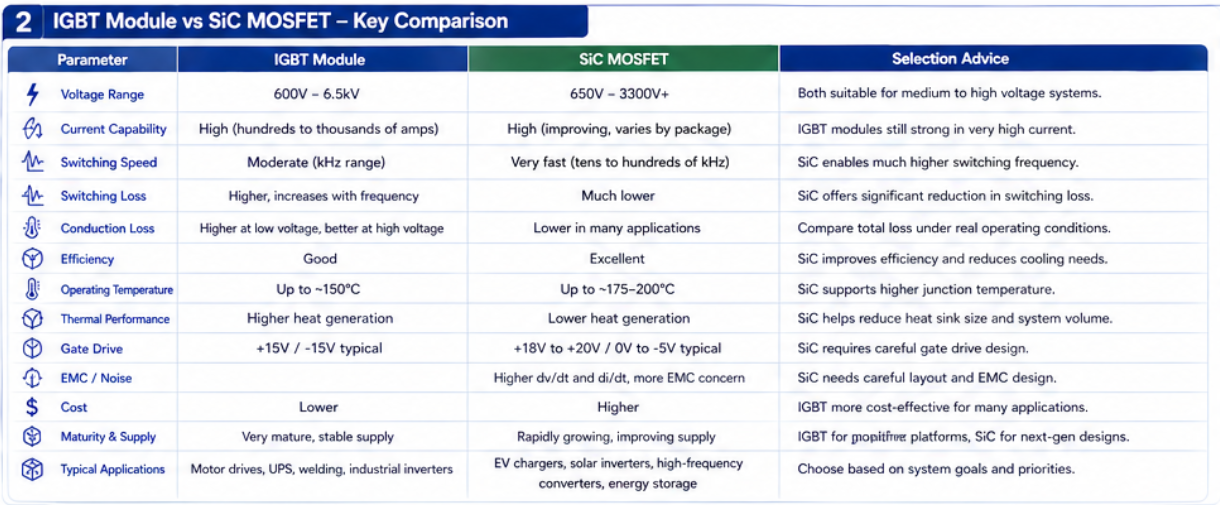
The most important comparison between IGBT modules and SiC MOSFETs is loss performance. IGBTs can handle high current and are widely used in established inverter platforms, but they usually have higher switching loss than SiC MOSFETs, especially when switching frequency increases. SiC MOSFETs switch much faster and can reduce switching loss, which helps improve system efficiency and reduce heat generation.
Efficiency is often the reason engineers consider SiC MOSFETs. In applications such as EV charging modules, solar inverters, and energy storage converters, even a small efficiency improvement can reduce thermal stress, improve power density, and support smaller cooling systems. However, the benefit depends on the full system design. If the layout, gate driver, protection circuit, and thermal design are not optimized, the advantage of SiC may not be fully realized.
Cost is still one of the strongest reasons to choose IGBT modules. IGBT technology is mature, widely available, and well understood by many design teams. For traditional motor drives, industrial inverters, welding machines, and other cost-sensitive systems with moderate switching frequency, IGBT modules can provide a strong balance between performance, price, and reliability.
Design complexity should not be ignored. SiC MOSFETs require more careful gate driving, PCB layout, parasitic inductance control, protection design, and EMC management. Their fast switching can improve efficiency but may also create voltage overshoot, ringing, and noise if the power loop is not designed properly. IGBT modules are generally easier to apply in conventional designs because their switching behavior is slower and more familiar to many engineering teams.
| Comparison Item | IGBT Module | SiC MOSFET | Selection Advice |
|---|---|---|---|
| Switching Speed | Moderate switching speed | Very fast switching | Choose SiC for high-frequency and compact designs |
| Switching Loss | Higher at high switching frequency | Lower switching loss | SiC improves efficiency in fast-switching applications |
| Conduction Performance | Good for many high-current systems | Strong in many high-efficiency designs | Compare loss under real current and temperature conditions |
| Efficiency | Suitable for conventional inverter efficiency targets | Higher efficiency potential | Choose SiC when efficiency and thermal reduction matter most |
| Cost | Usually more cost-effective | Usually higher device cost | Choose IGBT for cost-sensitive mature platforms |
| Thermal Design | Higher loss may require larger cooling design | Lower loss can reduce thermal stress | Review total heat sink, airflow, and power density requirements |
| Design Difficulty | Easier for traditional designs | Requires careful gate drive, layout, and EMC design | Choose SiC only when the design team can manage fast switching effects |
| Typical Applications | Motor drives, UPS, welding, traditional inverters | EV chargers, high-efficiency inverters, compact converters | Match the device with system efficiency, cost, and size goals |
When IGBT Modules Are A Better Choice
IGBT modules are often a better choice when the system uses a mature inverter design, the switching frequency is moderate, the current level is high, and cost control is important. They are suitable for many industrial motor drives, UPS systems, welding machines, general inverters, and power supplies where proven reliability and stable supply are more important than maximum efficiency or highest switching frequency.
When SiC MOSFETs Are A Better Choice
SiC MOSFETs are often a better choice when the system needs higher efficiency, higher switching frequency, lower heat generation, smaller magnetic components, compact structure, or improved power density. They are especially attractive for EV charging modules, high-efficiency solar inverters, high-frequency power supplies, energy storage converters, and next-generation power conversion designs.
3. Match The Device With Different Power Conversion Applications
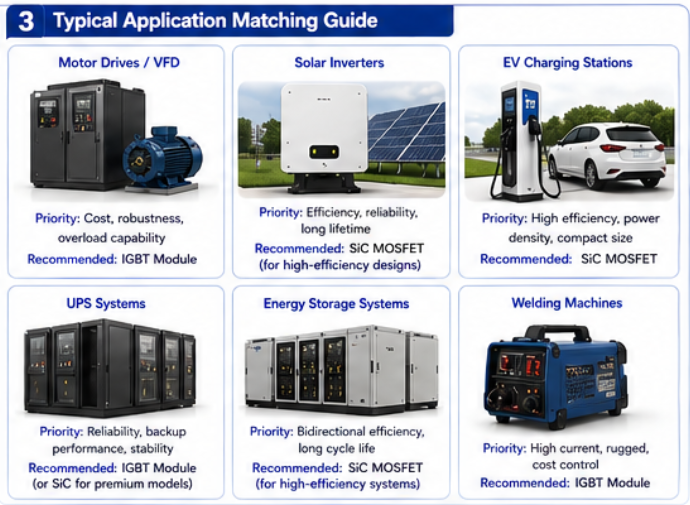
Different power conversion applications have different priorities. A motor drive may focus on cost, ruggedness, and overload capability. A solar inverter may focus on efficiency, long-term thermal performance, and compact size. An EV charger may focus on high power density, high efficiency, fast switching, and reliable thermal control. The best semiconductor choice depends on these application-level priorities.
For motor drives and VFDs, IGBT modules are still widely used because they are mature, robust, and cost-effective. In many pump, fan, compressor, and industrial automation drives, the switching frequency does not need to be extremely high, so IGBT modules can provide practical performance. For high-performance servo drives or compact premium drives, SiC may be considered if efficiency and size reduction justify the cost and design complexity.
For solar inverters, SiC MOSFETs can help improve efficiency and reduce switching loss, especially in high-frequency or high-power-density designs. However, IGBT modules may still be used in cost-sensitive or mature inverter platforms. Engineers should compare total system cost, cooling design, efficiency target, and expected product positioning.
For EV chargers and energy storage converters, SiC MOSFETs are often attractive because these systems benefit from high efficiency, compact size, and reduced heat generation. In high-power charging modules, lower loss can reduce cooling pressure and support higher power density. However, proper gate driver design, protection design, and EMC control are essential.
For UPS systems, welding equipment, and industrial power supplies, the choice depends on product grade. Standard industrial equipment may use IGBT modules for cost and proven reliability. High-efficiency, compact, or premium equipment may consider SiC MOSFETs if the performance benefits justify the additional device and design cost.
Application Matching Reference
| Application | Main Design Priority | Recommended Selection Direction |
|---|---|---|
| Industrial Motor Drive | Cost, reliability, current handling, mature design | IGBT module for most standard VFD platforms |
| Solar Inverter | Efficiency, thermal design, compact structure | SiC MOSFET for high-efficiency designs; IGBT for cost-sensitive mature platforms |
| EV Charging Module | High power density, high efficiency, reduced heat | SiC MOSFET is often preferred for advanced charging modules |
| UPS System | Reliability, thermal stability, backup power performance | IGBT for standard UPS; SiC for high-efficiency premium UPS designs |
| Energy Storage Converter | Bidirectional conversion, efficiency, long-term stability | SiC for compact high-efficiency systems; IGBT for cost-balanced systems |
| Welding Machine | High current, ruggedness, cost control | IGBT module is often practical for mature welding platforms |
Common Selection Mistakes To Avoid
Choosing SiC only because it is newer without checking system-level benefit
Choosing IGBT only because it is cheaper while ignoring efficiency and cooling cost
Comparing device price but ignoring total system cost, heat sink size, and efficiency loss
Using SiC MOSFETs without optimizing gate driver, layout, protection, and EMC design
Replacing IGBT with SiC directly without checking voltage spike, ringing, and parasitic inductance
Ignoring actual switching frequency and load profile in the final equipment
Not confirming module package, thermal interface, supply stability, and testing support
Conclusion
IGBT modules and SiC MOSFETs both have strong value in power conversion, but they serve different design priorities. IGBT modules are mature, reliable, cost-effective, and suitable for many conventional industrial power systems. SiC MOSFETs provide faster switching, lower switching loss, higher efficiency, and better power density, making them attractive for advanced high-efficiency designs.
The best choice depends on power level, voltage class, switching frequency, efficiency target, thermal design, gate driver capability, EMC requirement, cost target, and application environment. Instead of asking which device is universally better, engineers should ask which one creates the best total system value for the final power conversion product.
FAQ
1. Is SiC MOSFET always better than IGBT?
No. SiC MOSFETs offer higher switching speed and efficiency potential, but they usually cost more and require more careful design. IGBT modules may be better for cost-sensitive and mature industrial platforms.
2. When should I choose an IGBT module?
Choose an IGBT module when the system needs proven reliability, strong current handling, moderate switching frequency, lower device cost, and mature inverter design support.
3. When should I choose a SiC MOSFET?
Choose a SiC MOSFET when the design needs high efficiency, high switching frequency, compact size, lower switching loss, reduced cooling burden, and higher power density.
4. Can SiC MOSFET directly replace an IGBT module?
Not always. Direct replacement requires checking gate driver design, package compatibility, switching speed, voltage overshoot, protection circuit, thermal layout, and EMC performance.
5. What information should I provide before requesting a quote?
You should provide the application, voltage class, current rating, switching frequency, power level, topology, cooling method, package requirement, efficiency target, and whether the project is a new design or replacement project.
Contact Us For IGBT And SiC MOSFET Selection Support
If you are selecting IGBT modules, SiC MOSFETs, or power semiconductor components for motor drives, solar inverters, EV chargers, UPS systems, energy storage converters, welding machines, or industrial power supplies, send us your voltage class, current rating, switching frequency, package requirement, and application details. Our team can help you match a suitable solution.
Contact Us Get Quote