Hall Effect Current Sensor For EV Charging Module: Selection And Quotation Guide
Hall Effect Current Sensor For EV Charging Module: Selection And Quotation Guide
Hall effect current sensors are widely used in EV charging modules for DC output current monitoring, DC bus current detection, charging current feedback, overcurrent protection, and system safety control. For EV charger manufacturers and power module designers, selecting the right Hall effect current sensor is not only about current rating. The sensor must match the charging module power, current range, output signal, isolation voltage, response time, aperture size, temperature environment, and controller interface.
This guide explains how to choose a Hall effect current sensor for EV charging modules, what parameters buyers should confirm before requesting a quote, and how to avoid wrong model selection during sample testing, OEM production, or supplier replacement projects.
Quick Answer
To choose a Hall effect current sensor for EV charging modules, buyers should confirm the measured current type, rated current, peak current, output signal, supply voltage, isolation voltage, accuracy, response time, aperture size, conductor type, operating temperature, and installation structure. For DC fast chargers and charging power modules, the sensor should provide stable DC current measurement, reliable galvanic isolation, good anti-interference performance, and compatibility with the charging module controller, ADC, PLC, or monitoring system.
1. Why EV Charging Modules Need Hall Effect Current Sensors
EV charging modules need accurate and reliable current measurement to control charging output, protect power circuits, monitor DC bus conditions, and detect abnormal current events. In high-power charging equipment, current sensors are often installed at the DC output side, DC bus side, power conversion stage, or protection circuit. The measured signal is sent to the controller for regulation, monitoring, and fault protection.
Hall effect current sensors are commonly selected because they can measure current without placing a sensing resistor directly in the main current path. This helps reduce power loss and heat compared with shunt-based current measurement in high-current applications. They can also provide galvanic isolation between the high-current power circuit and the low-voltage control circuit, which is important for EV charging safety.
In an EV charging module, the current sensor may be used for charging current feedback, overcurrent protection, current display, fault diagnosis, output current balancing, or communication with the charging control system. If the sensor output is unstable, delayed, or inaccurate, the module may experience false protection, unstable charging current, control error, or system shutdown.
Before requesting a quote, buyers should avoid asking only for “a Hall current sensor for EV charger.” A better request should include current range, peak current, output signal, isolation requirement, busbar or cable size, supply voltage, and expected quantity. This helps the supplier recommend a suitable model faster and more accurately.
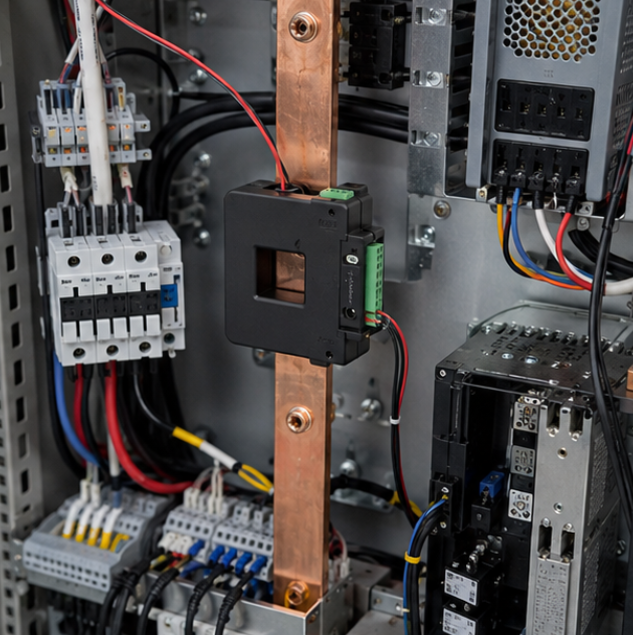
Typical Current Sensor Positions In EV Chargers
DC output current monitoring for charging current regulation.
DC bus current detection for power conversion feedback.
Input-side current monitoring for module protection.
Overcurrent protection circuit for abnormal operating conditions.
Charging module current sharing in parallel module systems.
System monitoring for maintenance and fault diagnosis.
2. Key Parameters To Confirm Before Choosing A Hall Effect Current Sensor
The first parameter is current range. EV charging modules may use different current levels depending on power rating, output voltage, and charging mode. Buyers should provide both rated current and peak current. If only rated current is provided, the supplier may not know whether the sensor needs additional overload margin for transient conditions.
The second parameter is output signal. Common current sensor outputs may include 0-5V, 0-10V, 4-20mA, ±4V, ±5V, CAN, RS485, or customized output. The sensor output must match the controller, ADC, PLC, or charging module control board. Wrong output selection may cause signal mismatch, calibration difficulty, or extra redesign cost.
Isolation voltage is critical in EV charging equipment. The current sensor should safely separate the high-current primary side from the low-voltage control side. Buyers should provide system voltage, required isolation voltage, and any safety or certification requirements. For high-voltage DC charging systems, isolation should not be treated as a secondary detail.
Response time and bandwidth are also important. If the current signal is used only for slow monitoring, standard response may be enough. If the signal is used for protection, current control, or fast power conversion feedback, the sensor should provide faster response and stable output under dynamic current changes.
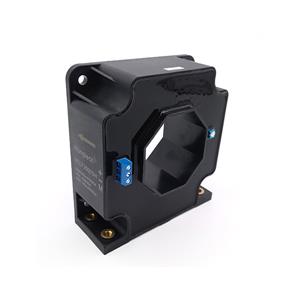
Mechanical structure must be checked before quotation. EV charging modules may use copper busbars, high-current cables, or compact internal layouts. Buyers should provide busbar width, busbar thickness, cable diameter, aperture size, mounting holes, and available installation space to avoid model mismatch.
| Parameter | Why It Matters | What Buyers Should Provide |
|---|---|---|
| Rated Current | Determines the basic sensor range | 100A, 300A, 500A, 1000A, or project-specific current |
| Peak Current | Prevents saturation during overload or transient operation | Example: 800A peak for 1 second |
| Current Type | Confirms AC, DC, pulse, or bidirectional measurement needs | DC output current / DC bus current / pulse current |
| Output Signal | Must match controller, ADC, PLC, or monitoring system | 0-5V, 0-10V, 4-20mA, CAN, RS485, or customized output |
| Supply Voltage | Determines whether the sensor can work with the module power rail | +5V, +12V, +15V, +24V, ±15V |
| Isolation Voltage | Protects the low-voltage control side from high-current circuits | 2.5kV, 4kV, 6kV, or project-specific requirement |
| Accuracy | Affects charging current regulation and protection logic | ±1%, ±0.5%, ±0.2%, or application-specific target |
| Aperture Size | Determines whether the sensor fits the busbar or cable | Busbar size or cable diameter |
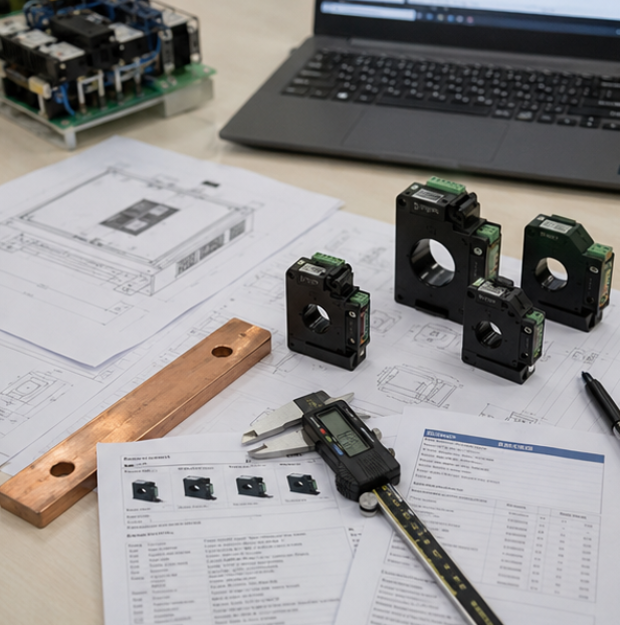
3. Open Loop Or Closed Loop Hall Effect Current Sensor For EV Chargers?
Hall effect current sensors can be open loop or closed loop. Open loop Hall effect current sensors are often more cost-effective and suitable for general current monitoring, charging current display, and applications where moderate accuracy is acceptable. They are widely used when cost, compact structure, and basic DC current measurement are important.
Closed loop Hall effect current sensors usually provide higher accuracy, better linearity, lower offset drift, and faster response. They are more suitable when the current signal is used for precise control, fast protection, high-accuracy DC measurement, or long-term stable operation. For high-performance EV charging modules, closed loop sensors may be preferred if the control system needs better feedback quality.
The final choice depends on charging module design. If the application is cost-sensitive and only requires current monitoring, open loop may be enough. If the system requires high accuracy, low drift, fast response, and stable control feedback, closed loop should be considered. Buyers should also compare total cost, not only sensor price, because wrong selection may lead to redesign, unstable testing, or field reliability problems.
| Comparison Item | Open Loop Hall Sensor | Closed Loop Hall Sensor |
|---|---|---|
| Cost | Usually more cost-effective | Usually higher cost |
| Accuracy | Suitable for general monitoring | Better for high-accuracy feedback |
| Response Time | Moderate response depending on model | Usually faster response |
| Offset Drift | May require more attention in DC measurement | Usually lower drift and better stability |
| Best Fit | Charging current monitoring and cost-sensitive systems | High-accuracy control, protection, and precision DC measurement |
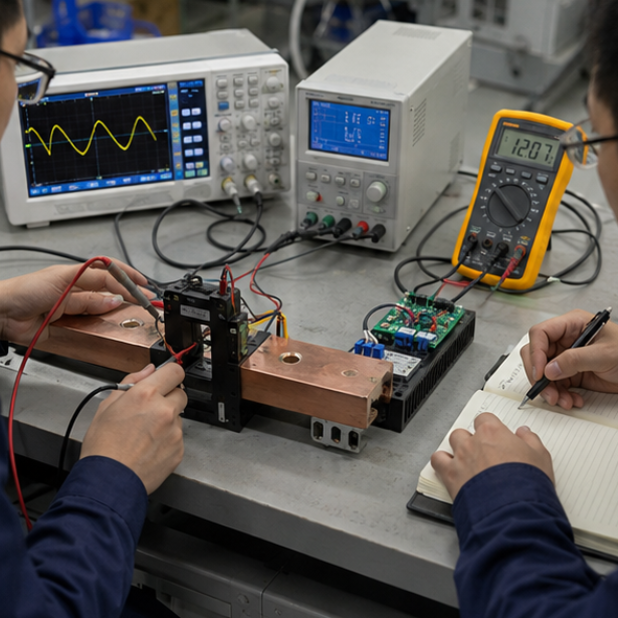
4. What Buyers Should Send Before Requesting A Hall Effect Current Sensor Quote
To get a fast and accurate quotation, buyers should send a complete parameter list. This allows the supplier to recommend a suitable Hall effect current sensor model and avoid repeated communication. If the project is an existing model replacement, buyers should provide the old sensor model number, datasheet, wiring definition, installation photo, and real working conditions.
If customization is needed, it should be mentioned before pricing. Common customization items include current range, output signal, supply voltage, aperture size, mounting hole position, connector, cable length, terminal type, housing structure, label, and special testing requirement.
Example Quote Request:
Application: EV charging module
Measured current: DC output charging current
Rated current: 500A
Peak current: 800A for 1 second
Output signal: 0-5V
Supply voltage: +15V
Isolation requirement: 4kV or higher
Installation: Copper busbar 40 × 6 mm
Quantity: 20 samples first, estimated annual demand 3000 pieces
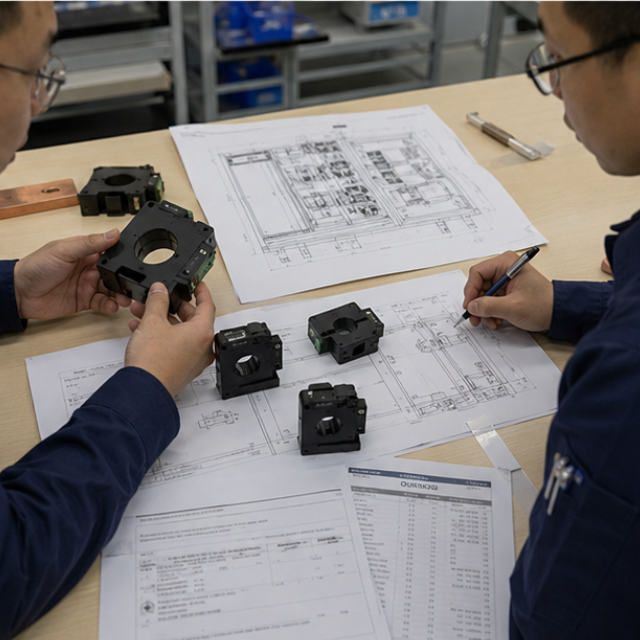
Final Quote Checklist
EV charger type and charging module power rating.
Measured current position: DC output, DC bus, input side, or protection circuit.
Current type, rated current, peak current, and overload condition.
Open loop or closed loop preference if known.
Accuracy, response time, and bandwidth requirements.
Output signal and supply voltage.
Isolation voltage and working voltage.
Aperture size, busbar size, or cable diameter.
Operating temperature and electrical noise environment.
Sample quantity, annual demand, and customization needs.
Common Selection Mistakes To Avoid
Choosing a sensor only by rated current and ignoring peak current.
Ignoring output signal compatibility with the controller.
Using a low-cost open loop sensor where high-accuracy closed loop feedback is required.
Forgetting isolation voltage in high-voltage EV charging systems.
Not providing busbar size, aperture size, and installation space.
Ignoring temperature drift and EMI in high-power charging modules.
Requesting a direct replacement without checking wiring definition and output polarity.
Conclusion
A Hall effect current sensor for EV charging modules should be selected according to rated current, peak current, output signal, supply voltage, isolation voltage, accuracy, response time, aperture size, installation method, operating temperature, and anti-interference requirement. The correct model helps improve charging current regulation, protection reliability, and long-term system stability.
For EV charger manufacturers, charging module designers, and OEM buyers, a complete parameter list is the fastest way to receive an accurate quotation. Instead of asking only for a current sensor price, buyers should provide the application, current range, controller interface, busbar size, isolation requirement, and expected quantity. This helps the supplier recommend the right Hall effect current sensor faster and reduce sample testing risk.
FAQ
1. Why are Hall effect current sensors used in EV charging modules?
They can measure high current with galvanic isolation and low insertion loss, making them suitable for DC output current monitoring, charging current feedback, and protection in EV charging modules.
2. Should I choose open loop or closed loop Hall current sensor?
Open loop sensors are suitable for cost-sensitive monitoring. Closed loop sensors are better for higher accuracy, lower drift, faster response, and more demanding current feedback applications.
3. What output signal should I choose?
The output signal should match your controller, ADC, PLC, or monitoring system. Common options include 0-5V, 0-10V, 4-20mA, ±4V, ±5V, CAN, RS485, or customized output.
4. Why is isolation voltage important?
Isolation voltage protects the low-voltage controller and signal circuit from the high-current charging circuit. It is especially important in high-voltage EV charging systems.
5. What information should I provide before requesting a quote?
You should provide application, rated current, peak current, output signal, supply voltage, isolation requirement, accuracy target, aperture size, busbar or cable size, operating temperature, sample quantity, and annual demand.
Request A Hall Effect Current Sensor Quote For EV Charging Modules
If you need Hall effect current sensors for EV charging modules, DC fast chargers, charging piles, DC bus monitoring, or charging current feedback, send us your current range, peak current, output signal, isolation requirement, busbar size, aperture size, and estimated quantity. Our team can help you match a suitable model and provide a practical quotation.
Contact Us Get Quote