Custom Current Sensor For Power Electronics: What Can Be Customized
Custom Current Sensor For Power Electronics: What Can Be Customized?
Power electronics projects often need current sensors that match specific current ranges, output signals, aperture sizes, installation structures, isolation requirements, and controller interfaces. Standard current sensors may work for many applications, but EV chargers, battery energy storage systems, solar inverters, motor drives, UPS systems, welding machines, railway power systems, and industrial power supplies often require customized current sensing solutions.
This guide explains what can be customized in a current sensor, what buyers should confirm before requesting a custom quotation, and how to reduce model mismatch during sample testing and mass production.
Quick Answer
A custom current sensor can usually be customized in current range, peak current capability, output signal, supply voltage, aperture size, busbar or cable fit, mounting structure, connector, cable length, terminal type, accuracy, response time, isolation voltage, housing design, label, calibration, and testing requirements. For power electronics applications, buyers should provide the application, current type, rated current, peak current, controller input, conductor size, installation space, insulation requirement, operating temperature, sample quantity, and annual demand before requesting a custom quote.
1. Why Power Electronics Projects Need Custom Current Sensors
Power electronics equipment is not always designed around standard sensor dimensions. A current sensor may need to fit a specific copper busbar, high-current cable, PCB layout, control cabinet, charging module, inverter structure, or battery cabinet. If the sensor aperture, mounting holes, output signal, or wiring direction does not match the equipment, even a technically correct sensor may not be usable in the final product.
Custom current sensors are often requested when buyers need a special current range, non-standard aperture, specific voltage output, special connector, cable assembly, stronger isolation, different mounting structure, or replacement for an existing imported model. These customization needs are common in EV charging modules, BESS cabinets, solar inverters, motor drives, UPS systems, welding power supplies, and railway power equipment.
For OEM projects, customization can also help improve assembly efficiency and reduce system integration cost. For example, a sensor with the right aperture size, mounting holes, connector direction, and output signal can reduce wiring work, avoid extra adapters, and simplify production. For replacement projects, customization can help match an existing model’s size, output, and installation interface.
However, customization should not start from appearance alone. Buyers should first confirm the real electrical requirements, such as current type, rated current, peak current, accuracy, response time, isolation voltage, and operating temperature. Then they can define the mechanical structure, output interface, and special testing requirements.
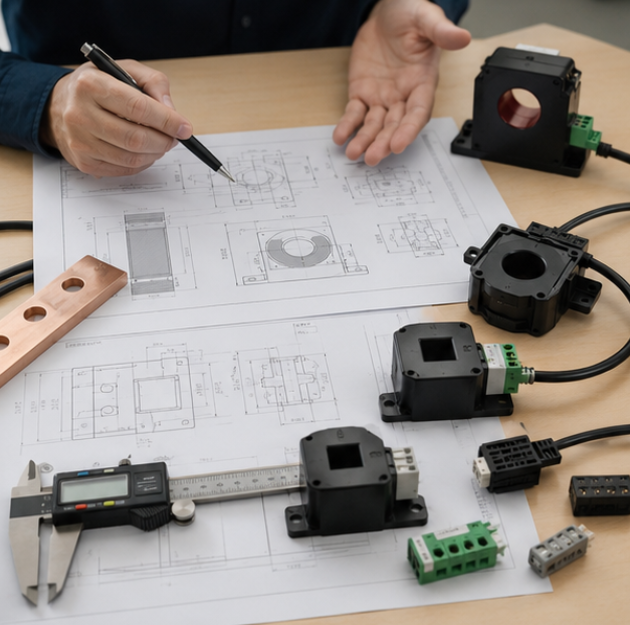
Common Reasons For Customization
The standard aperture size does not fit the cable or copper busbar.
The output signal does not match the controller, ADC, PLC, BMS, or PCS.
The installation space is limited inside the cabinet or power module.
The project requires a special current range or peak current capability.
The buyer needs a replacement for an existing current sensor model.
The system requires stronger isolation or a special safety requirement.
The project needs a specific connector, cable length, terminal type, or label.
2. What Can Be Customized In A Current Sensor?
The most common customization item is current range. Buyers may need 50A, 100A, 300A, 500A, 1000A, 2000A, or other project-specific ranges. The sensor should be selected according to normal working current, peak current, overload current, and measurement resolution. A custom range can help balance safety margin and measurement accuracy.
Output signal customization is also very common. Different controllers may require 0-5V, 0-10V, ±4V, ±5V, 4-20mA, CAN, RS485, or other customized outputs. If the current sensor output does not match the control system, the buyer may need extra signal conversion circuits. A customized output can make integration easier and reduce redesign cost.
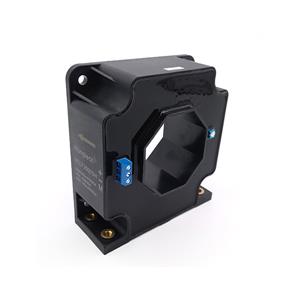
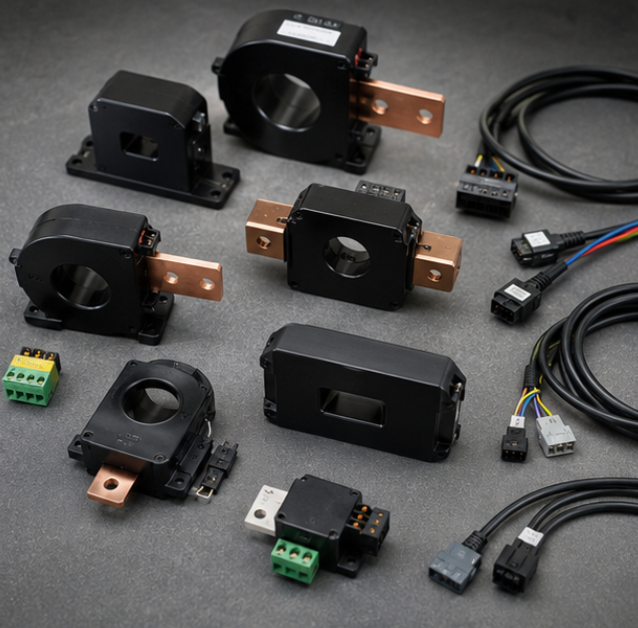
Mechanical customization is often required in high-current power electronics. Buyers may need a specific aperture size for copper busbars or cables, customized mounting holes, different terminal directions, compact housing, split core structure, panel mount design, PCB mount design, or DIN rail installation. Mechanical fit should be confirmed before sample production.
Electrical safety parameters may also be customized or selected according to project requirements. These include isolation voltage, working voltage, creepage distance, clearance distance, dielectric strength, and insulation structure. For EV chargers, BESS, solar inverters, UPS systems, and railway power systems, isolation design should be confirmed carefully.
Other customization items may include cable length, connector type, terminal block, wire color, housing color, product label, logo, calibration point, accuracy grade, operating temperature, test report format, and packaging. For OEM production, these details can help simplify assembly, inspection, and after-sales replacement.
| Customization Item | What Can Be Customized | What Buyers Should Provide |
|---|---|---|
| Current Range | Rated current, peak current, overload capability | Normal current, peak current, overload duration |
| Output Signal | 0-5V, 0-10V, ±4V, ±5V, 4-20mA, CAN, RS485, custom output | Controller input range and signal requirement |
| Supply Voltage | +5V, +12V, +15V, +24V, ±15V | Available power rail in the equipment |
| Aperture Size | Hole diameter, rectangular aperture, busbar window size | Cable diameter or busbar width and thickness |
| Mounting Structure | Panel mount, PCB mount, busbar mount, DIN rail, split core | Installation drawing and available space |
| Connector And Cable | Cable length, connector type, wire color, terminal block | Connector model, cable route, assembly requirement |
| Accuracy And Response | Accuracy grade, offset drift, response time, bandwidth | Measurement purpose and control requirement |
| Isolation Requirement | Isolation voltage, working voltage, insulation design | System voltage and safety requirement |
| Label And Packaging | Product label, logo, part number, packaging method | OEM label file and packaging requirement |
3. Custom Current Sensor Applications In Power Electronics
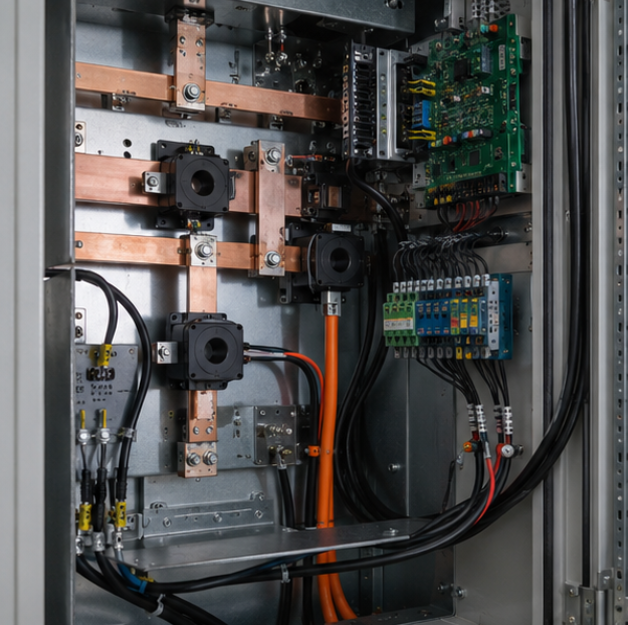
In EV charging modules, custom current sensors may be used for DC output current monitoring, DC bus current detection, charging current feedback, and overcurrent protection. Customization may include high-current range, busbar aperture, 0-5V output, stronger isolation, special mounting holes, or compact housing for charging module installation.
In battery energy storage systems, custom current sensors are often needed for bidirectional DC current measurement, battery charge and discharge monitoring, PCS current feedback, and battery cabinet protection. Low offset drift, stable DC measurement, isolation voltage, and busbar fit are usually important selection points.
In solar inverters and UPS systems, current sensors may need customized output signals, high-temperature performance, compact installation, and good anti-interference capability. These systems often operate continuously, so reliability and temperature stability should be considered during customization.
In motor drives and welding machines, custom current sensors may be required for fast response, high peak current, pulse current measurement, and strong overload capability. The sensor should match the dynamic current behavior and mechanical layout of the equipment.
For replacement projects, buyers may need to replace an existing current sensor model without changing the control system or cabinet structure. In this case, the supplier should compare the original model’s current range, output, pin definition, size, mounting holes, aperture, isolation voltage, and accuracy before recommending a replacement or custom solution.
| Application | Common Customization Need | Buyer Should Confirm |
|---|---|---|
| EV Charging Module | High current range, 0-5V output, busbar aperture, compact mounting | Charging current, output signal, isolation, busbar size |
| Battery Energy Storage System | Bidirectional DC measurement, low drift, high isolation, busbar fit | Charge/discharge current, BMS/PCS input, aperture, accuracy |
| Solar Inverter | Temperature stability, anti-interference performance, custom output | DC/AC current, response time, EMC environment, output signal |
| Motor Drive | Fast response, high accuracy, compact structure | Phase current, control loop requirement, bandwidth, installation space |
| Welding Machine | High peak current, pulse current, strong overload capability | Rated current, peak current, duty cycle, waveform type |
| Replacement Project | Same size, same output, same mounting holes, compatible wiring | Original datasheet, photos, wiring definition, application condition |
Common Customization Mistakes To Avoid
Customizing the aperture without confirming busbar tolerance and installation space.
Changing output signal without checking controller input range.
Ignoring peak current and overload current during custom range selection.
Focusing only on housing size while ignoring isolation voltage and safety requirements.
Requesting replacement without providing the original model datasheet.
Confirming price before clarifying sample quantity and annual demand.
Not testing the customized sensor under real operating conditions before mass production.
4. What Buyers Should Send Before Requesting A Custom Current Sensor Quote
A custom current sensor quote requires more information than a standard model inquiry. Buyers should provide the application, current type, rated current, peak current, output signal, supply voltage, isolation voltage, accuracy target, response time, aperture size, conductor size, mounting method, operating environment, sample quantity, annual demand, and customization details.
If the project is a replacement request, buyers should also provide the current sensor model number, datasheet, photos, installation drawings, wiring definition, and the reason for replacement. If the project is a new design, buyers should provide cabinet drawings, busbar drawings, controller input requirements, and expected production schedule.
Example Custom Quote Request:
Application: EV charging module
Measured current: DC output current
Current range: 500A rated, 800A peak
Output signal: 0-5V
Supply voltage: +15V
Isolation requirement: 4kV or higher
Aperture: suitable for 40 × 6 mm copper busbar
Customization: connector direction, cable length 300 mm, custom label
Quantity: 20 samples first, estimated annual demand 3000 pieces
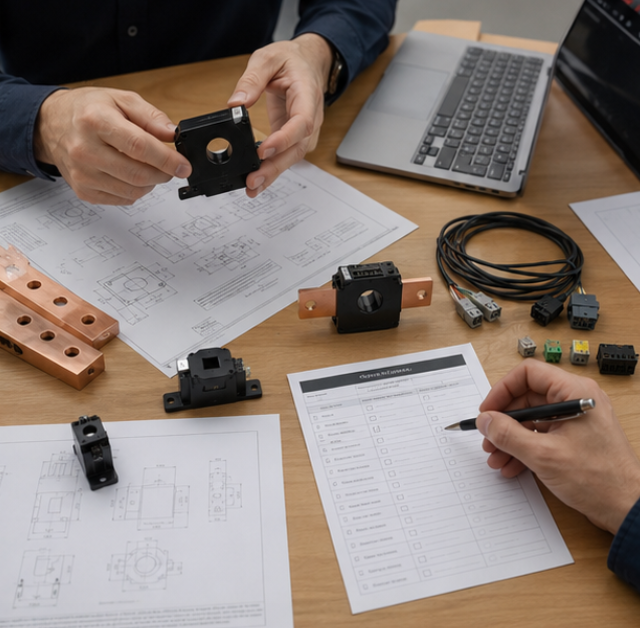
Final Customization Checklist
Application and measurement position.
Measured current type: AC, DC, pulse, leakage, or bidirectional current.
Rated current, peak current, overload current, and duty cycle.
Accuracy, offset drift, response time, and bandwidth requirements.
Output signal and supply voltage.
Isolation voltage, working voltage, creepage, and clearance requirements.
Aperture size, cable diameter, or busbar dimensions.
Mounting holes, installation space, and wiring direction.
Connector, cable length, terminal type, label, and packaging requirements.
Sample quantity, annual demand, and target delivery schedule.
Conclusion
A custom current sensor can be customized in current range, output signal, supply voltage, aperture size, mounting structure, connector, cable length, accuracy, response time, isolation voltage, housing design, label, calibration, and testing requirements. For power electronics applications, customization should be based on real electrical, mechanical, and safety requirements.
For EV chargers, BESS, solar inverters, motor drives, UPS systems, welding machines, railway power systems, and industrial power supplies, a well-designed custom current sensor can improve installation compatibility, signal matching, reliability, and production efficiency. Buyers should provide complete parameters before requesting a quote so the supplier can recommend a practical and reliable custom solution.
FAQ
1. What can be customized in a current sensor?
Common customization items include current range, output signal, supply voltage, aperture size, mounting structure, connector, cable length, terminal type, accuracy, isolation voltage, label, and testing requirements.
2. When should buyers request a custom current sensor?
Buyers should request customization when standard models do not match the current range, output signal, aperture size, installation space, connector, isolation requirement, or replacement requirement.
3. What information is needed for a custom current sensor quote?
Buyers should provide application, current type, rated current, peak current, output signal, supply voltage, isolation requirement, accuracy target, aperture size, conductor size, mounting method, customization details, sample quantity, and annual demand.
4. Can a custom current sensor replace an existing model?
Yes, but buyers should provide the original model number, datasheet, mechanical drawing, wiring definition, photos, and real working conditions so the supplier can evaluate compatibility.
5. Does customization increase lead time?
Customization may increase sample preparation time depending on the complexity. Providing complete technical information at the beginning helps reduce communication time and speed up quotation and sample development.
Request A Custom Current Sensor Quote For Power Electronics
If you need custom current sensors for EV chargers, battery energy storage systems, solar inverters, motor drives, UPS systems, welding machines, railway systems, or industrial power electronics, send us your current range, peak current, output signal, isolation requirement, aperture size, conductor size, mounting method, and customization needs. Our team can help you match a suitable custom solution.
Contact Us Get Quote