Fluxgate Current Sensor For Precision DC Measurement: When Is It Worth Choosing?
Fluxgate Current Sensor For Precision DC Measurement: When Is It Worth Choosing?
Fluxgate current sensors are used in applications that require high accuracy DC current measurement, low offset drift, excellent stability, and reliable small-current detection. They are often considered for battery energy storage systems, precision power supplies, calibration equipment, high-end inverters, railway systems, laboratory power electronics, battery testing, and advanced industrial control systems.
However, a fluxgate current sensor is not always necessary for every project. Compared with standard Hall effect current sensors or common closed loop current sensors, fluxgate sensors may cost more and require more careful application matching. This guide explains when a fluxgate current sensor is worth choosing, what buyers should check, and what information should be provided before requesting a quotation.
Quick Answer
A fluxgate current sensor is worth choosing when the application requires very accurate DC current measurement, low zero offset, low temperature drift, stable long-term output, and reliable measurement of small DC current changes. It is especially useful for precision battery testing, high-end BESS current measurement, laboratory power supplies, railway DC monitoring, calibration systems, and high-accuracy power electronics. If the application only needs general current monitoring or cost-sensitive protection, a Hall effect or standard closed loop current sensor may be more practical.
1. What Makes Fluxgate Current Sensors Different?
Fluxgate current sensors are designed for precision DC measurement. Their main advantage is the ability to provide very low offset, low drift, and high stability compared with many standard current sensing solutions. This makes them attractive when the measured current data is used for accurate control, battery calculation, energy statistics, laboratory testing, or calibration-grade measurement.
In many industrial applications, small measurement errors may be acceptable. For example, if the current sensor is only used for general monitoring or overcurrent protection, a standard Hall effect current sensor may be enough. But in high-accuracy DC measurement, even small offset drift can affect long-term data reliability. This is where fluxgate sensors become valuable.
For battery systems, current measurement directly affects charge and discharge tracking. For precision power supplies, current feedback affects output control. For railway and industrial DC systems, stable current monitoring supports safety and diagnostics. If the current sensor output drifts with temperature or time, the system may produce incorrect data even when the actual current is stable.
The key question for buyers is not simply “Is fluxgate better?” but “Does this project truly need fluxgate-level accuracy and stability?” If the answer is yes, the higher cost may be justified. If not, a suitable Hall effect, closed loop, or isolated current sensor may deliver better cost performance.
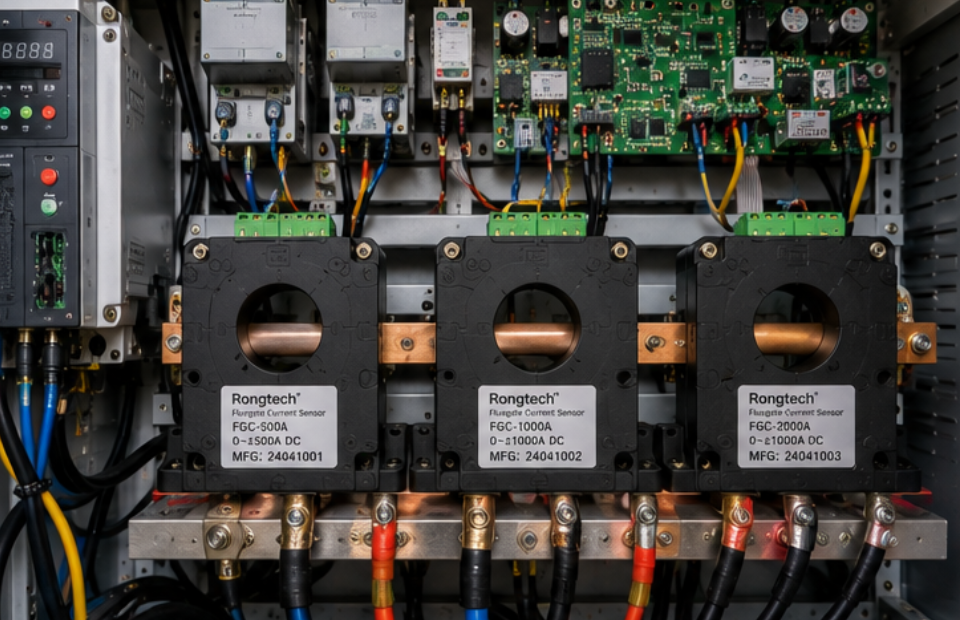
Typical Applications For Fluxgate Current Sensors
Precision DC current measurement systems.
Battery testing and battery charge/discharge analysis.
High-end BESS and battery cabinet current monitoring.
Laboratory power supplies and calibration equipment.
Railway DC current monitoring and traction power systems.
High-accuracy inverter, PCS, and power conversion equipment.
Industrial systems requiring low drift and long-term stability.
2. Fluxgate vs Hall Effect vs Closed Loop Current Sensor
Hall effect current sensors are widely used because they are cost-effective, compact, and suitable for many AC and DC current measurement applications. They are commonly used in EV chargers, inverters, motor drives, BESS, UPS systems, and industrial cabinets. For general current monitoring, Hall effect sensors are often the most practical choice.
Closed loop current sensors usually provide better accuracy, lower drift, faster response, and better linearity than many open loop Hall sensors. They are often used when the current signal is important for control feedback, protection, or higher-accuracy DC measurement.
Fluxgate current sensors are usually considered when the project requires even higher DC measurement stability, lower offset, and better long-term precision. They are especially useful when small current changes must be detected accurately or when accumulated measurement error matters over time.
The trade-off is cost and application complexity. Fluxgate sensors may not be necessary for every EV charger, inverter, or motor drive. Buyers should compare the real accuracy requirement, allowable error, temperature drift, output signal, integration cost, and project budget before choosing.
| Comparison Item | Hall Effect Current Sensor | Closed Loop Current Sensor | Fluxgate Current Sensor |
|---|---|---|---|
| Cost | Usually lower | Medium to higher | Usually higher |
| DC Accuracy | Suitable for general use | Better for control feedback | Best for precision DC measurement |
| Offset Drift | Needs careful review | Usually lower | Very low drift for precision use |
| Long-Term Stability | Standard monitoring level | Good stability | Strong long-term stability |
| Best Fit | General monitoring and cost-sensitive projects | Control feedback and higher accuracy systems | Precision DC measurement and low-drift systems |
3. When Is A Fluxgate Current Sensor Worth Choosing?
A fluxgate current sensor is worth choosing when current measurement accuracy directly affects system performance, safety, billing, testing, calibration, or long-term data reliability. If a small measurement error can cause wrong SOC calculation, wrong test result, inaccurate energy data, or unstable control, the higher sensor cost may be justified.
Battery testing is a typical example. When testing charge and discharge behavior, the system may need accurate current measurement over long periods. If the sensor has high zero drift, the accumulated calculation error may become significant. Fluxgate sensors can help improve current measurement reliability in these situations.
Another example is precision DC power equipment. If the current sensor is part of a control feedback loop or calibration process, low offset and stable output become important. For high-end industrial systems, stable current data can reduce calibration workload and improve repeatability.
However, if the sensor is only used for approximate current display, simple overcurrent protection, or cost-sensitive equipment, fluxgate may be unnecessary. A suitable open loop Hall effect current sensor or closed loop current sensor may provide enough performance at a lower cost.
| Choose Fluxgate When | Why It Helps | Typical Application |
|---|---|---|
| Very low DC offset is required | Reduces zero-current error | Battery testing, precision DC measurement |
| Long-term stability matters | Improves data reliability over time | BESS, railway DC monitoring, industrial monitoring |
| Small DC current changes must be detected | Improves low-current resolution | Laboratory equipment, calibration systems |
| Temperature drift must be minimized | Keeps output stable under temperature change | Outdoor power systems, high-end industrial equipment |
| Measurement data affects calculation or certification | Improves traceability and repeatability | Battery test systems, precision power supplies |
4. What Buyers Should Check Before Requesting A Quote
Before requesting a fluxgate current sensor quote, buyers should define the real measurement requirement. The supplier needs to know the current range, peak current, DC accuracy target, offset drift requirement, response time, output signal, supply voltage, isolation voltage, aperture size, conductor structure, operating temperature, and expected quantity.
For precision measurement, buyers should avoid using only a broad statement such as “high accuracy current sensor.” Different projects may require different accuracy levels, drift limits, response speeds, and output forms. Providing clear parameters helps the supplier judge whether fluxgate is necessary or whether another sensor type is more practical.
Output signal matching is also important. The sensor output must match the controller, ADC, PLC, data acquisition system, BMS, PCS, or test equipment. Common outputs may include voltage output, current output, digital communication, or customized output depending on the system design.
Example Quote Request:
Application: Precision battery charge and discharge testing
Measured current: Bidirectional DC current
Current range: 500A rated, 800A peak
Requirement: Low offset drift and high DC accuracy
Output signal: 0-5V or customized output
Supply voltage: +15V or project-specific
Isolation requirement: 4kV or higher
Installation: Copper busbar 40 × 6 mm
Quantity: 10 samples first, estimated annual demand 1000 pieces
Final Buyer Checklist
Confirm whether the application truly needs precision DC measurement.
Provide rated current, peak current, and measurement direction.
Confirm required accuracy, offset drift, temperature drift, and stability.
Confirm output signal and controller or data acquisition input.
Confirm supply voltage and wiring definition.
Check isolation voltage, working voltage, creepage, and clearance.
Provide busbar size, cable diameter, aperture size, and installation space.
Confirm operating temperature, EMC environment, and calibration needs.
Provide sample quantity, annual demand, and customization requirements.
Conclusion
A fluxgate current sensor is worth choosing when the project requires high-accuracy DC measurement, low zero offset, low temperature drift, stable long-term output, and reliable small-current detection. It is especially suitable for precision battery testing, high-end BESS, calibration systems, laboratory power electronics, railway DC monitoring, and advanced industrial measurement systems.
For general current monitoring, cost-sensitive protection, or standard industrial equipment, a Hall effect current sensor or closed loop current sensor may be more practical. Buyers should evaluate the real accuracy requirement, drift tolerance, output signal, installation structure, and budget before choosing a fluxgate current sensor.
FAQ
1. What is a fluxgate current sensor used for?
A fluxgate current sensor is used for precision DC current measurement where low offset, low drift, high stability, and accurate small-current detection are important.
2. Is fluxgate better than Hall effect current sensor?
Fluxgate sensors are usually better for precision DC measurement and low drift applications. Hall effect sensors are often more cost-effective for general monitoring and standard industrial current measurement.
3. When should buyers choose fluxgate instead of closed loop current sensor?
Choose fluxgate when the application requires very low offset drift, excellent DC accuracy, high stability, and reliable long-term measurement. If standard high accuracy is enough, a closed loop sensor may be more cost-effective.
4. What output signal can a fluxgate current sensor provide?
Output depends on the model and project requirement. Common options may include analog voltage output, current output, digital output, or customized output for precision measurement systems.
5. What should I provide before requesting a quote?
Provide application, current range, peak current, accuracy target, offset drift requirement, output signal, supply voltage, isolation requirement, aperture size, conductor size, operating temperature, sample quantity, and annual demand.
Request A Fluxgate Current Sensor Quote For Precision DC Measurement
If you need fluxgate current sensors for precision DC measurement, battery testing, BESS, laboratory power supplies, railway DC monitoring, calibration systems, or high-end industrial equipment, send us your current range, accuracy target, drift requirement, output signal, isolation requirement, aperture size, sample quantity, and annual demand. Our team can help you evaluate whether fluxgate is the right choice for your project.
Contact Us Get Quote