Current Sensor For Motor Drive Manufacturers: Feedback, Protection And Output Matching
Current Sensor For Motor Drive Manufacturers: Feedback, Protection And Output Matching
Motor drive manufacturers need reliable current sensors for phase current feedback, DC bus current monitoring, torque control, overcurrent protection, fault diagnosis, and system safety. In servo drives, variable frequency drives, traction drives, industrial inverters, and high-power motor control systems, the current sensor directly affects control stability and protection response.
Choosing a current sensor for motor drive applications is not only about rated current. Buyers should confirm current waveform, peak current, response time, bandwidth, accuracy, output signal, supply voltage, isolation voltage, aperture size, installation method, and controller input requirements before requesting a quote.
Quick Answer
To choose a current sensor for motor drive manufacturers, buyers should confirm whether the sensor is used for phase current feedback, DC bus current monitoring, motor protection, or fault diagnosis. Key parameters include rated current, peak current, current waveform, response time, bandwidth, accuracy, offset drift, output signal, supply voltage, isolation voltage, aperture size, conductor type, operating temperature, and controller input. For motor drives, fast response, stable output, low drift, and output signal matching are usually more important than price alone.
1. Why Motor Drives Need Reliable Current Sensors
Motor drives use current measurement to control motor torque, regulate inverter output, detect overload, protect power devices, and monitor abnormal operating conditions. If the current sensor output is unstable, delayed, or mismatched with the controller, the drive may suffer from poor control performance, false protection, overheating, or power module damage.
In motor drive systems, current sensors may be installed on the phase output side, DC bus side, inverter bridge output, input side, or protection circuit. The measured signal may be used by the DSP, MCU, PLC, ADC, or drive controller. Different measurement positions require different current sensor characteristics.
For phase current feedback, response time and bandwidth are important because motor current changes quickly during acceleration, braking, torque control, and load variation. For DC bus current monitoring, isolation, current range, and overload capability may be more important. For protection circuits, the sensor must respond quickly enough to support safe shutdown.
Motor drive manufacturers should not choose a sensor only by rated current. A 300A sensor used for general monitoring may not be suitable for fast current feedback. A 500A sensor used for DC bus monitoring may not match the phase current control loop. The application position and controller requirement should be confirmed first.
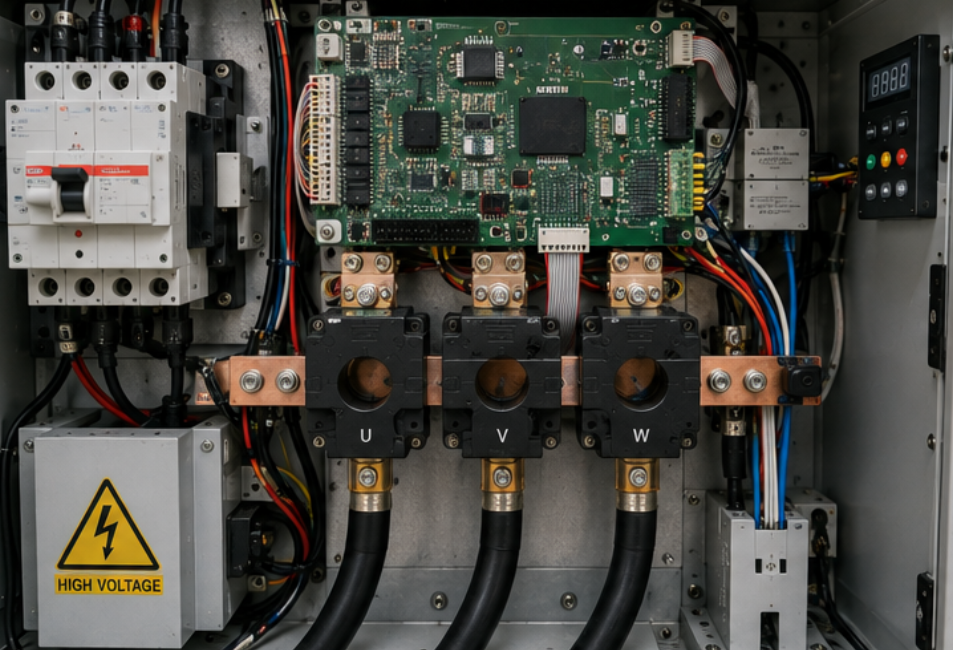
Typical Current Sensor Positions In Motor Drives
Phase current feedback for motor control and torque regulation.
DC bus current monitoring for inverter protection and system diagnosis.
Input current monitoring for power supply and drive protection.
Overcurrent protection circuit for abnormal load or short-circuit events.
Brake or regeneration current monitoring in drive systems.
Fault diagnosis and maintenance data collection.
2. Feedback Current Sensor: Accuracy, Response Time And Bandwidth
When a current sensor is used for motor control feedback, the signal quality directly affects control performance. The sensor should provide stable output, suitable accuracy, low offset drift, and enough response speed for the drive control loop. If the response is too slow, the controller may receive delayed current information and the motor may show unstable torque or poor dynamic response.
Bandwidth is especially important in servo drives, high-speed motor drives, and inverter systems with fast switching behavior. A sensor with insufficient bandwidth may smooth or delay fast current changes. This can affect current loop control, protection timing, and fault detection accuracy.
Accuracy should be evaluated together with offset drift, temperature drift, and linearity. A sensor may meet accuracy at room temperature, but its output may drift inside a hot control cabinet. For motor drive manufacturers, long-term stability across operating temperature is often more important than a single accuracy number.
Closed loop current sensors are often preferred for higher accuracy, lower drift, and faster response. Open loop Hall effect current sensors may be suitable for general current monitoring or cost-sensitive applications. The final choice depends on whether the signal is used for control feedback, protection, or simple monitoring.
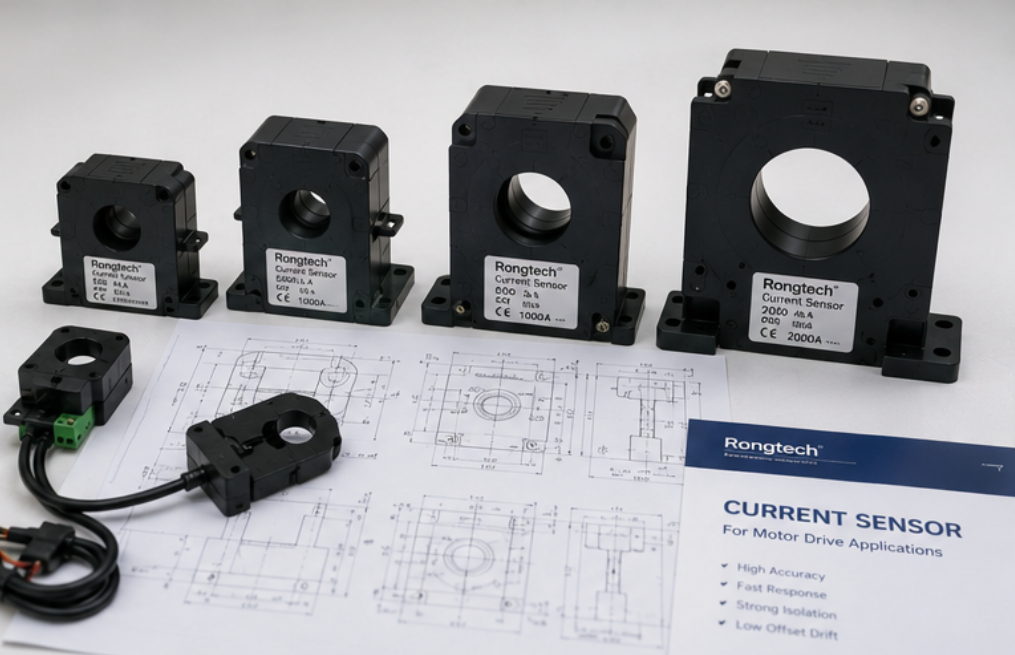
| Feedback Parameter | Why It Matters | What Buyers Should Confirm |
|---|---|---|
| Response Time | Affects control loop speed and protection timing | Required response for motor control or fault shutdown |
| Bandwidth | Determines ability to track fast current changes | Switching frequency and dynamic current behavior |
| Accuracy | Affects torque control and current calculation | ±1%, ±0.5%, ±0.2%, or project-specific target |
| Offset Drift | Affects zero-current reading and long-term stability | Operating temperature range and drift requirement |
| Linearity | Affects current measurement over full range | Full-scale current range and control precision requirement |
| EMC Performance | Motor drives contain switching noise and high dv/dt | Cabinet layout, shielding, grounding, and wiring environment |
3. Protection Current Sensor: Peak Current, Isolation And Reliability
Motor drives may experience overload, locked rotor, short circuit, braking current, regeneration current, or abnormal current spikes. A protection current sensor should support the expected peak current and provide reliable output before the power devices are damaged. If the sensor saturates too early or responds too slowly, the protection circuit may not react in time.
Peak current should be clearly provided before quotation. Buyers should define the rated current, maximum continuous current, short-time peak current, overload duration, and fault current if available. This helps the supplier choose a sensor range with enough margin without sacrificing normal current resolution.
Isolation voltage is important because motor drive systems often include high-voltage DC buses and inverter outputs. The current sensor should protect the low-voltage controller from the high-current power side. Buyers should confirm working voltage, isolation voltage, creepage distance, clearance distance, and insulation requirement.
Reliability is also critical for OEM motor drive manufacturers. The sensor should perform consistently during sample testing, pilot production, and mass production. Output consistency, insulation performance, mechanical strength, and long-term supply stability should be considered together.
| Protection Parameter | Why It Matters | What Buyers Should Provide |
|---|---|---|
| Rated Current | Defines normal operating range | 100A, 300A, 500A, 1000A, or project-specific value |
| Peak Current | Prevents saturation during overload or transient events | Peak current value and duration |
| Fault Current | Important for short-circuit or emergency protection | Fault current estimate and protection time requirement |
| Isolation Voltage | Protects controller and signal circuit | 2.5kV, 4kV, 6kV, or project-specific requirement |
| Temperature Range | Motor drive cabinets may become hot during operation | Operating temperature and cooling condition |
| Batch Consistency | Important for OEM production stability | Sample quantity, annual demand, and inspection requirement |
4. Output Matching: Avoid Signal Mismatch With The Drive Controller
Output signal matching is one of the most common problems in current sensor selection. Motor drive controllers may require 0-5V, 0-10V, ±4V, ±5V, 4-20mA, CAN, RS485, or customized signal. If the current sensor output does not match the drive controller input, the manufacturer may need additional conversion circuits or software calibration.
For bidirectional current measurement, the zero-current point should be clearly defined. Some sensors use a midpoint output at zero current, while others use positive and negative output. If the controller expects a different zero point or polarity, the motor drive may calculate current direction incorrectly.
Supply voltage should also be checked. Current sensors may require +5V, +12V, +15V, +24V, or ±15V. The sensor should match the power rail available inside the drive controller or control cabinet. Wrong supply voltage can cause unstable output or sensor failure.
Mechanical output interface should not be ignored. Buyers should confirm connector type, cable length, pin definition, terminal block direction, and wiring harness requirement. For OEM production, consistent wiring design can reduce assembly errors and after-sales problems.
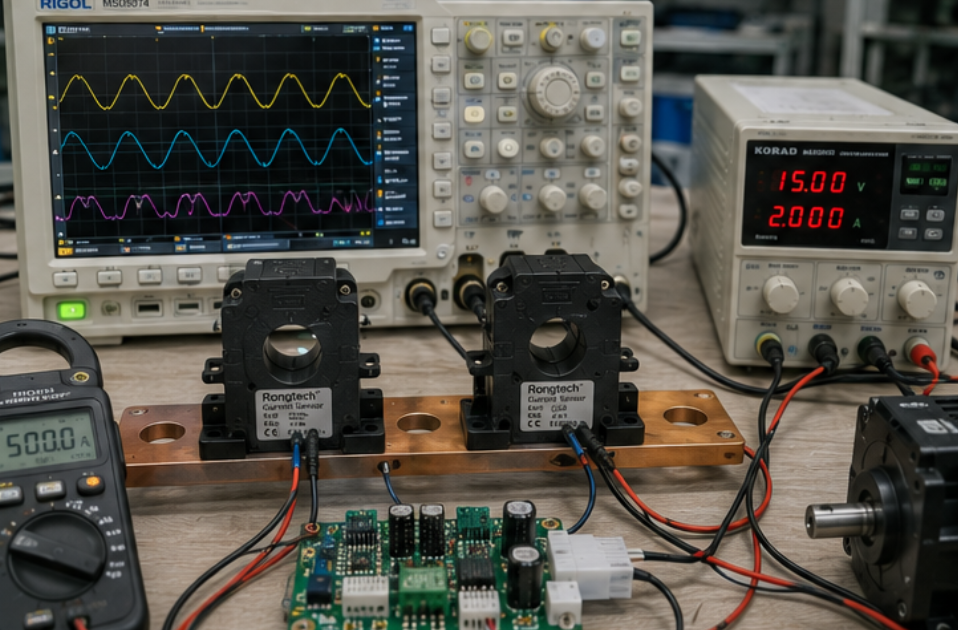
| Output Type | Typical Use | Selection Notes |
|---|---|---|
| 0-5V | Common ADC input for drive controller | Confirm scaling, zero point, and controller input range |
| 0-10V | Industrial controller or PLC input | Useful for industrial analog monitoring |
| ±4V / ±5V | Bidirectional current feedback | Confirm bipolar input and current direction logic |
| 4-20mA | Long-distance industrial signal transmission | Better for noise resistance over longer wiring distance |
| CAN / RS485 | Digital monitoring or smart drive system | Confirm protocol, baud rate, address, and data format |
| Custom Output | OEM motor drive projects | Provide controller input requirement before quotation |
Final Quote Checklist
Application: servo drive, VFD, inverter, traction drive, industrial motor controller, or custom motor drive.
Measurement position: phase current, DC bus current, input current, output current, or protection circuit.
Current type, rated current, peak current, overload current, and fault current.
Measurement purpose: feedback control, monitoring, protection, or fault diagnosis.
Accuracy, offset drift, response time, and bandwidth requirements.
Output signal and drive controller input requirement.
Supply voltage and wiring definition.
Isolation voltage, working voltage, creepage, and clearance requirement.
Aperture size, busbar size, cable diameter, mounting method, and cabinet space.
Sample quantity, annual demand, certification needs, and customization details.
Conclusion
For motor drive manufacturers, current sensors are important for current feedback, torque control, overcurrent protection, fault diagnosis, and system reliability. The right current sensor should match the real current waveform, rated current, peak current, response time, bandwidth, accuracy, output signal, supply voltage, isolation requirement, and installation structure.
For servo drives, VFD systems, industrial inverters, traction drives, welding power supplies, and high-power motor control systems, a complete parameter list helps suppliers recommend the correct current sensor faster and reduce sample testing risk. Buyers should focus on feedback quality, protection reliability, and output signal matching instead of comparing price alone.
FAQ
1. What current sensor is suitable for motor drive feedback?
For motor drive feedback, buyers should consider sensors with suitable accuracy, fast response, enough bandwidth, low drift, and output compatibility with the drive controller. Closed loop current sensors are often considered for higher performance applications.
2. Why is response time important in motor drive current sensors?
Response time affects how quickly the controller receives current changes. Slow response may affect current loop control, torque response, and overcurrent protection timing.
3. Should motor drives use open loop or closed loop current sensors?
Open loop sensors may be suitable for general monitoring and cost-sensitive designs. Closed loop sensors are better for high accuracy, low drift, fast response, and precise feedback control.
4. What output signal should I choose?
The output signal should match the drive controller or ADC input. Common options include 0-5V, 0-10V, ±4V, ±5V, 4-20mA, CAN, RS485, or customized output.
5. What information should I provide before requesting a quote?
Provide application, measurement position, current type, rated current, peak current, output signal, supply voltage, accuracy target, response time, bandwidth, isolation requirement, aperture size, sample quantity, and annual demand.
Request A Current Sensor Quote For Motor Drive Applications
If you need current sensors for servo drives, VFD systems, industrial inverters, traction drives, welding power supplies, or motor control systems, send us your current range, peak current, measurement position, response time, bandwidth, output signal, isolation requirement, aperture size, sample quantity, and annual demand. Our team can help you match a suitable current sensor solution.
Contact Us Get Quote