China Current Sensor Manufacturer For EV Charger, BESS And Inverter Projects
China Current Sensor Manufacturer For EV Charger, BESS And Inverter Projects
EV chargers, battery energy storage systems, solar inverters, PCS converters, UPS systems, motor drives, and industrial power electronics all require stable current measurement for control, protection, safety monitoring, and system diagnosis. For OEM buyers, choosing a China current sensor manufacturer can help improve cost control, customization flexibility, sample support, and long-term supply stability.
However, not every current sensor supplier is suitable for EV charger, BESS, and inverter projects. Buyers should confirm current range, output signal, isolation voltage, accuracy, response time, aperture size, customization capability, testing process, and batch consistency before ordering samples or starting mass production.
Quick Answer
When choosing a China current sensor manufacturer for EV charger, BESS, and inverter projects, buyers should check whether the supplier can support DC current measurement, bidirectional current sensing, high isolation voltage, 0-5V / 0-10V / 4-20mA / custom output, open loop and closed loop sensor options, custom aperture size, stable sample testing, technical documents, and batch production. The best supplier should help buyers reduce model selection risk, not only offer a low unit price.
1. Why EV Charger, BESS And Inverter Projects Need Reliable Current Sensors
In EV charger systems, current sensors are used for DC output current monitoring, charging current feedback, overcurrent protection, power module protection, and fault diagnosis. If the sensor output is unstable or mismatched with the controller, the charger may read wrong current data, trigger false protection, or fail during customer testing.
In BESS and battery cabinet projects, current sensors are usually used for bidirectional DC current measurement. The system needs to detect both charging and discharging current. Low offset drift, stable zero-current output, high isolation, and long-term reliability are important because the current data may affect SOC calculation, PCS control, and energy management.
In inverter and PCS projects, current sensors may be used for DC bus current monitoring, phase current feedback, converter protection, and fault shutdown. Response time, bandwidth, output stability, and EMC performance should be checked carefully because inverter systems often include fast switching devices, high dv/dt, high current cables, and compact cabinet layouts.
For these applications, a reliable China current sensor manufacturer should not only provide standard products, but also help buyers match the correct current range, output signal, aperture size, isolation voltage, and installation method according to real project conditions.
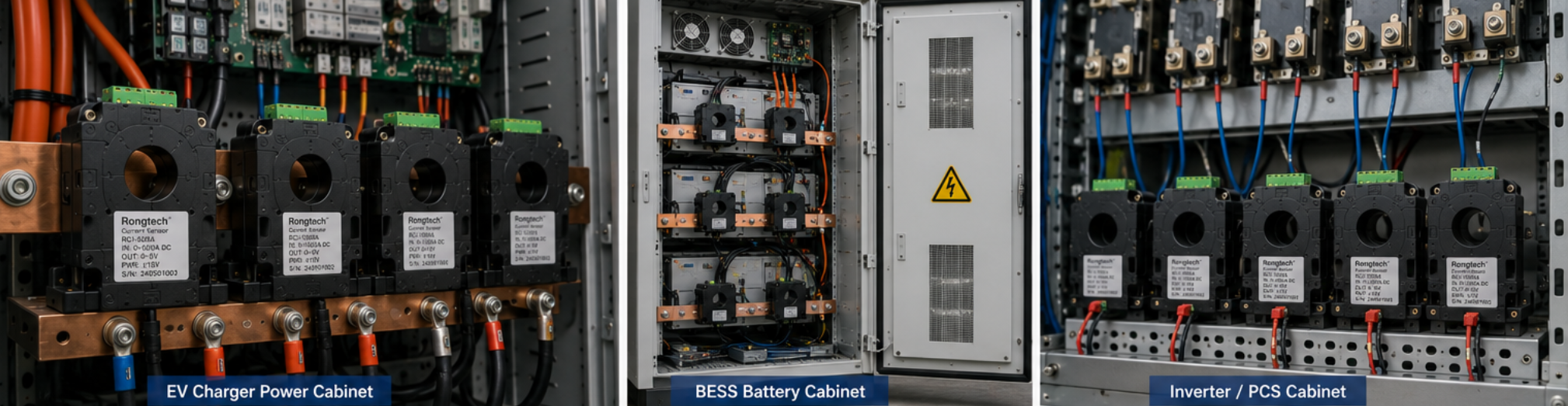
Typical Current Sensor Applications
EV charger DC output current monitoring.
EV charging module current feedback and protection.
BESS battery cabinet charge and discharge current measurement.
PCS converter current monitoring and protection.
Solar inverter DC bus and phase current measurement.
UPS system and industrial DC power supply current monitoring.
Motor drive phase current feedback and overcurrent protection.
2. What A China Current Sensor Manufacturer Should Support
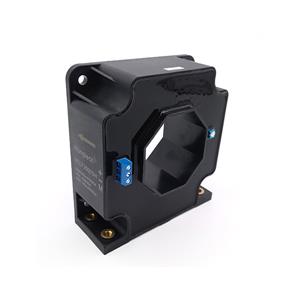
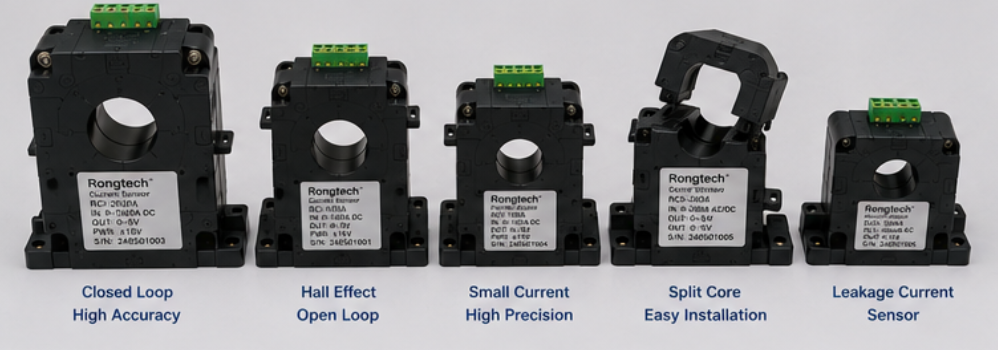
A suitable current sensor manufacturer should provide different sensor types for different power electronics needs. Open loop Hall effect current sensors are often used for cost-effective monitoring. Closed loop current sensors are better for higher accuracy and lower drift. Leakage current sensors are used for safety monitoring. Split core current sensors are useful for retrofit projects. Customized current sensors may be required for special apertures, output signals, connectors, or replacement models.
For OEM buyers, model coverage is important. EV charger, BESS, and inverter platforms may require 100A, 300A, 500A, 1000A, 2000A or customized current ranges. The supplier should be able to help buyers choose the correct range based on rated current, peak current, overload current, and measurement purpose.
Output signal options are also important. Many projects require 0-5V output for ADC or control boards, 0-10V output for industrial controllers, 4-20mA output for longer-distance signal transmission, or custom output for OEM controllers. If the output signal does not match the controller, buyers may need extra conversion circuits or software changes.
| Supplier Capability | Why It Matters | Buyer Should Confirm |
|---|---|---|
| Current Range Coverage | Different platforms need different ratings | 100A, 300A, 500A, 1000A, 2000A or custom range |
| Sensor Type Options | Different applications need different sensing technology | Open loop, closed loop, leakage, split core, custom current sensor |
| Output Signal Options | Sensor must match controller input | 0-5V, 0-10V, ± output, 4-20mA, CAN, RS485, custom output |
| Isolation Performance | Protects low-voltage control circuits | Working voltage, isolation voltage, creepage and clearance |
| Aperture Customization | Busbar and cable sizes vary by project | Round aperture, rectangular window, split core or custom aperture |
| Technical Support | Reduces wrong model selection risk | Datasheet, wiring diagram, drawing, sample testing support |
3. Key Parameters Buyers Should Confirm Before Ordering
Before ordering current sensor samples, buyers should prepare a complete parameter list. The most important information includes application, current type, rated current, peak current, output signal, supply voltage, isolation requirement, accuracy target, response time, aperture size, busbar or cable dimensions, operating temperature, sample quantity and annual demand.
For EV charger projects, buyers should confirm whether the sensor is used for DC output current, DC bus current, leakage current, charging current feedback, or protection. For BESS projects, buyers should confirm bidirectional DC measurement, zero-current output, low drift and battery cabinet installation. For inverter projects, buyers should confirm phase current, DC bus current, response time, bandwidth and EMC conditions.
Mechanical details are also necessary. A current sensor may have the correct electrical specifications but fail installation because the aperture is too small, the mounting holes do not match, the terminal direction is wrong, or the cabinet space is limited. Photos, drawings and busbar dimensions help the manufacturer recommend a more practical model.
| Project Type | Main Current Sensor Function | Selection Focus |
|---|---|---|
| EV Charger | DC output current feedback and protection | Fast response, isolation, output signal, aperture size |
| BESS / Battery Cabinet | Charge and discharge current measurement | Bidirectional DC, low drift, zero point stability, isolation |
| Solar Inverter | DC bus or phase current monitoring | Accuracy, response time, EMC performance, output matching |
| PCS Converter | Converter current feedback and protection | High isolation, stable output, bidirectional measurement |
| Motor Drive | Phase current feedback and overcurrent protection | Bandwidth, response time, peak current, controller input |
4. Why Customization And Batch Consistency Matter For OEM Buyers
OEM buyers often need more than a standard catalog model. A project may require a special aperture size, custom output signal, different connector direction, longer cable, special label, modified mounting holes, or replacement compatibility with an existing model. A China current sensor manufacturer with customization capability can help reduce redesign work and improve installation fit.
Batch consistency is equally important. A sample that works during testing is not enough if later batches have unstable output, different calibration, inconsistent dimensions, or delayed delivery. Buyers should ask about testing process, output inspection, insulation testing, dimensional inspection, and final quality control before mass production.
For replacement projects, buyers should provide the original model number, datasheet, photos, wiring definition, output signal, power supply, aperture size and installation dimensions. The manufacturer can then evaluate whether the replacement can be direct, similar, or customized.
Example OEM Quote Request:
Application: EV charging module and BESS cabinet
Measured current: Bidirectional DC current
Current range: 500A rated, 800A peak
Output signal: 0-5V or custom output
Supply voltage: +15V
Isolation requirement: 4kV or higher
Installation: Copper busbar 40 × 6 mm
Customization: Aperture size, connector direction and label
Quantity: 30 samples first, estimated annual demand 5000 pieces
Final Supplier Selection Checklist
Confirm whether the manufacturer understands EV charger, BESS and inverter applications.
Check current range coverage from small current to high current models.
Confirm open loop, closed loop, leakage, split core and custom current sensor options.
Match output signal with controller, ADC, PLC, BMS, PCS or inverter control board.
Confirm isolation voltage, working voltage, creepage and clearance.
Provide aperture size, busbar dimensions, cable diameter and installation space.
Check accuracy, drift, response time, bandwidth and EMC performance.
Ask for datasheet, wiring diagram, mechanical drawing and test support.
Confirm customization capability for aperture, connector, output, cable and label.
Confirm sample lead time, batch consistency, annual demand and delivery plan.
Conclusion
Choosing a China current sensor manufacturer for EV charger, BESS and inverter projects requires a full review of technical capability, product range, output signal options, isolation performance, customization support, testing process, batch consistency and long-term supply stability.
For OEM buyers, the right supplier should help match the current sensor with the real system, including current range, peak current, output signal, controller input, aperture size, busbar or cable layout, isolation voltage and operating conditions. A complete parameter list helps reduce sample testing risk and makes quotation faster and more accurate.
FAQ
1. Why choose a China current sensor manufacturer?
A China current sensor manufacturer may offer flexible customization, sample support, competitive cost, OEM cooperation, and stable supply for EV chargers, BESS, inverters and industrial power electronics projects.
2. What current sensor is suitable for EV charger projects?
EV charger projects usually need current sensors with suitable DC measurement range, fast response, high isolation, stable output and controller-compatible signal such as 0-5V, 0-10V, 4-20mA or custom output.
3. What current sensor is suitable for BESS projects?
BESS projects usually require bidirectional DC current measurement, low offset drift, stable zero-current output, high isolation, and an aperture size suitable for battery cabinet busbars or cables.
4. Can a current sensor manufacturer provide custom models?
Yes. Customization may include current range, output signal, aperture size, connector direction, cable length, mounting holes, label, packaging and replacement compatibility.
5. What information should buyers provide before requesting a quote?
Buyers should provide application, current type, rated current, peak current, output signal, supply voltage, isolation requirement, aperture size, busbar or cable dimensions, sample quantity, annual demand and customization needs.
Request Current Sensor Manufacturer Support For Your Project
If you need current sensors for EV chargers, BESS, inverters, PCS converters, UPS systems, motor drives or industrial power electronics, send us your current range, peak current, output signal, isolation requirement, aperture size, busbar or cable dimensions, sample quantity and annual demand. Our team can help you match a suitable current sensor solution for OEM production.
Contact Us Get Quote