What Engineers Should Check Before Ordering A Closed Loop Current Sensor
What Engineers Should Check Before Ordering A Closed Loop Current Sensor
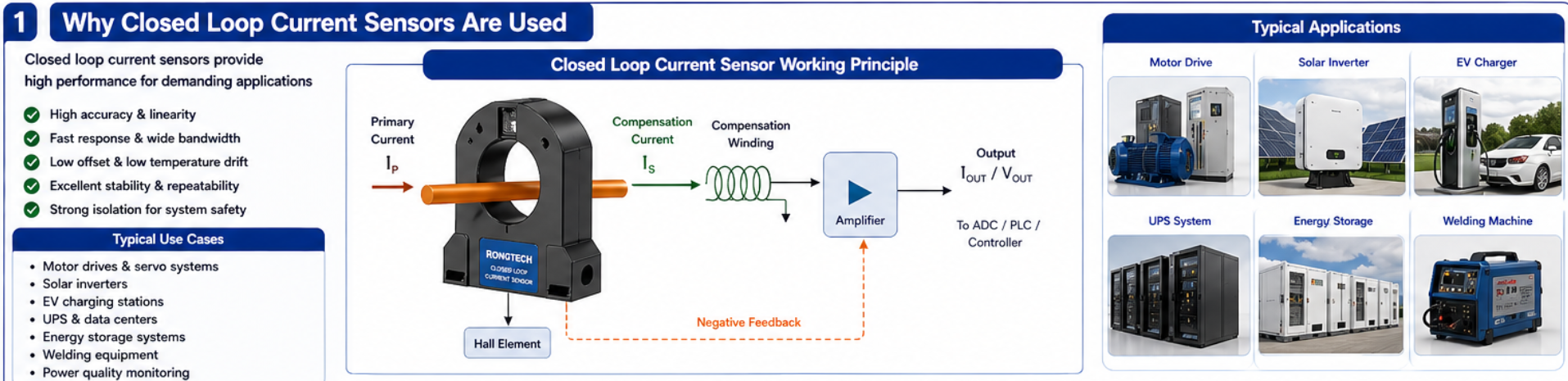
Closed loop current sensors are widely used in industrial power electronics because they provide high accuracy, fast response, good linearity, low temperature drift, and stable current feedback. They are commonly applied in motor drives, servo systems, solar inverters, EV charging stations, UPS systems, energy storage systems, welding equipment, and precision power measurement applications.
Before ordering a closed loop current sensor, engineers should not only check the rated current. They also need to confirm accuracy, response time, bandwidth, isolation voltage, output signal, power supply, aperture size, mounting method, thermal environment, and system compatibility. This guide explains what should be checked before placing an order and how to avoid common selection mistakes.
Quick Answer
Before ordering a closed loop current sensor, engineers should check the measured current type, rated current, peak current, accuracy requirement, linearity, response time, bandwidth, isolation voltage, output signal, supply voltage, aperture size, mounting structure, operating temperature, and application environment. Closed loop sensors are best suited for applications that require high-precision current feedback, fast dynamic response, and stable long-term measurement performance. The final model should match both the electrical specifications and the actual installation conditions.
1. Confirm The Real Measurement Requirement First
The first step before ordering a closed loop current sensor is to define the real measurement requirement. Many selection problems happen because buyers only provide the rated current value but do not explain the current waveform, application position, control purpose, or operating environment. A closed loop current sensor may be technically advanced, but it still needs to match the system design.
Engineers should first confirm whether the sensor will measure AC current, DC current, pulse current, or bidirectional current. In motor drives and servo systems, the current waveform may change quickly and require fast response. In EV chargers and energy storage systems, DC measurement stability and low drift may be more important. In solar inverters and UPS systems, the sensor may need to handle both steady current and transient current changes.
The measurement purpose should also be clear. If the sensor is only used for rough monitoring, a closed loop design may not always be necessary. If the current signal is used for control feedback, torque control, inverter regulation, protection logic, power conversion, or precision measurement, closed loop technology can provide stronger value. This is because closed loop sensors usually offer better accuracy, lower offset, faster response, and improved linearity compared with standard open loop designs.
The rated current and peak current should be checked together. A sensor selected too close to the normal operating current may saturate during startup, overload, or transient conditions. A sensor with too large a range may reduce useful measurement resolution at low current levels. The best choice should cover normal operation, peak current, and overload margin while still delivering accurate feedback under daily working conditions.
Key Questions Engineers Should Answer
Is the measured current AC, DC, pulse, or bidirectional?
What are the rated current, peak current, and overload current?
Is the signal used for monitoring, feedback control, protection, or precision measurement?
What accuracy and linearity level does the system require?
How fast does the sensor need to respond to current changes?
What isolation voltage is required for the equipment?
What output signal and supply voltage does the controller support?
2. Check The Core Electrical And Performance Parameters
Closed loop current sensors are usually selected for higher-performance systems, so the core specifications must be reviewed carefully. These include current range, accuracy, linearity, offset, bandwidth, response time, isolation voltage, output signal, power supply, and temperature drift. Each parameter affects the final system performance in a different way.
Accuracy and linearity are among the most important parameters. A closed loop current sensor is often used when the current signal directly affects system control quality. If accuracy is not sufficient, motor torque control, inverter regulation, charging current control, or protection logic may be affected. Linearity is also important because the sensor output should remain proportional to the actual current across the measurement range.
Response time and bandwidth are critical for dynamic applications. In motor drives, servo systems, welding equipment, inverters, and fast protection circuits, the sensor output must follow current changes quickly. A slow sensor may delay feedback and reduce system control performance. For simple monitoring, moderate bandwidth may be acceptable. For dynamic control or fault protection, faster response is usually required.
Isolation voltage must match the safety design of the system. Closed loop current sensors are often used in high-power circuits where the primary conductor carries dangerous current or voltage. Proper galvanic isolation helps protect the low-voltage control board, PLC, MCU, ADC, and communication circuits. Engineers should review both isolation voltage and working voltage, especially in high-voltage inverter, EV charging, railway, UPS, and energy storage applications.
Output signal and power supply should be confirmed before ordering. Some sensors provide voltage output, some provide current output, and others may support customized signal formats. The output must match the controller input. The sensor supply voltage should also match the available power rail in the system. If these details are ignored, the selected sensor may require additional signal conditioning or redesign work.
| Check Item | Why It Matters | Engineering Checkpoint |
|---|---|---|
| Current Range | Determines whether the sensor can measure normal and peak current | Confirm rated current, peak current, and overload margin |
| Accuracy | Affects control feedback, measurement quality, and system stability | Match accuracy with control or monitoring purpose |
| Linearity | Ensures output remains proportional to actual current | Important for precision feedback and wide-range measurement |
| Response Time | Affects how quickly the system reacts to current changes | Use faster response for motor drives, inverters, and protection |
| Bandwidth | Determines the frequency range the sensor can follow accurately | Match bandwidth with current waveform and controller speed |
| Isolation Voltage | Protects low-voltage circuits from high-current primary circuits | Confirm isolation level, working voltage, and safety margin |
| Output Signal | Determines compatibility with controller, ADC, PLC, or monitoring system | Confirm voltage output, current output, or custom signal requirement |
| Power Supply | Ensures the sensor can work with the system power design | Check supply voltage, tolerance, and power consumption |

Why Closed Loop Sensors Are Used In Demanding Systems
Closed loop current sensors use a compensation feedback structure to improve measurement performance. This design helps reduce magnetic error, improve linearity, increase response speed, and maintain more stable output. For demanding power electronics, this can improve control accuracy, system protection, and long-term measurement reliability.
3. Review Mechanical Fit, Environment, And Supplier Support
Electrical parameters are not enough. Engineers should also check whether the closed loop current sensor can physically fit inside the equipment. Aperture size, conductor shape, busbar dimensions, cable diameter, mounting holes, terminal type, installation direction, and available cabinet space all affect whether the sensor can be installed correctly.
Aperture size should be selected according to the actual conductor. If the opening is too small, the cable or busbar cannot pass through. If the aperture is much larger than necessary, installation may become less compact and measurement performance may be affected by conductor position. Engineers should provide conductor dimensions and mechanical drawings if possible.
Operating environment should also be reviewed. Closed loop current sensors used in inverters, drives, EV chargers, and UPS cabinets may face high temperature, switching noise, vibration, dust, humidity, and long operating hours. A sensor with good temperature stability, insulation performance, and anti-interference ability can improve long-term reliability.
Supplier support is especially important when the project involves model replacement, new equipment development, or system integration. A professional supplier should help confirm current range, output signal, installation structure, and application matching. For OEM projects, customized output, aperture, mounting, or cable connection may also be required.

Application Matching Reference
| Application | Main Requirement | Closed Loop Sensor Selection Focus |
|---|---|---|
| Motor Drives And Servo Systems | Fast feedback, torque control, speed stability | Fast response, high bandwidth, good linearity |
| Solar Inverters | DC/AC current measurement, inverter control, protection | Low drift, stable output, strong isolation |
| EV Charging Stations | Charging current feedback, safety, high-power control | Accuracy, isolation voltage, response speed |
| UPS And Energy Storage | Battery current, DC bus monitoring, charge/discharge control | DC stability, low offset, long-term reliability |
| Welding Equipment | High current, rapid current variation, harsh environment | Overload capability, fast response, robust insulation |
Common Selection Mistakes To Avoid
Choosing only by rated current and ignoring peak current or overload conditions
Not confirming whether the sensor measures AC, DC, pulse, or bidirectional current
Ignoring response time and bandwidth in dynamic control applications
Selecting an output signal that does not match the controller input
Ignoring aperture size, busbar shape, or cable diameter
Not checking isolation voltage and working voltage separately
Overlooking temperature drift, EMI, vibration, and long-term stability requirements
Conclusion
Before ordering a closed loop current sensor, engineers should review both performance specifications and real installation conditions. Important factors include current type, rated and peak current, accuracy, linearity, response time, bandwidth, isolation voltage, output signal, supply voltage, aperture size, mounting method, operating temperature, and electromagnetic environment.
Closed loop current sensors are especially valuable in applications where current feedback directly affects system control, protection, and measurement quality. A properly selected sensor can improve power electronics performance, reduce measurement errors, support fast protection, and improve long-term system reliability in motor drives, EV chargers, solar inverters, UPS systems, energy storage equipment, and industrial automation systems.
FAQ
1. What is a closed loop current sensor?
A closed loop current sensor uses a compensation feedback structure to measure current with higher accuracy, faster response, better linearity, and lower drift compared with many open loop designs.
2. When should engineers choose a closed loop current sensor?
Closed loop sensors are suitable when the application requires precise current feedback, fast response, stable control, low temperature drift, and reliable measurement in demanding power electronics systems.
3. Is a closed loop sensor always better than an open loop sensor?
Not always. Closed loop sensors usually provide better performance, but they may cost more. For simple monitoring or cost-sensitive projects, an open loop sensor may be sufficient.
4. Why are response time and bandwidth important?
They determine how quickly and accurately the sensor follows current changes. Fast response and suitable bandwidth are important for motor drives, inverters, welding equipment, and protection circuits.
5. What information should I provide before requesting a quote?
You should provide the application, current type, rated current, peak current, accuracy target, response requirement, output signal, power supply, isolation voltage, aperture size, mounting method, and operating environment.
Contact Us For Closed Loop Current Sensor Selection Support
If you are ordering closed loop current sensors for motor drives, solar inverters, EV chargers, UPS systems, welding equipment, energy storage systems, or industrial power electronics, send us your current range, accuracy target, output signal, isolation requirement, aperture size, and application details. Our team can help you match a suitable sensor solution.
Contact Us Get Quote