How To Choose A Split Core Current Sensor For Retrofit Projects
How To Choose A Split Core Current Sensor For Retrofit Projects
Split core current sensors are widely used in retrofit projects because they can be installed around existing cables or busbars without disconnecting the primary conductor. This makes them especially useful for energy monitoring upgrades, industrial control cabinet renovation, building power management, EV charging system upgrades, solar inverter monitoring, UPS maintenance, and electrical safety improvement projects.
This guide explains how to choose a split core current sensor for retrofit applications, what technical parameters should be checked before ordering, and how to avoid common selection mistakes related to current range, aperture size, accuracy, output signal, installation space, and long-term measurement stability.
Quick Answer
To choose a split core current sensor for retrofit projects, first confirm the measured current type, rated current, peak current, conductor diameter, aperture size, installation space, output signal, accuracy requirement, and operating environment. Split core sensors are ideal when the existing cable or busbar cannot be disconnected. For general monitoring, standard split core current sensors are usually sufficient. For control feedback, energy management, or safety monitoring, buyers should pay closer attention to accuracy, linearity, temperature drift, and signal compatibility.
1. Why Split Core Current Sensors Are Suitable For Retrofit Projects
In many retrofit projects, the electrical system is already installed and operating. Disconnecting cables, removing busbars, or redesigning the cabinet structure can be expensive, time-consuming, and risky. A split core current sensor solves this problem by using an openable core structure. The sensor can be opened, placed around the existing conductor, and closed again without cutting or disconnecting the circuit.
This feature makes split core current sensors very practical for power monitoring upgrades, energy management systems, building automation, industrial equipment renovation, charging station upgrades, solar power monitoring, UPS load monitoring, and factory electrical safety projects. They are also useful when installation downtime must be minimized.
However, split core current sensors should not be selected only because they are easy to install. The sensor still needs to match the actual current range, cable size, output signal, accuracy target, and application environment. If the aperture is too small, installation may be impossible. If the current range is too high, low-current measurement resolution may be poor. If the sensor output is not compatible with the controller, additional signal conversion may be required.
For retrofit applications, the best selection approach is to start from the real site conditions. Buyers should check the conductor size, cabinet space, installation position, wiring direction, existing control system, and whether the measurement is used only for monitoring or also for protection and control feedback.
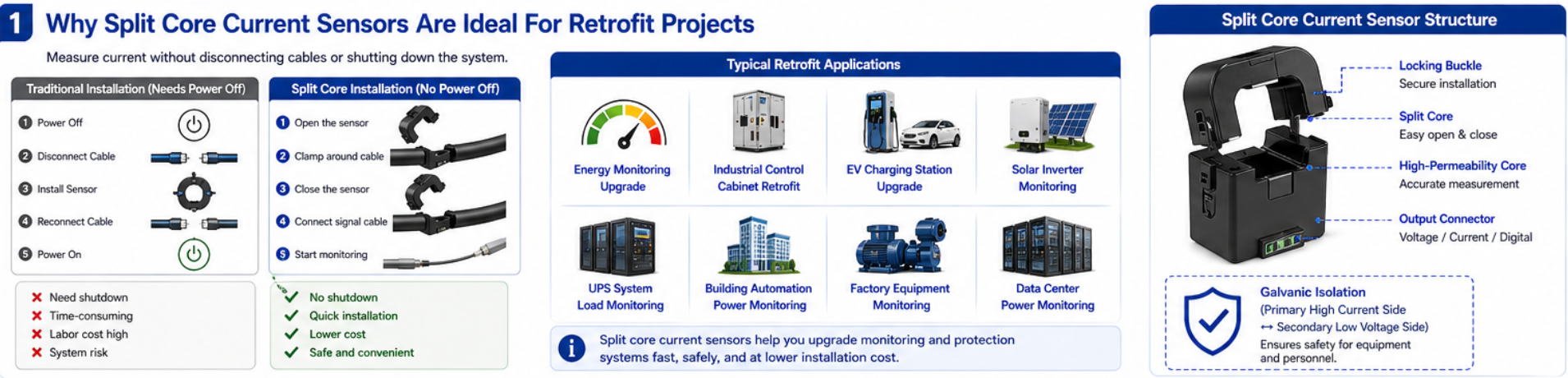
Key Questions Before Selection
Is the project a new installation or a retrofit upgrade?
Can the existing cable or busbar be disconnected, or must the sensor clamp around it?
What are the rated current, peak current, and normal operating current?
What is the cable diameter or busbar size?
How much installation space is available inside the cabinet?
What output signal does the monitoring system or controller require?
Is the sensor used for energy monitoring, load monitoring, protection, or control feedback?
2. Check The Core Parameters Before Ordering
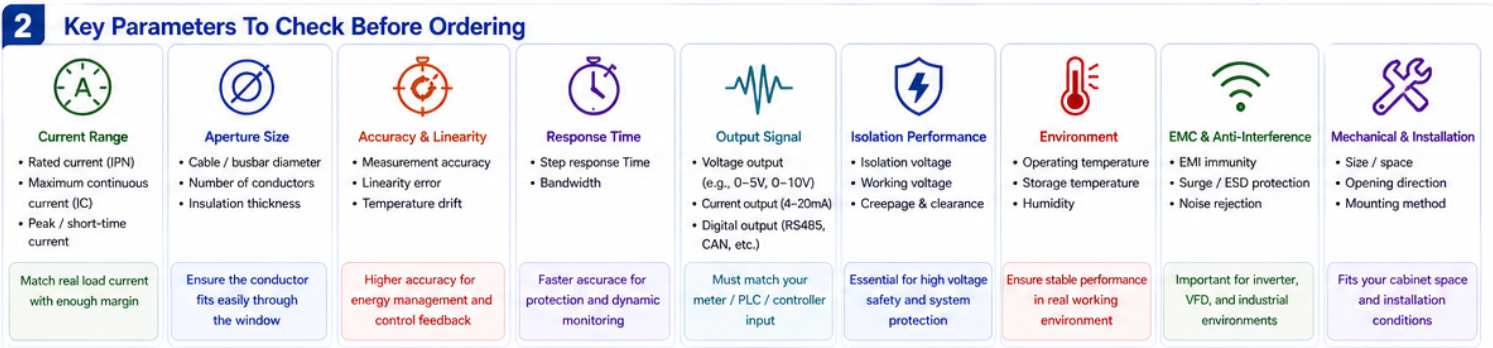
Split core current sensor selection should begin with current range and conductor size. The selected sensor must cover the normal operating current and allow enough margin for temporary overload or startup current. At the same time, the range should not be much higher than the actual current, because this may reduce measurement resolution at lower load levels.
Aperture size is one of the most important parameters in retrofit projects. The sensor window must be large enough for the existing cable or busbar to pass through easily. Buyers should measure the real cable diameter, insulation thickness, cable bending condition, and available installation space. If multiple conductors need to pass through the sensor, the aperture must be selected accordingly.
Accuracy should be selected according to the purpose of measurement. For basic load monitoring, standard accuracy may be enough. For energy management, equipment performance tracking, or current feedback, better accuracy and lower drift are more important. In retrofit projects, installation conditions may be less ideal than new designs, so stable output and good anti-interference performance should also be considered.
Output signal compatibility is another common issue. Split core current sensors may provide voltage output, current output, or other conditioned signals depending on the model. The output must match the input requirement of the PLC, meter, data acquisition device, energy management system, or monitoring controller. If the signal type is wrong, the sensor may not work correctly even if the current range is suitable.
For industrial retrofit sites, environmental factors should also be reviewed. These may include cabinet temperature, humidity, dust, vibration, electromagnetic interference, nearby power cables, and installation direction. A reliable split core current sensor should maintain stable measurement performance under the actual working environment.
| Selection Parameter | Why It Matters In Retrofit Projects | Recommended Checkpoint |
|---|---|---|
| Current Range | Determines whether the sensor can measure normal and peak current safely | Confirm rated current, peak current, and daily operating current |
| Aperture Size | Affects whether the sensor can clamp around the existing cable or busbar | Measure cable diameter, busbar size, and insulation thickness |
| Installation Space | Retrofit cabinets may have limited space for new components | Check sensor body size, opening direction, and cable bending space |
| Accuracy | Affects energy monitoring, load analysis, and system feedback quality | Choose accuracy according to monitoring or control purpose |
| Output Signal | Determines compatibility with meters, PLCs, controllers, or monitoring platforms | Confirm voltage output, current output, or custom signal requirement |
| Response Time | Affects dynamic load monitoring and protection response | Use faster response for protection or control feedback applications |
| Anti-Interference | Industrial cabinets may contain switching devices and strong EMI | Review cable routing, shielding, grounding, and signal stability |
| Mechanical Reliability | Split core structure must close firmly after installation | Check locking structure, core alignment, and installation convenience |
Split Core vs Solid Core Current Sensor
Solid core current sensors are often used in new equipment designs where the conductor can pass through the sensor during assembly. Split core current sensors are better for retrofit projects because they can be installed without disconnecting the conductor. Solid core designs may offer stronger structural stability in some applications, but split core designs provide much better installation flexibility for existing systems.
3. Match Split Core Sensors With Retrofit Applications
Split core current sensors are commonly used in building energy monitoring, factory electrical upgrades, power distribution cabinet monitoring, EV charging retrofit projects, solar power system monitoring, UPS load monitoring, and industrial automation renovation. In these applications, fast installation and minimal downtime are important advantages.
For building energy management systems, split core current sensors are often installed around existing branch circuit cables to monitor power consumption. The main selection points are current range, aperture size, output compatibility, and installation convenience. Accuracy should match the monitoring purpose, especially if the data will be used for energy analysis or cost allocation.
For industrial control cabinet upgrades, split core sensors may be used to monitor motor load, pump current, fan current, inverter output, or production equipment power consumption. These environments may include electrical noise and limited installation space, so anti-interference ability and mechanical structure should be checked carefully.
For EV charging and solar retrofit projects, split core current sensors may support load monitoring, system diagnostics, and safety-related current measurement. In these applications, buyers should confirm whether the sensor needs to measure AC, DC, or AC/DC current. If leakage current detection is required, a dedicated leakage current sensor should be selected instead of a general split core load current sensor.
For UPS and data center upgrades, split core sensors are useful for monitoring existing load circuits without interrupting power supply. The selected sensor should provide stable output, suitable accuracy, and reliable signal transmission to the monitoring system. Since downtime is costly in these environments, installation convenience and output compatibility are very important.
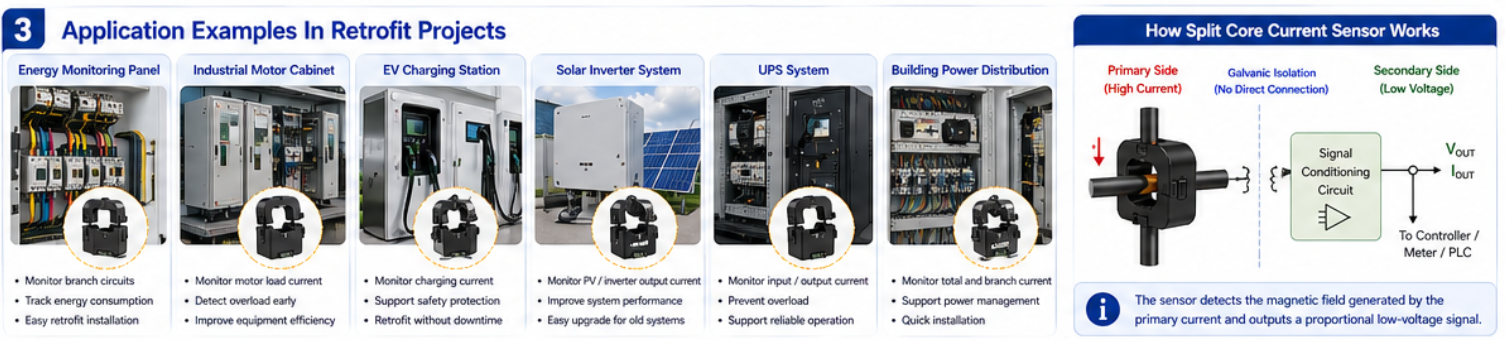
Typical Application Matching Reference
| Retrofit Application | Main Requirement | Sensor Selection Direction |
|---|---|---|
| Building Energy Monitoring | Fast installation, branch circuit monitoring, data collection | Compact split core current sensor with suitable output signal |
| Industrial Control Cabinet Upgrade | Motor load monitoring, limited space, EMI environment | Split core sensor with good anti-interference performance |
| EV Charging Retrofit | Charging current monitoring and system upgrade | AC/DC-compatible current sensor if required by the system |
| Solar Inverter Monitoring Upgrade | PV current, inverter output, power system diagnostics | Sensor matched to DC or AC measurement point |
| UPS And Data Center Monitoring | Non-stop installation and reliable load monitoring | Stable split core sensor with monitoring system compatibility |
Common Selection Mistakes To Avoid
Choosing the sensor only by current range and ignoring cable or busbar size
Selecting an aperture that is too small for the actual installation site
Using a split core load current sensor where leakage current detection is required
Ignoring output signal compatibility with the meter, PLC, or monitoring platform
Choosing a current range that is too high and losing low-current resolution
Not checking cabinet space, cable bending direction, or sensor opening direction
Ignoring EMI, temperature, and mechanical locking reliability in industrial environments
Conclusion
Choosing a split core current sensor for retrofit projects requires a careful review of both electrical and mechanical conditions. Buyers should confirm the measured current type, current range, aperture size, conductor dimensions, output signal, accuracy requirement, installation space, and operating environment before ordering.
For existing electrical systems where cables or busbars cannot be disconnected, split core current sensors provide a practical and efficient solution. A properly selected sensor can reduce installation time, minimize downtime, improve monitoring quality, and support safer, smarter electrical system upgrades in buildings, factories, EV charging stations, solar power systems, UPS cabinets, and industrial equipment.
FAQ
1. What is a split core current sensor?
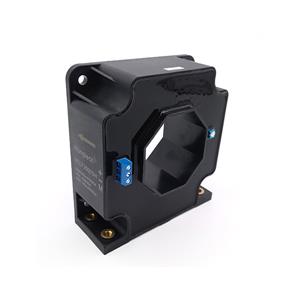
A split core current sensor has an openable magnetic core that can clamp around an existing cable or busbar. It allows current measurement without disconnecting the primary conductor.
2. Why are split core current sensors useful for retrofit projects?
They are useful because they can be installed quickly on existing systems, reduce installation downtime, and avoid rewiring or disconnecting power cables.
3. How do I choose the right aperture size?
Measure the actual cable diameter, insulation thickness, busbar size, and available cabinet space. The aperture must be large enough for the conductor to pass through without forcing the sensor.
4. Can a split core current sensor be used for leakage current detection?
Only if it is specifically designed for leakage or residual current detection. A standard split core load current sensor should not be used as a replacement for a dedicated leakage current sensor.
5. What information should I provide when requesting a quote?
You should provide the application, current type, rated current, peak current, cable diameter, busbar size, aperture requirement, output signal, accuracy target, installation space, and operating environment.
Current Sensor Selection Support
If you are selecting split core current sensors for retrofit projects, control cabinet upgrades, building energy monitoring, EV charging systems, solar inverters, UPS systems, or industrial equipment monitoring, send us your current range, conductor size, aperture requirement, output signal, and installation details. Our team can help you match a suitable sensor solution.
Contact Us Get Quote