What Accuracy Class Matters Most In Current Sensor Selection
What Accuracy Class Matters Most In Current Sensor Selection
Accuracy is one of the most important factors when choosing a current sensor, but it is also one of the most easily misunderstood. Many engineers and purchasing teams focus only on the nominal accuracy value in the datasheet, while ignoring rated current, full-scale error, temperature drift, offset, linearity, response time, and the real purpose of the measurement inside the equipment.
This guide explains what accuracy class means in current sensor selection, which accuracy level matters most for different industrial applications, and how to choose a practical current sensor for motor drives, EV charging stations, solar inverters, UPS systems, energy storage, welding equipment, and power electronics control systems.
Quick Answer
The most important accuracy class depends on how the current signal is used. For general monitoring and protection, standard accuracy may be enough. For power control, motor drives, solar inverters, EV charging, and energy storage, higher accuracy and lower temperature drift are more important. For billing, metering, laboratory testing, or precision control, the selected current sensor should provide tighter accuracy, better linearity, and stable performance across the full operating range. In practical selection, accuracy should be evaluated together with offset, linearity, temperature drift, bandwidth, and overload capability.
1. Understand What Accuracy Really Means In Current Sensors
When selecting a current sensor, accuracy is often described as a percentage of the rated current or full-scale current. For example, a current sensor may be specified with an accuracy of ±1%, ±0.5%, or ±0.2% under certain test conditions. However, this number alone does not tell the full story. A sensor that looks accurate in a datasheet may perform differently when installed in a real industrial cabinet, exposed to temperature changes, electrical noise, vibration, or high-current switching conditions.
Accuracy is usually affected by several factors. Offset error means the sensor may produce a small output even when the actual current is zero. Gain error means the output slope may differ from the ideal value. Linearity error means the sensor output may not follow the input current perfectly across the full measurement range. Temperature drift means the output may change when the ambient temperature changes. For industrial applications, these factors can be just as important as the headline accuracy class.
It is also important to understand whether the sensor is used near its rated range or far below it. If a 500A sensor is used to measure very small currents most of the time, the percentage error may become more noticeable in the actual measurement. This is why current range and accuracy should be selected together. A higher-rated sensor is not always better if the normal operating current is much lower than the sensor range.
For Hall effect current sensors, open loop and closed loop designs may also provide different accuracy behavior. Open loop sensors are practical and cost-effective for many industrial applications, while closed loop sensors usually provide better accuracy, lower drift, faster response, and stronger linearity. The right choice depends on whether the application needs standard monitoring or high-quality feedback control.
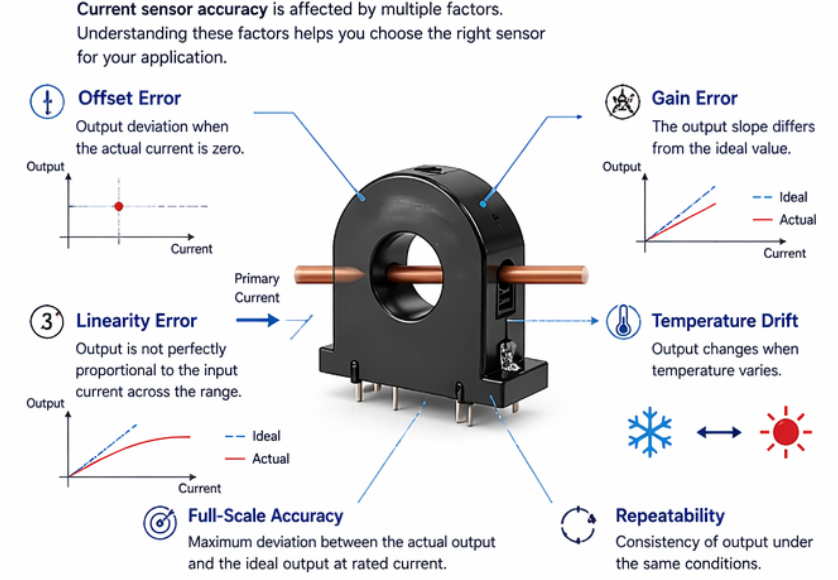
Accuracy Terms Buyers Should Know
Full-scale accuracy: error calculated against the rated current or full measurement range.
Linearity: how closely the sensor output follows the actual current change.
Offset: output deviation when the measured current is zero.
Temperature drift: output variation caused by temperature changes.
Repeatability: how consistently the sensor produces the same output under repeated conditions.
Dynamic accuracy: how accurately the sensor responds to fast current changes.
2. Match Accuracy Class With The Real Application
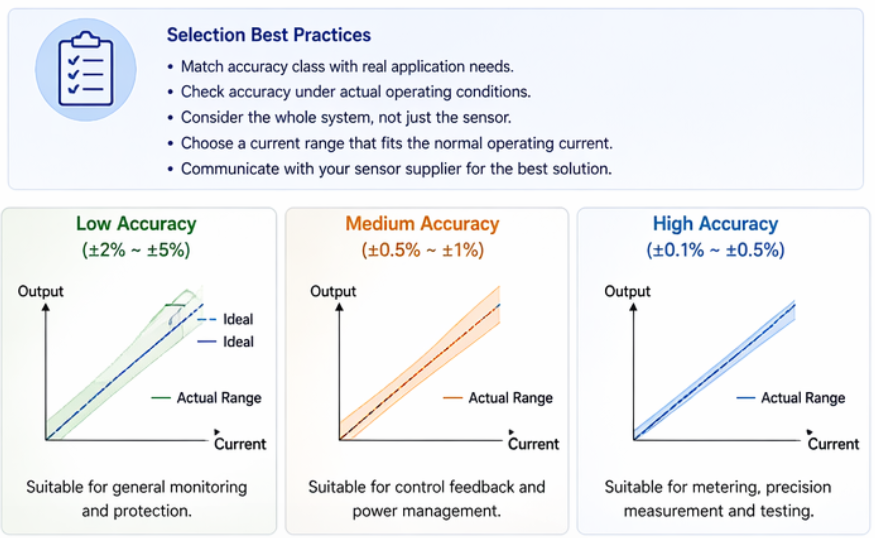
The best accuracy class is not always the highest one. A very high-accuracy current sensor may increase cost, require more careful installation, and be unnecessary for simple monitoring applications. On the other hand, using a low-accuracy sensor in a precision control or energy measurement system may cause poor feedback quality, unstable control, or unreliable data. The correct selection should match the accuracy level to the actual function of the sensor.
For basic equipment monitoring, such as checking whether current is present or whether a load is operating within a safe range, standard accuracy is often acceptable. In these cases, the sensor is mainly used for status monitoring, overload warning, or simple protection. The priority may be cost, compact size, isolation, and installation convenience rather than ultra-high precision.
For motor drives, servo systems, and inverter control, accuracy becomes more important because the current signal may be used as part of the feedback loop. Inaccurate feedback can affect torque control, speed stability, efficiency, and protection response. In these applications, linearity, response time, and temperature stability should be reviewed carefully, not just the basic accuracy value.
For EV charging stations, solar inverters, energy storage systems, and UPS equipment, accuracy affects charging control, power conversion stability, battery protection, and system monitoring. These applications often require stable DC or AC/DC current measurement under changing load and temperature conditions. If the system uses current measurement for control or safety decisions, a higher accuracy level and lower drift are usually preferred.
For metering, laboratory testing, precision power analysis, or high-end industrial equipment, accuracy requirements are more demanding. In these cases, buyers should pay attention to not only the stated accuracy class but also calibration conditions, temperature coefficient, response characteristics, and long-term stability. The sensor should support reliable measurement over the expected operating range, not only at one ideal test point.
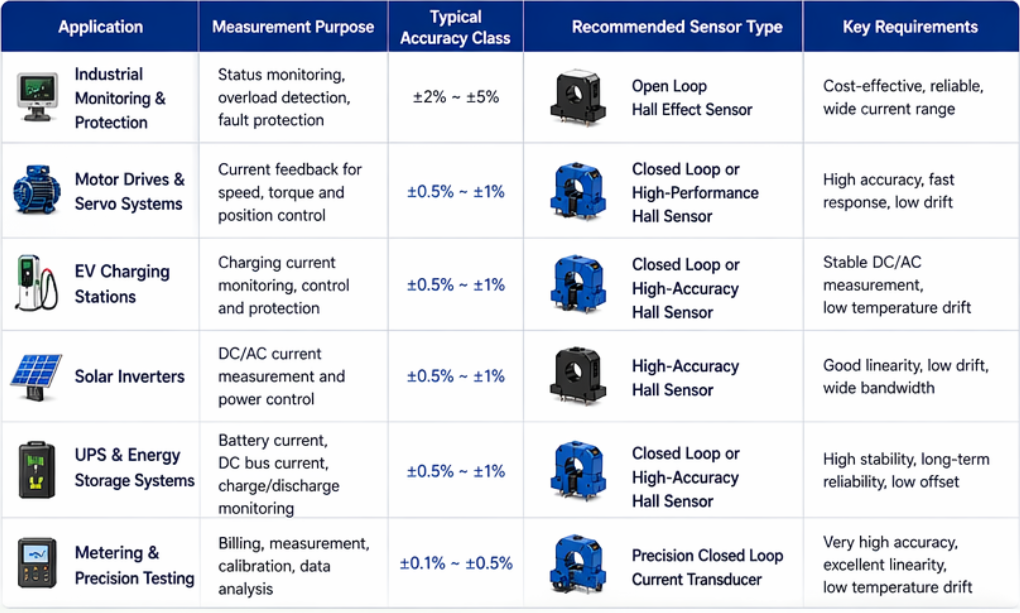
| Application Type | Main Measurement Purpose | Accuracy Priority | Selection Direction |
|---|---|---|---|
| Basic Industrial Monitoring | Load status, current presence, overload warning | Medium | Open loop current sensor with practical accuracy and good cost control |
| Motor Drives And Servo Systems | Current feedback for speed, torque, and protection control | High | Closed loop or high-performance Hall effect current sensor |
| EV Charging Stations | Charging current monitoring, control feedback, safety protection | Medium To High | Higher accuracy for DC fast charging and power modules |
| Solar Inverters | DC/AC current measurement and power conversion control | High | Stable current sensor with good linearity and low temperature drift |
| UPS And Energy Storage | Battery current, DC bus current, charge/discharge monitoring | High | Accurate AC/DC or DC current sensor with stable long-term output |
| Precision Testing And Metering | Measurement, validation, calibration, data analysis | Very High | High-accuracy closed loop or precision current transducer |
Simple Selection Rule
If the sensor is only used to detect whether current exists or whether a load is overloaded, standard accuracy is usually enough. If the current signal affects control performance, system efficiency, energy management, battery protection, or safety decisions, choose a higher accuracy class with lower drift and better linearity.
3. Avoid Common Mistakes When Comparing Accuracy Class
A common mistake is comparing two current sensors only by the accuracy number on the datasheet. For example, one sensor may claim higher accuracy under room temperature, but another sensor may deliver better stability across a wider temperature range. In real industrial environments, stable performance over time may be more valuable than a slightly better nominal accuracy value.
Another mistake is ignoring the operating current range. If the actual current is usually much lower than the rated current of the sensor, the practical measurement quality may not meet expectations. Buyers should select a current range that covers the normal and peak current while still keeping enough resolution for daily operating conditions. Choosing a sensor that is too large can reduce useful signal detail at low current levels.
Temperature conditions are also very important. EV chargers, solar inverters, industrial cabinets, welding systems, and outdoor power equipment may operate in changing or high-temperature environments. A sensor with low temperature drift can help maintain stable measurement performance. If the system depends on accurate current feedback, temperature drift should always be checked before confirming the model.
Response time and bandwidth should not be ignored either. A highly accurate sensor with slow response may not be suitable for fast switching systems or dynamic control applications. In motor drives, inverters, and protection circuits, the current signal must respond quickly enough to support real-time decisions. For these cases, closed loop current sensors are often preferred because they can provide stronger dynamic performance.
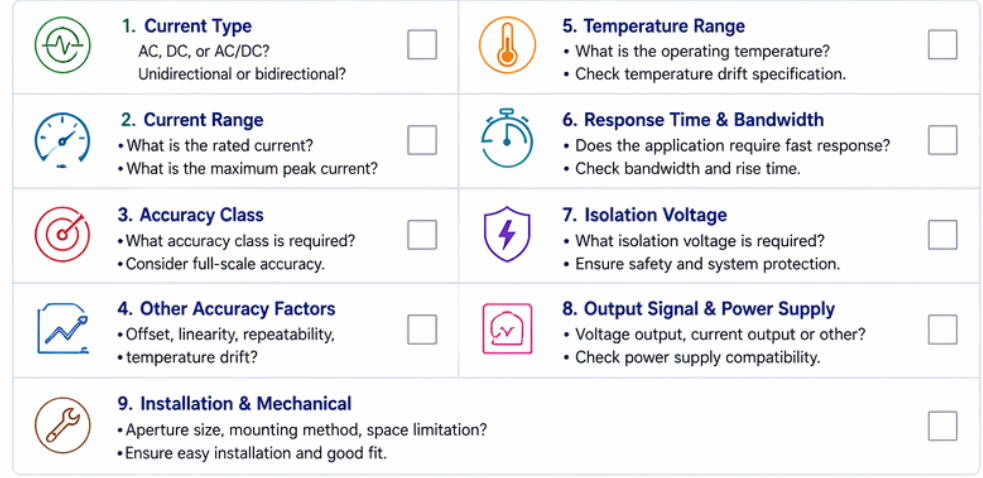
Finally, buyers should consider the complete system requirement instead of focusing on the sensor alone. The output signal, power supply, aperture size, installation method, isolation voltage, and control board compatibility all affect final measurement performance. A high-accuracy sensor installed incorrectly or matched with the wrong signal interface may still produce poor results.
Common Accuracy Selection Mistakes
Choosing the highest accuracy class without checking whether the application really needs it
Comparing only nominal accuracy and ignoring temperature drift or offset
Selecting a current range that is too large for the actual working current
Using a standard sensor for precision control or metering applications
Ignoring response time in fast-changing power electronics systems
Not confirming whether accuracy is stated as full-scale error or measured value error
Forgetting to check output signal compatibility with the controller or monitoring system
Conclusion
The most important accuracy class in current sensor selection depends on the real purpose of the measurement. For simple monitoring and overload detection, standard accuracy may be practical and cost-effective. For motor drives, EV charging stations, solar inverters, UPS systems, energy storage, and precision control, higher accuracy, lower offset, better linearity, and lower temperature drift become much more important.
A correct selection should balance accuracy, current range, response speed, isolation, installation structure, and long-term stability. Instead of choosing only by one datasheet number, buyers should evaluate how the current sensor will perform in the actual industrial environment. This approach helps improve measurement reliability, system safety, control quality, and total project value.
FAQ
1. Is a higher accuracy class always better?
Not always. A higher accuracy class can improve measurement quality, but it may also increase cost. The best choice depends on whether the application needs basic monitoring, feedback control, protection, metering, or precision testing.
2. What accuracy should I choose for motor drives?
Motor drives usually need stable and accurate current feedback. A higher-performance current sensor with good linearity, fast response, and low temperature drift is recommended, especially for servo drives and precision control systems.
3. Does temperature affect current sensor accuracy?
Yes. Temperature can affect offset, gain, and output stability. For outdoor equipment, enclosed cabinets, EV chargers, and inverters, temperature drift should be reviewed carefully before selection.
4. Why does current range affect practical accuracy?
If the sensor range is much higher than the normal operating current, the useful signal resolution may be reduced. The selected range should cover normal and peak current while still providing good measurement quality during daily operation.
5. What information should I provide when asking for sensor accuracy recommendations?
You should provide the application, rated current, peak current, accuracy target, current type, response requirement, operating temperature, output signal, installation method, and whether the signal is used for monitoring, control, protection, or metering.
Support
If you are selecting current sensors for industrial equipment, EV charging stations, solar inverters, motor drives, UPS systems, or energy storage applications, send us your current range, accuracy target, output signal, operating temperature, and application details. Our team can help you match a suitable current sensor solution.
Contact Us Get Quote