How To Select A Current Sensor For EV Charging Stations
How To Select A Current Sensor For EV Charging Stations
Current sensors play a critical role in EV charging stations because they help monitor charging current, support control feedback, improve electrical safety, and protect the charging system from abnormal current conditions. Whether the charger is designed for AC charging, DC fast charging, or high-power charging infrastructure, choosing the right current sensor directly affects measurement accuracy, system stability, and long-term reliability.
This guide explains how to select a current sensor for EV charging stations, what parameters should be checked before ordering, and how to match different current sensor types with real charging applications such as AC chargers, DC fast chargers, charging piles, charging modules, and power conversion units.
Quick Answer
To select a current sensor for EV charging stations, first confirm whether the system measures AC current, DC current, or both. Then check the rated current, peak current, isolation voltage, accuracy, response time, output signal, installation space, operating temperature, and safety requirements. Open loop Hall effect current sensors are suitable for many standard charging applications, while closed loop current sensors are better for higher accuracy, faster response, and more demanding DC fast charging systems.
1. Understand The Current Measurement Role In EV Charging Stations
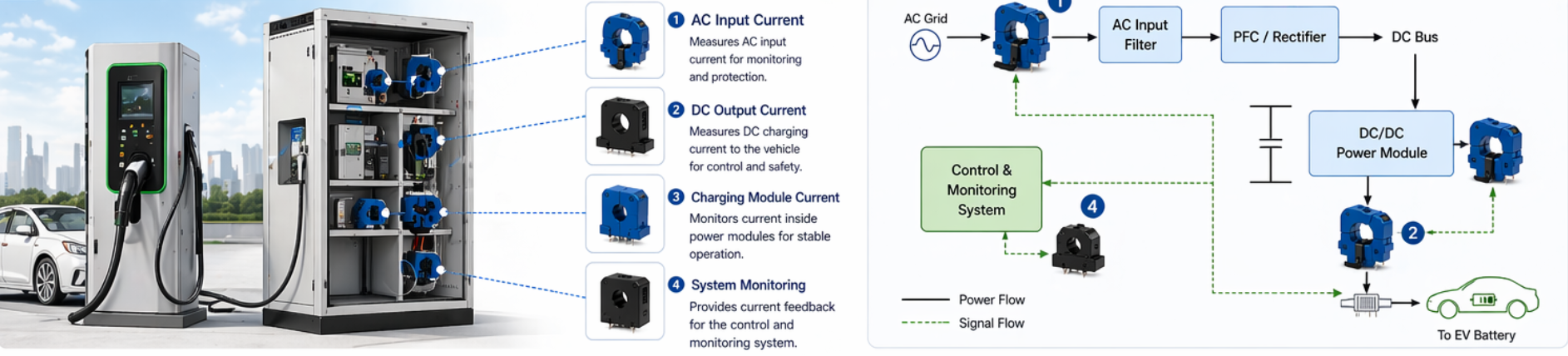
Before selecting a current sensor, it is important to understand where the sensor will be used inside the EV charging station. Current sensing may be used in the AC input side, DC output side, charging module, power conversion circuit, protection circuit, or monitoring system. Each position has different electrical conditions and performance requirements. A sensor used for basic monitoring may not need the same accuracy as a sensor used for control feedback or safety protection.
In AC charging stations, current sensors are often used to monitor AC line current, detect abnormal load conditions, and support system protection. In DC fast chargers, current sensors may need to measure high DC current accurately and continuously. Because DC fast charging involves higher power levels and more demanding control requirements, the current sensor must provide stable output, good isolation, low drift, and reliable performance under long operating hours.
The current sensor can also be used to support charging control. Accurate current feedback helps the charging system regulate output, protect the vehicle battery, and respond to load changes. If the sensor signal is unstable or inaccurate, the charging station may experience reduced efficiency, unstable control behavior, or unnecessary fault alarms. For this reason, current sensor selection should be treated as part of the overall charging system design, not just as a small electronic component purchase.
Another important point is electrical safety. EV charging stations are installed in public, commercial, industrial, and outdoor environments. The current sensor should provide proper isolation between the high-current conductor and the low-voltage signal circuit. This helps protect the control system and improves the safety level of the entire charging equipment.
Key Questions Before Selection
Is the sensor measuring AC current, DC current, or both?
Where will the current sensor be installed inside the charging station?
What is the rated current and maximum peak current?
Is the signal used for monitoring, feedback control, protection, or billing support?
What output signal does the control board require?
What isolation voltage and safety margin are required?
Will the charger operate in high-temperature or outdoor conditions?
2. Check The Core Parameters That Affect Charging Performance
For EV charging stations, the most important current sensor parameters include current range, accuracy, isolation voltage, response time, output type, aperture size, power supply, and temperature stability. These specifications determine whether the sensor can work reliably in real charging conditions. A wrong selection may cause inaccurate current feedback, unstable control, overheating risk, poor protection performance, or difficult installation.
Current range is the first parameter to confirm. The selected sensor should cover the normal charging current and leave enough margin for peak current or abnormal operating conditions. If the sensor range is too low, it may saturate during high-current operation. If the range is too high, the measurement resolution may be reduced, especially under lower charging current conditions. The best choice should balance overload capacity and measurement sensitivity.
Accuracy is another key factor. For simple monitoring, standard accuracy may be acceptable. For DC fast charging, power control, battery protection, and charging data feedback, higher accuracy is often preferred. Temperature drift should also be considered because charging stations may operate for long periods and may be installed outdoors or inside compact electrical cabinets where heat accumulation is common.
Isolation voltage is especially important in EV charging equipment. The sensor must safely separate the high-current power path from the low-voltage control circuit. A current sensor with good isolation performance helps improve system safety and reduce electrical risk. Buyers should check the system voltage, insulation design, and safety margin before confirming the sensor model.
Response time should be matched with the system function. If the sensor is used only for slow monitoring, ultra-fast response may not be necessary. If the sensor supports protection or control feedback in a fast-changing power conversion system, faster response becomes more important. Output type must also match the charger controller. Common options may include analog voltage output, analog current output, or other signal formats depending on the control system design.
| Selection Parameter | Why It Matters In EV Charging | Recommended Checkpoint |
|---|---|---|
| Current Range | Determines whether the sensor can measure rated and peak charging current | Confirm rated current, maximum current, and overload margin |
| AC / DC Measurement | Different charger positions may require AC, DC, or bidirectional current measurement | Match the sensor type with the actual measurement point |
| Accuracy | Affects charging control, monitoring reliability, and system feedback quality | Use higher accuracy for DC fast charging and feedback control |
| Isolation Voltage | Protects the control circuit from the high-current power side | Select according to system voltage and safety margin |
| Response Time | Supports protection and fast control response in power conversion circuits | Choose faster response for protection and dynamic control |
| Output Signal | Determines compatibility with the charger control board | Confirm voltage output, current output, or custom signal needs |
| Aperture Size | Affects installation around cable or busbar conductors | Check cable diameter, busbar size, and available space |
| Temperature Stability | Charging stations may operate outdoors or in enclosed cabinets | Select a sensor suitable for the expected working environment |

Open Loop Or Closed Loop For EV Chargers?
Open loop Hall effect current sensors are often a practical choice for standard EV charging applications where compact size, cost efficiency, and reliable monitoring are important. Closed loop current sensors are better suited for demanding DC fast charging systems, high-performance power modules, and applications requiring better accuracy, faster response, lower drift, and more stable current feedback. The final choice should depend on the charger power level, control requirement, safety design, and cost target.
3. Match The Sensor Type With EV Charging Applications
Different EV charging stations require different current sensing strategies. A wall-mounted AC charger may use current sensing mainly for monitoring and protection. A public DC fast charging station may require more accurate and stable current measurement for high-power output control. A modular charger cabinet may need multiple current sensors across input, output, and internal power conversion modules. Therefore, current sensor selection should always be based on the real charger architecture.
For AC charging stations, current sensors should support reliable AC measurement, compact installation, and stable output for monitoring and protection. The current range is usually lower than in DC fast charging, but safety and consistency are still important. For DC fast chargers, the sensor must handle higher current levels and provide stable DC measurement. In these applications, closed loop Hall effect current sensors may be preferred when accuracy and dynamic response are critical.
For high-power charging modules, current sensors may operate in compact electrical spaces with heat, switching noise, and high current density. In this case, installation structure and anti-interference capability should be reviewed carefully. The sensor should fit the conductor layout, support the required output signal, and remain stable under the expected temperature range. Mechanical compatibility is just as important as electrical performance.
For charging station manufacturers and integrators, it is also useful to choose a current sensor partner that can support model matching, parameter confirmation, and project-specific recommendations. If the project has special requirements such as customized current range, output signal, aperture size, housing structure, or mounting method, early technical communication can reduce design changes and shorten the development cycle.

Typical Matching Reference
| Charging Application | Current Sensing Priority | Sensor Selection Direction |
|---|---|---|
| AC Charging Station | AC monitoring, protection, compact installation | Open loop or standard Hall effect current sensor |
| DC Fast Charger | Stable DC measurement, accuracy, safety isolation | Closed loop or high-performance Hall effect sensor |
| Charging Module | Fast response, compact structure, system compatibility | PCB or panel-mounted current sensor based on design |
| Power Distribution Unit | Load monitoring, overload detection, electrical safety | Isolated current sensor with suitable aperture size |
| High-Power Charging Cabinet | High current range, thermal stability, reliability | High-current Hall effect or closed loop current sensor |
Common Selection Mistakes To Avoid
Choosing only by rated current and ignoring peak current or overload conditions
Using an AC-only measurement approach where DC current sensing is required
Ignoring isolation voltage in high-power charging systems
Selecting a low-accuracy sensor for a control-critical DC fast charger
Forgetting to confirm aperture size for cable or busbar installation
Overlooking temperature drift in outdoor or compact cabinet environments
Not confirming output signal compatibility with the charger control board
Conclusion
Selecting the right current sensor for EV charging stations requires a full review of the charging system, not just the current rating. Engineers and procurement teams should confirm AC or DC measurement needs, rated and peak current, isolation voltage, accuracy, response time, output signal, installation space, temperature conditions, and long-term reliability requirements.
For standard charging applications, open loop Hall effect current sensors can provide a cost-effective and practical solution. For DC fast charging and high-performance power electronics, closed loop current sensors may provide better accuracy, faster response, and stronger stability. A properly selected current sensor helps improve EV charger safety, control quality, measurement reliability, and overall equipment performance.
FAQ
1. What type of current sensor is commonly used in EV charging stations?
Hall effect current sensors are commonly used because they can measure AC and DC current, provide electrical isolation, and support reliable current monitoring in charging systems.
2. Should I choose open loop or closed loop current sensors for EV chargers?
Open loop sensors are suitable for many standard charging applications where cost and compactness matter. Closed loop sensors are better for DC fast charging and applications requiring higher accuracy, faster response, and lower drift.
3. Why is isolation important in EV charging current sensors?
Isolation helps separate the high-current power circuit from the low-voltage control circuit. This improves safety, protects electronic control systems, and supports reliable operation in high-power charging equipment.
4. What current range should I select?
The current range should cover the normal charging current and leave enough margin for peak current or overload conditions. The exact range depends on charger power level and circuit design.
5. What information should I provide when requesting a current sensor quote?
You should provide the application, current type, rated current, peak current, output signal, power supply, isolation requirement, mounting method, aperture size, and operating environment.
Contact Us For EV Charging Current Sensor Selection Support
If you are selecting current sensors for EV charging stations, DC fast chargers, charging modules, or power conversion systems, send us your current range, AC/DC measurement needs, output signal, aperture size, and installation requirements. Our team can help you match a suitable current sensor solution.
Contact Us Get Quote