How To Select A DC-Link Capacitor For Inverter Applications
How To Select A DC-Link Capacitor For Inverter Applications
DC-link capacitors are critical components in inverter applications because they help stabilize the DC bus voltage, absorb ripple current, support power conversion, reduce voltage fluctuation, and protect power semiconductors such as IGBTs, MOSFETs, and SiC devices. A poorly selected DC-link capacitor can cause overheating, reduced lifetime, unstable inverter operation, or premature system failure.
This guide explains how to select a DC-link capacitor for inverter applications, what parameters matter most, and how to match capacitor performance with solar inverters, motor drives, EV chargers, UPS systems, energy storage converters, welding machines, and industrial power electronics.
Quick Answer
To select a DC-link capacitor for inverter applications, engineers should confirm the DC bus voltage, ripple current, capacitance value, voltage rating, operating temperature, lifetime requirement, ESR, ESL, mounting method, and cooling conditions. Film capacitors are commonly used in high-performance inverter systems because they provide low loss, strong ripple current capability, good self-healing performance, and long service life. The right capacitor should match the inverter power level, switching frequency, thermal design, and expected operating environment.
1. Understand The Role Of DC-Link Capacitors In Inverters
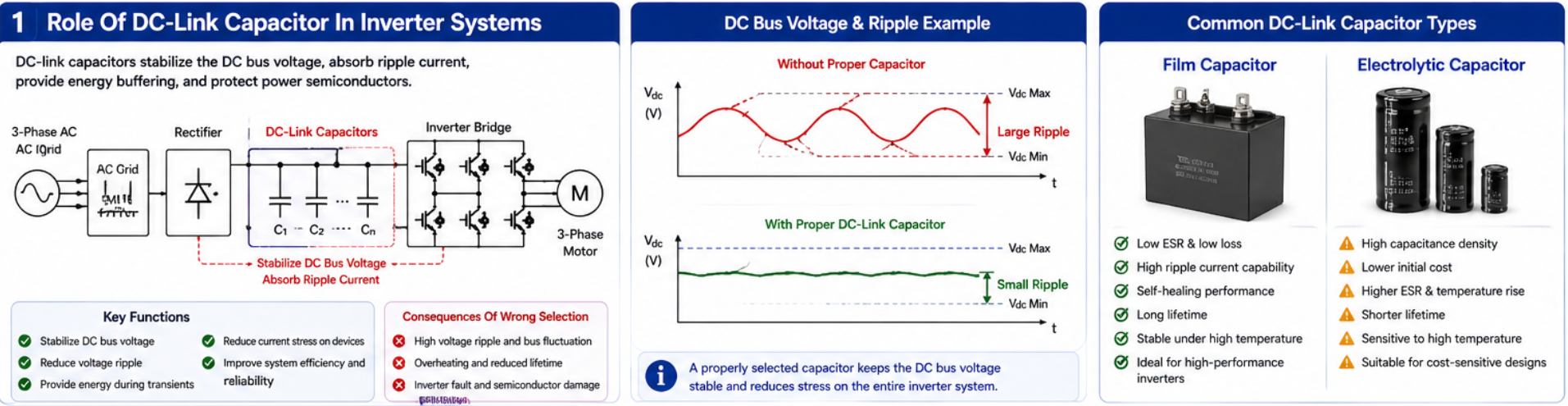
In an inverter system, the DC-link capacitor is installed between the rectifier or DC source and the inverter bridge. Its main function is to stabilize the DC bus voltage and provide energy buffering during switching operation. When the inverter converts DC power into AC power, the load and switching devices create current ripple and voltage fluctuation. The DC-link capacitor helps absorb this ripple and keeps the DC bus more stable.
A stable DC bus is important for inverter efficiency, control quality, and system reliability. If the capacitor is too small or has poor ripple current capability, the DC bus voltage may fluctuate too much. This can increase stress on IGBT modules, MOSFETs, SiC devices, rectifiers, and control circuits. It may also cause overheating, noise, poor output waveform quality, or unexpected inverter faults.
DC-link capacitors are widely used in motor drives, solar inverters, EV charging modules, UPS systems, energy storage converters, welding machines, railway traction converters, and industrial power supplies. Although the function is similar, the selection requirements are different for each application. For example, solar inverters may require long lifetime and outdoor temperature stability, while motor drives may need strong ripple current handling and vibration resistance.
Before selecting a capacitor, engineers should understand the inverter topology, DC bus voltage, switching frequency, output power, expected ripple current, ambient temperature, cooling method, and lifetime target. These factors determine whether the selected DC-link capacitor can operate safely and reliably over the full service life of the equipment.
Key Questions Before Selection
What is the rated DC bus voltage and maximum voltage?
What ripple current must the capacitor handle?
What capacitance value is required by the inverter design?
What is the switching frequency and power level?
Will the capacitor operate in high temperature or limited cooling conditions?
What lifetime requirement does the project need?
What mounting structure, size, and terminal type are required?
2. Check The Core Parameters Before Ordering
DC-link capacitor selection should begin with voltage rating. The capacitor voltage rating must be higher than the maximum DC bus voltage, including possible voltage spikes, regeneration voltage, grid fluctuation, or transient conditions. Choosing a capacitor with insufficient voltage margin can increase failure risk and reduce system reliability.
Capacitance value is also important. A higher capacitance can improve DC bus stability and reduce voltage ripple, but it may also increase size, cost, and inrush current. A lower capacitance may save space but may not provide enough energy buffering. The correct value should be calculated according to inverter topology, power level, ripple requirement, and control strategy.
Ripple current capability is one of the most critical parameters. In inverter applications, DC-link capacitors must continuously handle ripple current generated by switching and load variation. If the ripple current exceeds the capacitor rating, internal heating increases and capacitor lifetime drops quickly. Engineers should check ripple current at the actual operating frequency and temperature, not only under standard datasheet conditions.
ESR and ESL affect capacitor heating and high-frequency performance. Lower ESR helps reduce power loss and temperature rise. Lower ESL improves high-frequency ripple handling and reduces voltage spikes. For compact high-power inverters, low-inductance design and proper busbar layout are important for reducing stress on power semiconductors.
Operating temperature and lifetime must be reviewed carefully. Capacitor lifetime is strongly affected by temperature. In solar inverters, EV chargers, UPS systems, and industrial drives, capacitors may operate for long periods under high load. A capacitor that looks suitable by voltage and capacitance may still fail early if thermal conditions are not considered.
| Selection Parameter | Why It Matters In Inverters | Recommended Checkpoint |
|---|---|---|
| DC Bus Voltage | Determines required voltage rating and safety margin | Confirm rated voltage, maximum voltage, and transient voltage |
| Capacitance Value | Affects DC bus stability and voltage ripple | Match capacitance with inverter topology and power level |
| Ripple Current | Main cause of capacitor heating in inverter operation | Check RMS ripple current at actual frequency and temperature |
| ESR | Affects power loss and internal temperature rise | Lower ESR is preferred for high ripple current applications |
| ESL | Affects high-frequency performance and voltage spike control | Choose low-inductance design for compact high-power inverter layout |
| Operating Temperature | High temperature reduces capacitor lifetime | Review ambient temperature, hot spot temperature, and cooling method |
| Lifetime | Determines long-term system reliability | Match lifetime rating with equipment service requirement |
| Mounting And Terminals | Affects installation, thermal performance, and busbar connection | Confirm dimensions, terminal type, fixing method, and clearance |

Film Capacitor Or Electrolytic Capacitor?
Film capacitors are often preferred for high-performance inverter applications because they offer low ESR, strong ripple current capability, good self-healing behavior, long lifetime, and better stability under harsh operating conditions. Electrolytic capacitors may provide higher capacitance density and lower initial cost, but they usually have shorter lifetime and higher temperature sensitivity. The choice depends on power level, cost target, lifetime requirement, available space, and thermal design.
3. Match DC-Link Capacitors With Different Inverter Applications
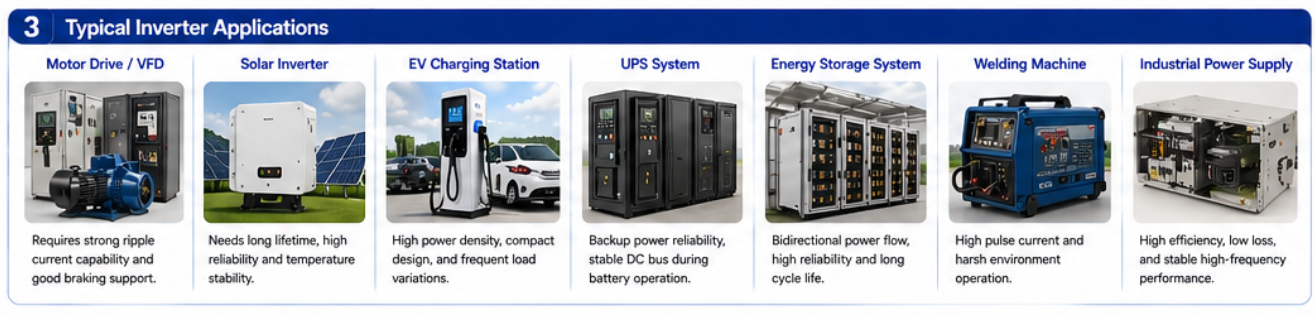
Different inverter applications have different DC-link capacitor requirements. A motor drive may require strong ripple current capability and good vibration resistance. A solar inverter may require long lifetime, outdoor temperature stability, and reliable DC bus support. An EV charging module may require compact size, low loss, and high reliability under frequent load changes. UPS and energy storage converters may require stable operation during charge, discharge, and backup power cycles.
For motor drives and VFDs, DC-link capacitors help stabilize the inverter DC bus during motor acceleration, braking, and load variation. Engineers should pay attention to ripple current, voltage margin, terminal structure, and thermal performance. For regenerative drives, voltage rise during braking must also be considered.
For solar inverters, capacitors may operate for long hours under changing ambient temperatures. Long lifetime, low loss, high insulation resistance, and stable performance are important. The capacitor should match the PV inverter DC bus voltage, power rating, and expected outdoor or cabinet temperature conditions.
For EV chargers and energy storage systems, DC-link capacitors must support high-power conversion and frequent load changes. The capacitor should provide strong ripple current handling, good thermal design, compact installation, and reliable connection with power modules. Low-inductance layout is especially important when switching devices operate at higher frequency.
When requesting a DC-link capacitor quote, buyers should provide the application, DC bus voltage, capacitance requirement, ripple current, switching frequency, operating temperature, expected lifetime, mounting dimensions, terminal type, and quantity. This information helps suppliers recommend a capacitor that matches both electrical performance and mechanical installation.
Typical Application Matching Reference
| Inverter Application | Main Requirement | DC-Link Capacitor Selection Direction |
|---|---|---|
| Motor Drive / VFD | Ripple current handling, DC bus stability, braking conditions | Film capacitor with strong ripple current and thermal performance |
| Solar Inverter | Long lifetime, temperature stability, stable DC bus voltage | Long-life film capacitor with proper voltage and temperature rating |
| EV Charging Module | High power density, frequent load changes, compact installation | Low-ESR, low-ESL capacitor with reliable terminal design |
| UPS System | Backup power reliability, stable inverter operation, long service life | Capacitor selected for lifetime, ripple current, and thermal stability |
| Energy Storage Converter | Bidirectional power flow, charge/discharge cycles, high reliability | High-reliability DC-link capacitor with stable performance under cycling |
Common Selection Mistakes To Avoid
Choosing the capacitor only by capacitance value and ignoring ripple current
Selecting insufficient voltage rating without considering transient voltage
Ignoring ESR and internal temperature rise under continuous inverter operation
Using poor thermal design and expecting rated lifetime under high temperature
Ignoring ESL and busbar layout in high-frequency switching systems
Not checking mounting dimensions, terminal structure, and clearance requirements
Comparing price without reviewing lifetime, reliability, and real operating conditions
Conclusion
Selecting a DC-link capacitor for inverter applications requires a full review of voltage rating, capacitance, ripple current, ESR, ESL, temperature rise, lifetime, mounting method, and mechanical fit. The capacitor must stabilize the DC bus, handle ripple current, reduce voltage fluctuation, and support long-term inverter reliability.
For motor drives, solar inverters, EV chargers, UPS systems, energy storage converters, welding machines, and industrial power electronics, film capacitors are often preferred because of their low loss, strong ripple capability, self-healing performance, and long service life. A properly selected DC-link capacitor helps improve inverter stability, protect power semiconductors, reduce failure risk, and extend equipment lifetime.
FAQ
1. What does a DC-link capacitor do in an inverter?
A DC-link capacitor stabilizes the DC bus voltage, absorbs ripple current, provides energy buffering, and helps reduce voltage fluctuation during inverter switching operation.
2. Why is ripple current important?
Ripple current causes internal heating in the capacitor. If the ripple current rating is too low, the capacitor may overheat and fail early.
3. Are film capacitors better than electrolytic capacitors for DC-link applications?
Film capacitors are often better for high-performance inverter applications because they provide low ESR, strong ripple current capability, self-healing performance, long lifetime, and better thermal stability.
4. How do I choose the correct voltage rating?
The voltage rating should be higher than the maximum DC bus voltage, including transient voltage, regeneration voltage, and abnormal operating conditions. A suitable safety margin is important.
5. What information should I provide before requesting a quote?
You should provide the application, DC bus voltage, capacitance value, ripple current, switching frequency, operating temperature, lifetime requirement, dimensions, terminal type, and mounting method.
Contact Us For DC-Link Capacitor Selection Support
If you are selecting DC-link capacitors for motor drives, solar inverters, EV chargers, UPS systems, energy storage converters, welding equipment, or industrial power electronics, send us your DC bus voltage, capacitance value, ripple current, operating temperature, lifetime target, dimensions, and terminal requirements. Our team can help you match a suitable capacitor solution.
Contact Us Get Quote