How To Select A Leakage Current Sensor For Electrical Safety Monitoring
How To Select A Leakage Current Sensor For Electrical Safety Monitoring
Leakage current sensors are important components in electrical safety monitoring systems. They help detect unwanted current flowing to ground, identify insulation problems, support fault protection, and reduce the risk of electric shock, equipment damage, fire hazards, and system shutdown. In power electronics, EV charging, solar inverters, industrial power supplies, UPS systems, and energy storage equipment, leakage current monitoring is often a key part of the safety design.
This guide explains how to select a leakage current sensor, what technical parameters should be checked before ordering, and how to match the sensor with real electrical safety monitoring applications such as ground fault detection, residual current monitoring, insulation fault protection, charging station safety, inverter protection, and industrial equipment monitoring.
Quick Answer
To select a leakage current sensor for electrical safety monitoring, first confirm the leakage current type, detection range, response time, system voltage, conductor structure, installation method, output signal, and protection logic. The sensor should be sensitive enough to detect small residual current while avoiding false alarms caused by normal switching noise. For EV chargers, solar inverters, UPS systems, and industrial power equipment, a good leakage current sensor should provide stable detection, strong insulation performance, fast response, reliable anti-interference capability, and compatibility with the controller or protection circuit.
1. Understand What The Leakage Current Sensor Needs To Detect
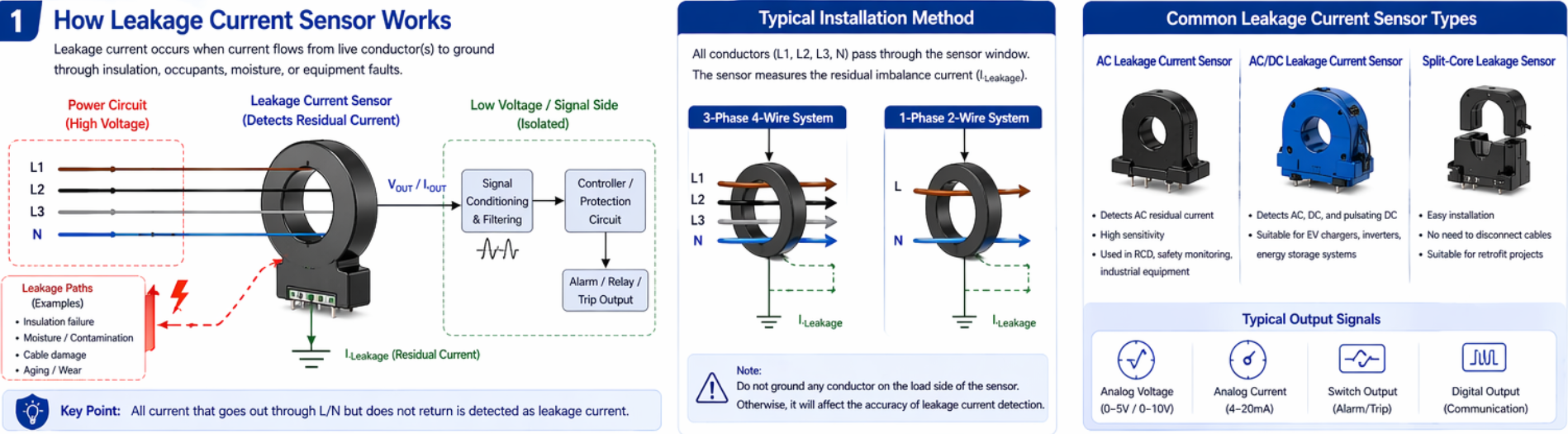
Leakage current is current that flows through an unintended path, usually from a live conductor to ground or through insulation that has started to degrade. In a safe electrical system, the current flowing out through the live conductor should return through the neutral or corresponding return path. If part of the current leaks to ground, it may indicate insulation failure, moisture, cable damage, equipment aging, or a fault condition. A leakage current sensor helps detect this abnormal current and sends a signal to the monitoring or protection circuit.
Unlike normal load current sensors, leakage current sensors are usually designed to detect much smaller current values. This means sensitivity, stability, and anti-interference performance are very important. If the sensor is not sensitive enough, it may fail to detect a dangerous fault. If it is too easily disturbed by noise, switching harmonics, or installation errors, it may trigger false alarms and affect system operation.
The first selection step is to define what kind of leakage current the system needs to monitor. Some applications mainly monitor AC leakage current. Some power electronics systems may involve DC leakage or mixed AC/DC residual current. EV charging stations, solar inverters, energy storage systems, and variable frequency drives may generate complex leakage current waveforms due to rectifiers, inverters, filters, and switching devices. The selected leakage current sensor must match the actual current type and protection requirement.
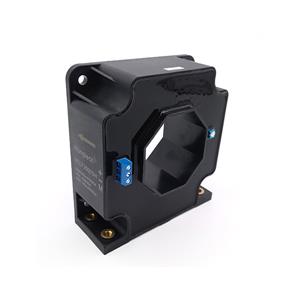
Buyers should also confirm the installation position. In some systems, all phase conductors and neutral pass through the sensor window together so the sensor detects the residual imbalance current. In other systems, the sensor may be installed at a specific grounding point, cable path, or protection circuit. The conductor layout, cable diameter, busbar size, and available space must be checked before choosing the sensor structure.
Key Questions Before Selection
Does the system need to detect AC leakage, DC leakage, or mixed AC/DC residual current?
What leakage current threshold should trigger warning or protection?
Is the sensor used for monitoring, alarm, shutdown, or protection control?
What is the system voltage and insulation requirement?
How many conductors need to pass through the sensor window?
What output signal does the control board require?
Will the equipment operate in a noisy switching power environment?
2. Check The Core Parameters For Safety Monitoring
Leakage current sensor selection should focus on safety performance and system compatibility. The most important parameters include detection range, sensitivity, response time, current type, output signal, aperture size, isolation performance, temperature stability, and anti-interference capability. These specifications determine whether the sensor can detect faults accurately and reliably in real electrical equipment.
Detection range and sensitivity are the first parameters to confirm. A leakage current sensor must be able to detect the target residual current level. For personnel protection, the detection threshold may be relatively low. For equipment protection or insulation monitoring, the threshold may depend on system design and safety standards. The sensor should provide enough sensitivity for the required protection level while maintaining stable output under normal operating conditions.
Response time is also critical. In electrical safety monitoring, the sensor must detect abnormal leakage current quickly enough for the protection system to react. A slow response may delay fault detection, while an overly sensitive system without proper filtering may cause unnecessary trips. The sensor response should be matched with the protection circuit, controller logic, and application risk level.
Output signal compatibility should be checked before ordering. Leakage current sensors may provide analog voltage output, current output, switching output, or a signal designed for a specific protection circuit. If the output does not match the controller, relay module, PLC, or monitoring board, additional signal conditioning may be required. For OEM equipment manufacturers, confirming the signal interface early can reduce redesign work.
Anti-interference capability is especially important in power electronics. Solar inverters, EV chargers, UPS systems, welding machines, and motor drives may generate high-frequency switching noise. A suitable leakage current sensor should help detect real residual current while reducing false alarms caused by normal switching behavior. Buyers should review the application environment, filtering requirement, and signal stability before confirming the final model.
| Selection Parameter | Why It Matters | Recommended Checkpoint |
|---|---|---|
| Leakage Current Type | Different systems may produce AC, DC, pulsating DC, or mixed leakage current | Match the sensor with the actual leakage current waveform |
| Detection Range | Determines whether the sensor can detect the required fault level | Confirm alarm and trip thresholds before selection |
| Sensitivity | Affects small leakage current detection capability | Use suitable sensitivity without causing frequent false alarms |
| Response Time | Affects protection speed during fault conditions | Match response speed with protection logic |
| Output Signal | Determines compatibility with controller, relay, PLC, or monitoring circuit | Confirm analog output, current output, or switching output requirement |
| Aperture Size | Affects whether conductors can pass through the sensor window correctly | Check cable quantity, diameter, and installation space |
| Isolation Performance | Protects signal circuits and improves electrical safety | Match insulation design with system voltage and safety requirements |
| Anti-Interference Ability | Reduces false alarms in switching power environments | Review EMI, inverter noise, and filtering requirements |

Normal Current Sensor vs Leakage Current Sensor
A normal current sensor is designed to measure load current in a power circuit. A leakage current sensor is designed to detect residual current imbalance or unwanted current flowing to ground. These two sensor types serve different purposes. Using a normal current sensor for leakage protection may not provide the required sensitivity or detection logic. For electrical safety monitoring, a dedicated leakage current sensor is usually the better choice.
3. Match The Sensor With Electrical Safety Applications
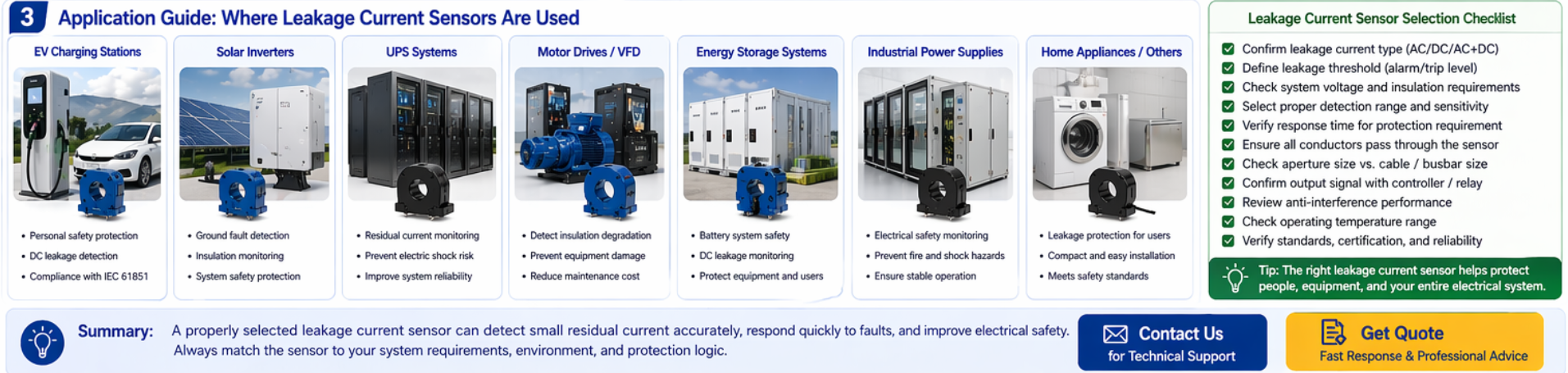
Leakage current sensors are used in many electrical safety monitoring systems. In EV charging stations, they help detect residual current and support protection against electric shock and insulation faults. In solar inverters, they help monitor ground fault risks caused by cable aging, humidity, insulation damage, or PV system leakage. In industrial equipment, they help detect abnormal leakage before it causes downtime or safety hazards.
For EV charging stations, leakage current monitoring is especially important because the equipment is used by the public and connected to vehicles, grid power, and charging electronics. The sensor should detect the required leakage current type and work reliably with the charger protection system. If DC leakage detection is required, the sensor must be selected accordingly instead of using an AC-only solution.
For solar inverters, leakage current sensors should be selected based on system topology, grid connection type, DC voltage, AC output, and protection requirements. Photovoltaic systems often work outdoors and may face moisture, temperature changes, and insulation aging. A stable leakage current sensor can help improve ground fault detection and support safer long-term operation.
For UPS systems, power supplies, motor drives, and industrial automation equipment, leakage current monitoring can help detect insulation deterioration, equipment faults, or unsafe grounding conditions. In these systems, the sensor should provide stable output, good noise immunity, and compatibility with the protection circuit. The selected model should also fit the available space inside the cabinet or device.
When requesting a leakage current sensor quote, buyers should provide the application, system voltage, leakage current detection threshold, current type, aperture size, output signal, installation method, operating temperature, and whether the signal will be used for alarm, shutdown, or continuous monitoring. This information helps avoid wrong model selection and improves project efficiency.
Typical Application Matching Reference
| Application | Monitoring Purpose | Sensor Selection Direction |
|---|---|---|
| EV Charging Station | Residual current detection, user safety, insulation fault protection | Leakage current sensor matched to AC/DC residual current requirement |
| Solar Inverter | Ground fault detection, PV insulation monitoring, safety protection | Dedicated leakage sensor with stable performance in inverter environments |
| UPS System | Power safety monitoring, insulation fault warning, load protection | Sensor with reliable output and protection circuit compatibility |
| Motor Drive / VFD | Ground leakage detection in noisy switching environments | Leakage current sensor with good anti-interference performance |
| Industrial Control Cabinet | Electrical safety monitoring, insulation deterioration warning | Compact leakage sensor with suitable aperture and output signal |
Common Selection Mistakes To Avoid
Using a normal load current sensor instead of a dedicated leakage current sensor
Selecting an AC-only leakage sensor where DC leakage detection is required
Ignoring false alarm risks caused by switching noise and EMI
Choosing a sensor without confirming the leakage current threshold
Not checking aperture size for all required conductors
Failing to match output signal with controller or protection circuit
Ignoring operating temperature, humidity, and insulation environment
Conclusion
Selecting a leakage current sensor for electrical safety monitoring requires more than choosing a current range. Buyers must confirm leakage current type, detection threshold, sensitivity, response time, output signal, aperture size, insulation performance, anti-interference capability, and the real protection function of the system. The sensor must be matched to the electrical safety requirement, not only to the equipment category.
For EV charging stations, solar inverters, UPS systems, motor drives, power supplies, energy storage systems, and industrial control cabinets, a properly selected leakage current sensor can improve fault detection, protect equipment, reduce safety risks, and support long-term reliable operation. The best selection always starts with a clear understanding of the system voltage, leakage threshold, current waveform, installation structure, and protection logic.
FAQ
1. What is a leakage current sensor used for?
A leakage current sensor is used to detect unwanted residual current flowing to ground or through an unintended path. It supports electrical safety monitoring, insulation fault detection, and protection control.
2. Is a leakage current sensor the same as a normal current sensor?
No. A normal current sensor measures load current, while a leakage current sensor detects residual current imbalance or ground leakage. Leakage current sensors usually require higher sensitivity for safety monitoring.
3. Why is DC leakage detection important in EV charging and solar inverter systems?
EV chargers and solar inverters may involve rectifiers, DC buses, batteries, and switching power circuits. These systems can produce DC or mixed residual current, so the sensor must match the real leakage current type.
4. What causes false alarms in leakage current monitoring?
False alarms can be caused by switching noise, EMI, incorrect conductor installation, unsuitable sensor sensitivity, poor filtering, or mismatch between sensor output and protection logic.
5. What information should I provide when requesting a leakage current sensor quote?
You should provide the application, system voltage, leakage current type, detection threshold, response requirement, output signal, aperture size, conductor layout, installation method, and operating environment.
Contact Us For Leakage Current Sensor Selection Support
If you are selecting leakage current sensors for EV charging stations, solar inverters, UPS systems, motor drives, power supplies, or industrial electrical safety monitoring, send us your leakage threshold, current type, output signal, aperture size, and application details. Our team can help you match a suitable sensor solution.
Contact Us Get Quote