How Bandwidth And Response Time Affect Current Sensor Performance
How Bandwidth And Response Time Affect Current Sensor Performance
Bandwidth and response time are two critical performance parameters in current sensor selection. They determine how quickly and accurately a current sensor can follow changes in the measured current. In power electronics, motor drives, solar inverters, EV chargers, UPS systems, welding equipment, and industrial automation, the wrong bandwidth or response time may cause delayed feedback, poor control stability, inaccurate fault detection, or unreliable system protection.
This guide explains what bandwidth and response time mean in current sensors, how they affect measurement accuracy and control performance, and how to choose the right sensor speed for different industrial applications.
Quick Answer
Bandwidth shows how wide a frequency range the current sensor can measure accurately, while response time shows how fast the sensor output reacts when the input current changes. Higher bandwidth and faster response are important for motor drives, inverters, switching power supplies, short-circuit protection, and dynamic control systems. For simple monitoring applications, moderate bandwidth may be enough. The best choice depends on whether the current signal is used for monitoring, control feedback, protection, or precision measurement.
1. What Bandwidth And Response Time Mean In Current Sensors
Bandwidth describes the frequency range over which a current sensor can measure current changes with acceptable accuracy. If the measured current changes slowly, a lower bandwidth sensor may still provide reliable data. If the current changes rapidly, such as in inverter switching, motor control, or pulse current measurement, the current sensor must have enough bandwidth to follow the waveform without distortion or delay.
Response time refers to how quickly the sensor output reaches the expected value after the input current changes. A fast response time allows the control system to react quickly to load changes, overcurrent events, short-circuit conditions, and dynamic current transitions. A slow sensor may still show the correct final current value, but it may arrive too late for real-time control or protection.
In many industrial applications, bandwidth and response time are closely related. A sensor with higher bandwidth usually responds better to fast-changing current signals. However, buyers should not only choose the highest value on the datasheet. Higher bandwidth can also make the system more sensitive to noise if the circuit design, filtering, and controller input are not properly matched. The right sensor should provide enough speed for the application while maintaining stable and clean signal output.
For Hall effect current sensors, open loop and closed loop designs may provide different dynamic performance. Open loop Hall effect sensors are often suitable for standard monitoring and general control. Closed loop current sensors usually provide faster response, better linearity, lower drift, and stronger dynamic performance, making them more suitable for demanding power electronics applications.
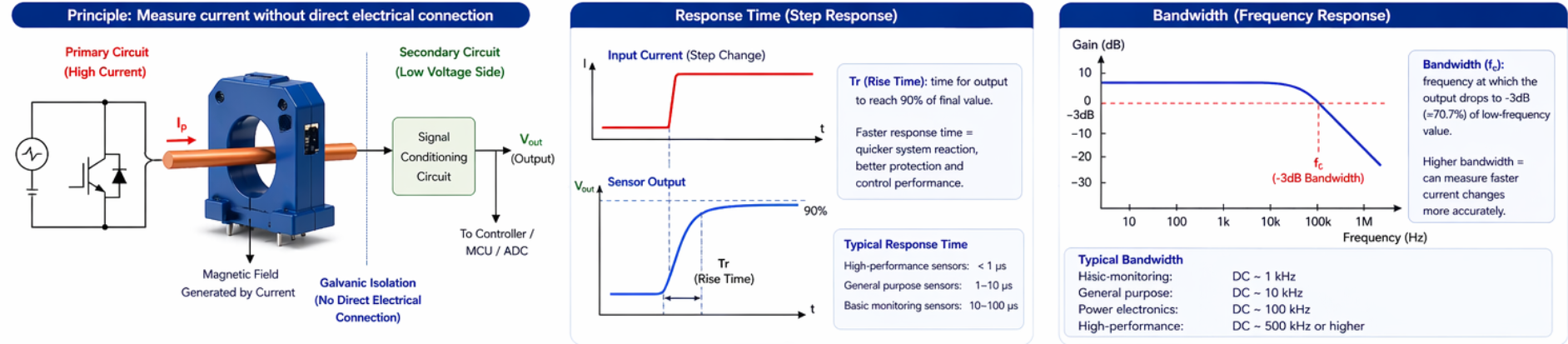
Simple Explanation
Bandwidth shows how well the sensor follows different current frequencies.
Response time shows how quickly the output reacts to current changes.
Higher bandwidth helps measure fast current waveforms more accurately.
Faster response supports real-time protection and control feedback.
The correct value depends on the actual application, not only the datasheet maximum.
2. How Bandwidth And Response Time Affect System Performance
Bandwidth and response time affect more than measurement speed. They influence control stability, protection reliability, waveform accuracy, and system safety. In power electronics, the current signal is often used by the controller to make decisions. If the current sensor is too slow, the controller may receive delayed information and make incorrect or late adjustments.
In motor drives and servo systems, current feedback is essential for torque control, speed regulation, and protection. A slow current sensor can reduce control accuracy and cause unstable dynamic behavior. A fast sensor helps the drive respond quickly to load changes and improves the quality of current control. For high-performance motor control, closed loop current sensors are often preferred because of their stronger dynamic response.
In solar inverters, EV chargers, UPS systems, and switching power supplies, current changes may happen quickly due to switching devices, load transitions, grid events, or battery charge and discharge behavior. A suitable current sensor must capture these changes accurately enough for the control system to maintain stable operation. If the bandwidth is too low, the measured waveform may be distorted and important transient information may be lost.
In protection applications, response time can be even more important. For overcurrent detection, short-circuit protection, and fault shutdown, the sensor must react quickly enough for the protection circuit to respond before serious damage occurs. A delayed current signal may increase risk to power semiconductors, capacitors, cables, batteries, and other system components.
| Application | Why Speed Matters | Selection Direction |
|---|---|---|
| Motor Drives | Current feedback affects torque control, speed control, and drive stability | Choose fast response and suitable bandwidth for dynamic control |
| Solar Inverters | Supports DC/AC current monitoring, power conversion control, and protection | Use stable bandwidth with low drift and good noise immunity |
| EV Charging Stations | Helps detect load changes, charging current variation, and fault conditions | Match response time with charging control and protection logic |
| UPS Systems | Supports battery current monitoring, inverter output control, and overload protection | Choose a sensor with reliable transient response |
| Welding Equipment | Current changes rapidly during welding output control | Select high response capability and strong overload tolerance |
| Short-Circuit Protection | Delayed sensing may reduce protection effectiveness | Use fast response sensors matched with protection circuit timing |

What Happens If Bandwidth Is Too Low?
The sensor output may not follow fast current changes accurately.
Waveform distortion may appear in dynamic current measurement.
Protection circuits may receive delayed or incomplete fault information.
Motor drives and inverters may have reduced control stability.
Important transient current events may be missed.
3. How To Choose The Right Bandwidth And Response Time
The right bandwidth and response time depend on how the current signal is used. If the sensor is only used for slow monitoring, such as checking load current or equipment status, a moderate-speed current sensor may be enough. If the signal is used for closed-loop control, fast protection, inverter feedback, or dynamic current analysis, higher bandwidth and faster response are more important.
Buyers should start by confirming the system function. Is the sensor used for monitoring, control, protection, or precision measurement? Monitoring applications usually require stability and reliability more than extreme speed. Control applications require the sensor output to follow current changes quickly and accurately. Protection applications require fast response to abnormal current events. Precision measurement applications may require a balance of bandwidth, accuracy, linearity, and noise control.
The next step is to review the current waveform. A smooth DC current does not require the same bandwidth as a high-frequency switching waveform. A motor drive phase current, inverter output current, or pulse current waveform may include fast transitions and higher-frequency components. If these components are important for control or analysis, the sensor bandwidth must be high enough to capture them.
It is also important to consider noise. A very high bandwidth sensor may capture unwanted high-frequency noise if the system has strong switching interference. In this case, the sensor, filter circuit, cable routing, shielding, grounding, and controller input should be designed together. The goal is not simply to choose the fastest sensor, but to choose a sensor that provides useful and stable information to the system.

Selection Checklist
| Check Item | What To Confirm | Why It Matters |
|---|---|---|
| Signal Purpose | Monitoring, control, protection, or precision measurement | Different purposes require different sensor speed |
| Current Waveform | DC, AC, pulse, inverter waveform, or fast transient current | Determines bandwidth requirement |
| Response Time | How quickly the output must respond to current changes | Critical for protection and dynamic control |
| Bandwidth | Frequency range required for accurate measurement | Prevents waveform distortion and signal delay |
| Noise Environment | Switching noise, EMI, cable length, grounding condition | Avoids unstable readings and false protection actions |
| Sensor Type | Open loop, closed loop, leakage, or precision current sensor | Different structures provide different dynamic performance |
| Output Signal | Voltage output, current output, or custom signal | Must match controller and signal processing circuit |
Common Selection Mistakes To Avoid
Choosing a current sensor only by current range and ignoring bandwidth
Using a slow sensor in a fast protection or control application
Choosing unnecessarily high bandwidth without considering noise
Ignoring response delay in short-circuit or overcurrent protection
Not matching sensor output with controller sampling speed
Comparing bandwidth without checking accuracy, drift, and linearity
Failing to evaluate real waveform conditions in the final equipment
Conclusion
Bandwidth and response time have a direct impact on current sensor performance. They determine whether the sensor can capture fast current changes, support stable feedback control, and provide timely protection signals. In simple monitoring applications, moderate dynamic performance may be sufficient. In motor drives, inverters, EV chargers, UPS systems, welding equipment, and fault protection circuits, faster response and suitable bandwidth are much more important.
The best current sensor is not always the one with the highest bandwidth. It is the one that matches the real current waveform, controller speed, protection timing, noise environment, accuracy requirement, and installation conditions. A properly selected current sensor improves measurement reliability, control stability, protection performance, and long-term system safety.
FAQ
1. What does bandwidth mean in a current sensor?
Bandwidth means the frequency range over which the current sensor can measure current changes accurately. Higher bandwidth allows the sensor to follow faster current waveforms.
2. What does response time mean in current sensing?
Response time is how quickly the sensor output reacts after the input current changes. Faster response is important for protection, control feedback, and dynamic current measurement.
3. Do all applications need high bandwidth current sensors?
No. Basic current monitoring may not need very high bandwidth. High bandwidth is more important for motor drives, inverters, switching power systems, pulse current measurement, and fast protection circuits.
4. Can high bandwidth cause noise problems?
Yes. A sensor with very high bandwidth may capture unwanted switching noise if filtering, shielding, grounding, and signal processing are not properly designed.
5. What information should I provide when selecting sensor bandwidth?
You should provide the application, current waveform, rated current, peak current, control purpose, protection timing, response requirement, output signal, and noise environment.
Contact Us For Current Sensor Selection Support
If you are selecting current sensors for motor drives, solar inverters, EV charging stations, UPS systems, welding equipment, or protection circuits, send us your current range, waveform type, bandwidth requirement, response time target, output signal, and application details. Our team can help you match a suitable current sensor solution.
Contact Us Get Quote