How To Match Current Sensor Range With Motor Drive Requirements
How To Match Current Sensor Range With Motor Drive Requirements
Choosing the right current sensor range is critical for motor drive performance. If the sensor range is too small, the output may saturate during startup, acceleration, braking, overload, or fault conditions. If the range is too large, the system may lose measurement resolution during normal operation, reducing control accuracy and protection sensitivity.
This guide explains how to match current sensor range with motor drive requirements, including rated current, peak current, overload current, phase current, DC bus current, response speed, accuracy, installation space, and output signal compatibility. It is written for engineers and procurement teams selecting current sensors for VFDs, servo drives, industrial motors, pumps, fans, compressors, CNC machines, robots, and power conversion equipment.
Quick Answer
To match current sensor range with motor drive requirements, first confirm the motor rated current, drive output current, maximum overload current, startup current, braking condition, and whether the sensor measures phase current or DC bus current. The sensor range should cover the highest expected current without saturation while still maintaining enough resolution during normal operation. For precision motor control and servo systems, closed loop current sensors are usually preferred because they provide higher accuracy, faster response, better linearity, and lower drift.
1. Start With The Motor Drive Current Profile
The first step is to understand the real current profile of the motor drive. A motor drive does not always operate at one stable current value. During startup, acceleration, deceleration, braking, heavy load operation, overload, or fault conditions, the current can be much higher than the normal running current. If the current sensor range is selected only according to the motor nameplate current, the sensor may become saturated during real operation.
Engineers should confirm whether the sensor is used on the motor phase output, the DC bus, the input side, or a protection branch. Phase current sensors are often used for feedback control, torque regulation, and motor protection. DC bus current sensors are often used for overall power monitoring, inverter protection, and energy flow analysis. These two measurement positions may require different sensor ranges and different response characteristics.
For VFDs and general industrial drives, the current sensor may mainly support monitoring and protection. For servo drives, robotics, CNC machines, and high-performance motor control, the current signal may directly affect torque control and dynamic response. In these systems, selecting the correct current range is not only about avoiding saturation. It also affects control resolution, feedback quality, and system stability.
A practical rule is to choose a sensor range that covers the maximum expected operating current and short-time overload current, while avoiding an unnecessarily oversized range. The sensor should have enough margin for transient conditions but should still provide useful signal resolution at the normal working current.
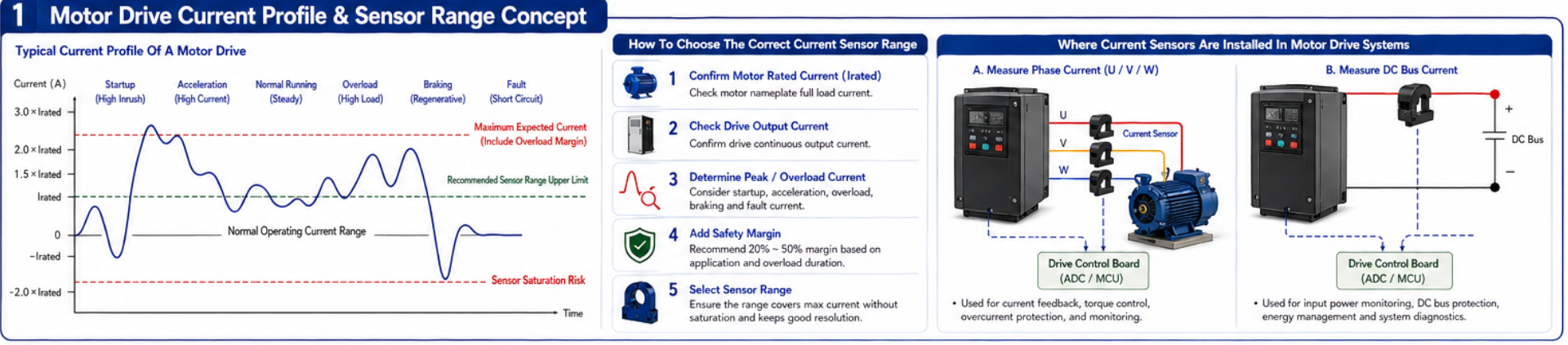
Key Questions Before Selecting Sensor Range
What is the motor rated current?
What is the drive rated output current?
What is the maximum short-time overload current?
Will the sensor measure phase current or DC bus current?
Is the current signal used for monitoring, torque control, or protection?
Does the application involve frequent acceleration, braking, or load changes?
What accuracy and response speed does the controller require?
2. Balance Overload Margin And Measurement Resolution
Current sensor range selection always requires a balance between overload margin and measurement resolution. If the range is too low, the sensor may saturate when the motor starts or when the drive handles a heavy load. Saturation means the sensor output cannot accurately represent the actual current, which may affect protection logic and control feedback.
If the sensor range is too high, the sensor may safely cover overload current, but the normal operating current may occupy only a small part of the output range. This can reduce measurement resolution and make the signal less useful for fine control. For example, using a very high-range sensor to measure a low-current motor may result in poor signal detail during normal operation.
For general industrial motor drives, a practical safety margin is usually needed to cover startup and overload conditions. For precision servo systems, engineers should place more emphasis on resolution, linearity, low offset, and fast response. The final selection should depend on how the motor operates and how the current signal is used by the drive controller.
Peak current and overload duration should be checked carefully. Some applications may experience short high-current pulses, while others may require longer overload capability. The current sensor must handle these conditions without damage or serious output distortion. At the same time, the sensor should maintain stable performance during continuous rated operation.
| Selection Factor | Why It Matters In Motor Drives | Recommended Checkpoint |
|---|---|---|
| Motor Rated Current | Shows the normal load current level | Use as the starting point, not the only selection basis |
| Drive Output Current | Reflects the inverter or drive output capacity | Match sensor range with actual drive current capability |
| Peak / Overload Current | Prevents saturation during startup, acceleration, or heavy load | Leave enough margin for short-time overload conditions |
| Measurement Position | Phase current and DC bus current have different signal characteristics | Confirm whether the sensor is used on phase output or DC bus |
| Resolution | Affects low-current measurement and control detail | Avoid selecting a range much larger than the real operating current |
| Accuracy And Linearity | Affects torque control, feedback quality, and protection reliability | Use higher accuracy for servo and precision motor control |
| Response Time | Determines how fast the drive reacts to current changes | Choose fast response for dynamic control and protection |
| Output Signal | Must match the drive controller or ADC input | Confirm voltage output, current output, or custom signal |
Open Loop Or Closed Loop For Motor Drives?
Open loop current sensors can be suitable for general motor monitoring and cost-sensitive drive applications. Closed loop current sensors are better for motor drives that require accurate feedback, fast response, low drift, and better linearity. For servo drives, robotics, high-performance VFDs, and precision torque control, closed loop sensors are usually the stronger choice.
3. Match Current Sensor Range With Different Motor Drive Applications
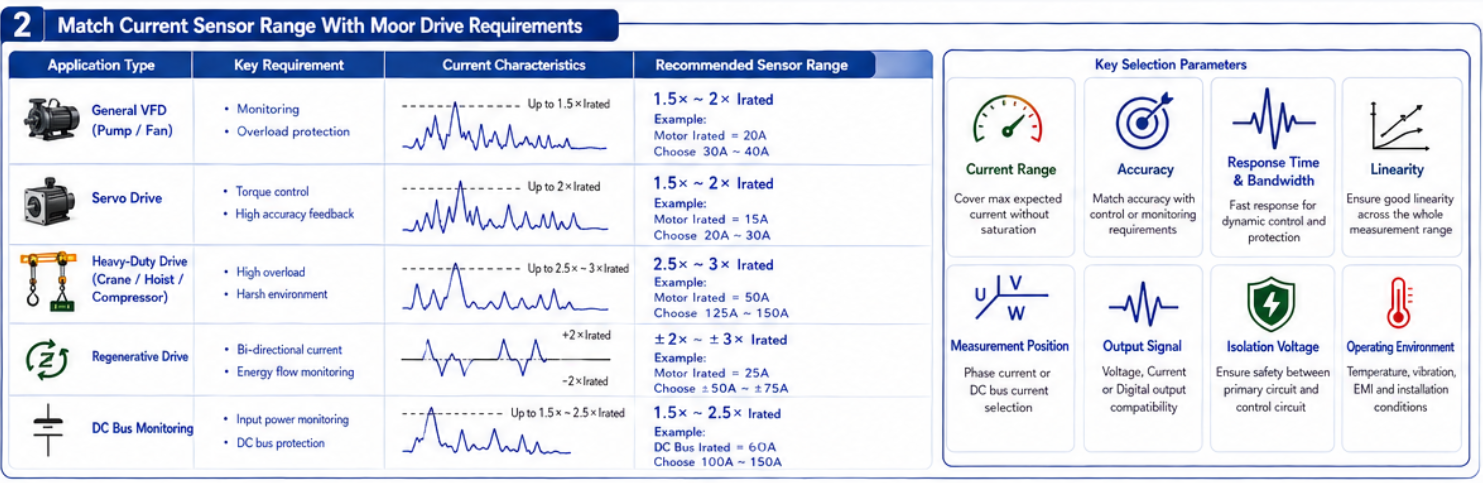
Different motor drive applications require different current sensor range strategies. A pump or fan drive may have relatively stable load conditions and may mainly need current monitoring and overload protection. A servo drive or robot joint drive may require fast and accurate feedback for dynamic torque control. A crane, compressor, or heavy-duty industrial motor may experience high overload current and harsh operating conditions.
For general VFD applications, the current sensor range should cover rated drive current and typical overload current. Accuracy should be sufficient for monitoring and protection. For servo systems, the range should be selected more carefully because current feedback directly affects torque response and control precision. In these systems, too large a sensor range may reduce feedback resolution and affect low-speed or low-load control.
For heavy-duty motor drives, such as cranes, hoists, presses, compressors, and large industrial machines, peak current and overload capability become more important. The sensor should tolerate short-time high current while maintaining stable output during continuous operation. Mechanical strength, isolation voltage, thermal stability, and anti-interference performance should also be reviewed.
For regenerative drives and braking systems, current direction and bidirectional measurement may be important. Engineers should confirm whether the sensor output can represent positive and negative current correctly. If the system uses bidirectional current feedback, the output signal range and zero-current point should be matched with the drive controller.
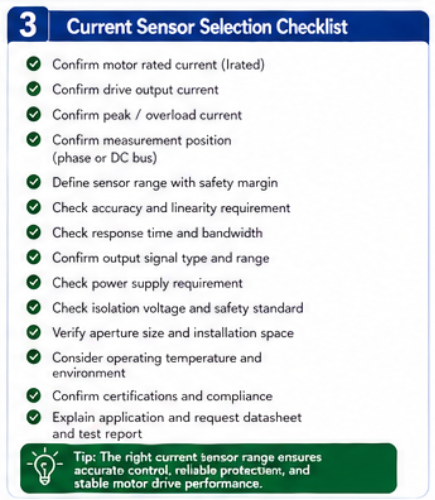
Before ordering, procurement teams should provide the motor power, rated current, drive model, current measurement position, overload requirement, output signal, aperture size, and operating environment. This information helps the supplier recommend a current sensor that matches both electrical performance and installation conditions.
Application Matching Reference
| Motor Drive Application | Current Sensing Priority | Sensor Range Selection Direction |
|---|---|---|
| General VFD For Pumps And Fans | Load monitoring and overload protection | Range should cover rated current plus practical overload margin |
| Servo Drive | Fast torque feedback and precise control | Avoid oversized range; prioritize accuracy, response, and resolution |
| Robot And CNC Drive | Dynamic current feedback and smooth motion control | Use high-performance current sensor with fast response |
| Heavy-Duty Industrial Motor | High overload current and harsh operation | Leave higher peak current margin and check overload capability |
| Regenerative Drive | Bidirectional current measurement | Choose sensor range and output signal supporting positive and negative current |
Common Selection Mistakes To Avoid
Selecting the sensor range only according to motor nameplate current
Ignoring startup, acceleration, braking, and overload current
Choosing a range too large and losing low-current measurement resolution
Not confirming whether the sensor measures phase current or DC bus current
Using a slow sensor in a fast torque control application
Ignoring bidirectional current needs in regenerative drive systems
Failing to match output signal with the drive controller input
Conclusion
Matching current sensor range with motor drive requirements requires more than checking the rated current. Engineers should review normal current, peak current, overload current, current measurement position, control purpose, accuracy, response speed, output signal, and installation conditions. The sensor must avoid saturation during high-current events while still providing enough resolution during normal motor operation.
For general VFD monitoring, a practical open loop or standard current sensor may be enough. For servo drives, robotics, CNC equipment, regenerative drives, and high-performance motor control, a closed loop current sensor with proper range, fast response, good linearity, and stable output is usually the better choice. A correctly matched sensor helps improve motor drive control quality, protection reliability, and long-term system performance.
FAQ
1. Should current sensor range match the motor rated current exactly?
No. The sensor range should cover rated current plus startup, peak, and overload current. However, it should not be much larger than necessary because an oversized range can reduce measurement resolution.
2. Why is peak current important in motor drive sensor selection?
Motor drives may produce high current during startup, acceleration, braking, or overload. The current sensor must handle these conditions without saturation or output distortion.
3. Which sensor is better for servo drives?
Closed loop current sensors are usually better for servo drives because they provide higher accuracy, faster response, better linearity, and more stable current feedback for torque control.
4. What happens if the sensor range is too large?
If the range is too large, normal operating current may occupy only a small part of the output range. This can reduce measurement resolution and affect low-current feedback quality.
5. What information should I provide before requesting a quote?
You should provide motor power, motor rated current, drive output current, peak current, overload requirement, measurement position, output signal, accuracy target, response requirement, aperture size, and operating environment.
Contact Us For Motor Drive Current Sensor Selection Support
If you are selecting current sensors for VFDs, servo drives, pumps, fans, compressors, CNC machines, robots, or heavy-duty motor drive systems, send us your motor rated current, peak current, overload condition, measurement position, output signal, and accuracy requirement. Our team can help you match a suitable current sensor solution.
Contact Us Get Quote