How To Choose A Voltage Sensor For Railway Power Systems
How To Choose A Voltage Sensor For Railway Power Systems
Voltage sensors are essential components in railway power systems because they help monitor traction voltage, DC bus voltage, converter voltage, auxiliary power voltage, and protection signals. In rail transit, high-speed rail, metro systems, locomotives, traction substations, and onboard power converters, voltage measurement must be safe, stable, isolated, and reliable under demanding electrical and environmental conditions.
This guide explains how to choose a voltage sensor for railway power systems, what technical parameters matter most, and how to match voltage sensing performance with traction power, onboard converters, substations, auxiliary systems, battery systems, and railway electrical safety monitoring applications.
Quick Answer
To choose a voltage sensor for railway power systems, first confirm the measurement point, rated voltage, peak voltage, AC/DC voltage type, isolation requirement, accuracy, response time, output signal, installation method, and operating environment. Railway applications usually require strong galvanic isolation, high reliability, stable temperature performance, good anti-interference ability, and compatibility with traction control or monitoring systems. For traction converters, DC bus monitoring, substations, and onboard power systems, isolation voltage, long-term stability, and system safety are especially important.
1. Understand Where The Voltage Sensor Is Used In Railway Systems
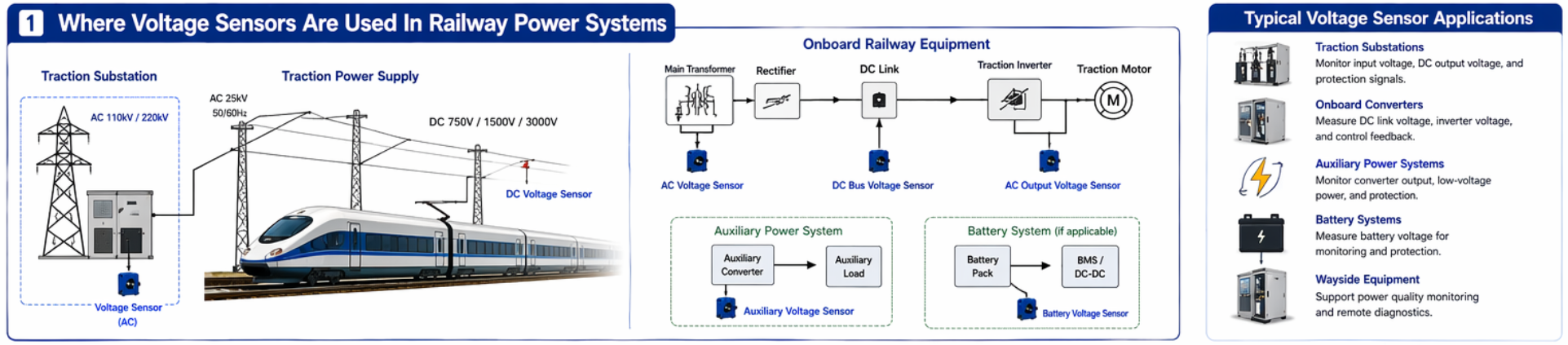
Railway power systems include many voltage measurement points. A voltage sensor may be used in traction substations, onboard converters, auxiliary power systems, DC bus circuits, battery systems, monitoring cabinets, and protection circuits. Each position has different requirements for voltage range, isolation, accuracy, response speed, and environmental reliability. Before selecting a model, buyers should clearly define where the sensor will be installed and how the measured signal will be used.
In traction power systems, voltage sensors are often used to monitor high-voltage DC or AC circuits and provide feedback for control and protection. The sensor must safely separate the high-voltage primary side from the low-voltage signal side. Strong galvanic isolation is essential because railway systems involve high power levels, switching converters, grounding complexity, and strict safety requirements.
In onboard railway converters, voltage sensors may monitor DC link voltage, traction inverter voltage, auxiliary converter voltage, or battery voltage. These systems can experience fast voltage changes, vibration, temperature variation, electrical noise, and long operating hours. A suitable voltage sensor should deliver stable output under real railway conditions, not only under ideal laboratory conditions.
For railway substations and wayside equipment, voltage sensors may support power monitoring, protection systems, fault detection, and remote diagnostics. The sensor should provide stable signal output, strong insulation performance, and reliable operation in electrical cabinets or outdoor-related environments. If the signal is used for protection logic, response speed and accuracy become more important.
Key Questions Before Selection
Is the voltage sensor measuring AC voltage, DC voltage, or both?
Where will the sensor be installed: substation, onboard converter, DC bus, auxiliary system, or battery circuit?
What are the rated voltage, peak voltage, and possible transient voltage conditions?
What isolation voltage and safety margin are required?
Will the output signal be used for monitoring, control feedback, protection, or diagnostics?
What output signal does the railway control system require?
Will the sensor face vibration, temperature changes, humidity, dust, or strong EMI?
2. Check The Core Parameters For Railway Voltage Measurement
Voltage sensor selection for railway power systems should focus on safety, stability, and long-term reliability. The most important parameters include rated input voltage, overload capability, isolation voltage, working voltage, accuracy, linearity, response time, output signal, power supply, temperature range, and anti-interference performance. These factors determine whether the sensor can deliver reliable measurement data in a demanding railway electrical environment.
Input voltage range is the first parameter to confirm. The selected sensor must cover the normal operating voltage and leave enough margin for voltage fluctuation, transient events, and abnormal operating conditions. If the input range is too low, the sensor may be damaged or produce unreliable output during overvoltage conditions. If the range is too high, measurement resolution may be reduced under normal operation.
Isolation voltage is one of the most important factors in railway applications. The sensor must provide reliable electrical separation between the high-voltage measurement side and the low-voltage control side. Buyers should check not only the stated isolation voltage but also the actual working voltage, insulation structure, creepage distance, clearance distance, and application environment. Railway systems may face high voltage stress, electrical noise, and grounding complexity, so isolation design should not be underestimated.
Accuracy and stability are also important. In monitoring applications, standard accuracy may be sufficient. In traction control, converter feedback, energy management, or protection applications, higher accuracy and lower temperature drift are preferred. Temperature stability matters because railway equipment may operate in outdoor, onboard, tunnel, cabinet, or station environments where temperature conditions can vary significantly.
Response time should be matched with the system function. If the voltage sensor is used for slow monitoring, moderate response may be enough. If the sensor is used for converter control, fault protection, or fast system diagnostics, faster response is more important. Output signal compatibility should also be confirmed early, especially when the sensor must connect to PLCs, traction controllers, monitoring modules, ADCs, or protection relays.
| Selection Parameter | Why It Matters In Railway Systems | Recommended Checkpoint |
|---|---|---|
| Voltage Type | Railway systems may involve AC supply, DC traction, DC bus, battery, or auxiliary voltage | Confirm AC, DC, or AC/DC measurement requirement |
| Input Voltage Range | Determines whether the sensor can measure normal and abnormal voltage conditions | Check rated voltage, peak voltage, and transient margin |
| Isolation Voltage | Protects low-voltage control circuits from high-voltage railway circuits | Match isolation level with system voltage and safety design |
| Accuracy | Affects monitoring reliability, control feedback, and protection decisions | Use higher accuracy for traction control and converter feedback |
| Temperature Drift | Railway equipment may face wide temperature changes and long service hours | Choose low-drift sensors for stable long-term output |
| Response Time | Supports fast fault detection, converter control, and protection response | Match response speed with control and protection logic |
| Output Signal | Determines compatibility with railway control and monitoring systems | Confirm voltage output, current output, or custom signal requirement |
| Anti-Interference Ability | Railway converters and power equipment can generate strong EMI | Review shielding, grounding, and signal stability requirements |

Why Isolation Is Especially Important
Railway voltage sensors often measure high-voltage circuits while sending a low-voltage signal to the control system. Galvanic isolation helps protect controllers, monitoring devices, communication modules, and maintenance personnel. In railway systems, isolation also helps reduce ground loop risks and improves signal reliability in complex power environments.
3. Match The Voltage Sensor With Railway Applications
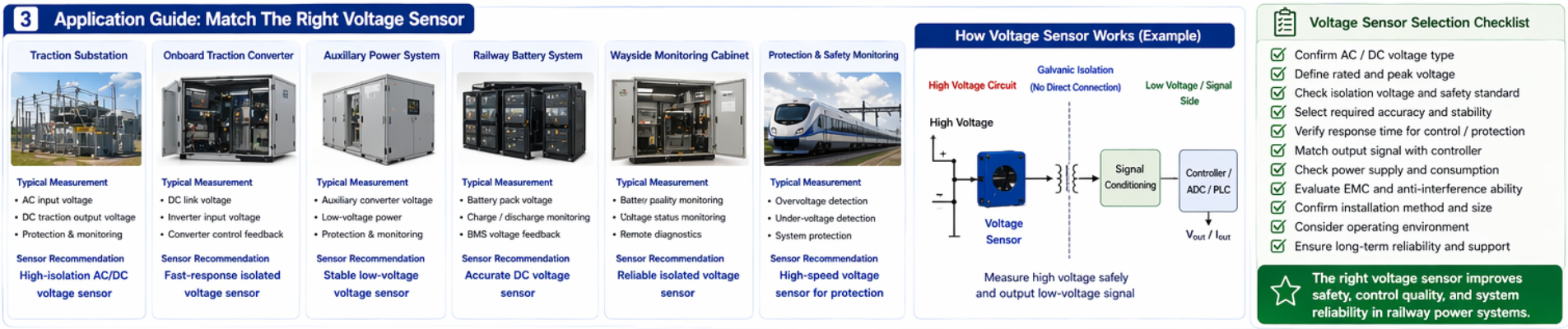
Different railway power applications require different voltage sensing strategies. In traction substations, voltage sensors may monitor supply voltage, DC traction voltage, protection voltage, and power quality signals. In onboard traction converters, they may measure DC link voltage, inverter input voltage, or auxiliary converter voltage. In railway battery systems, sensors may support voltage monitoring for backup power, energy storage, or control systems.
For traction converters and onboard power electronics, voltage sensors should provide fast response, reliable isolation, stable output, and good immunity to switching noise. These systems may operate under vibration and thermal stress, so mechanical structure and environmental adaptability should also be reviewed. The sensor must remain stable over long service cycles because railway equipment often requires high reliability and low maintenance frequency.
For traction substations and wayside cabinets, the sensor should support safe high-voltage measurement and stable monitoring output. Since the signal may be used for protection, diagnostics, or remote monitoring, the output must be clear and compatible with the monitoring system. Strong insulation performance and stable operation under electrical stress are important for long-term service reliability.
For auxiliary railway power systems, voltage sensors may monitor lower-voltage circuits used for lighting, control electronics, HVAC, communication equipment, and onboard auxiliary devices. These applications may not always require the highest precision, but they still need stable measurement, proper isolation, and good compatibility with the controller or monitoring unit.
When requesting a voltage sensor quote, buyers should provide the railway application, voltage type, rated voltage, peak voltage, isolation requirement, output signal, accuracy target, response requirement, installation method, and environmental conditions. This helps the supplier recommend a sensor that fits both the electrical design and the real railway operating environment.
Typical Application Matching Reference
| Railway Application | Voltage Sensing Purpose | Sensor Selection Direction |
|---|---|---|
| Traction Substation | Supply voltage monitoring, protection, diagnostics | High-isolation voltage sensor with stable monitoring output |
| Onboard Traction Converter | DC link voltage, inverter control, converter protection | Fast-response isolated voltage sensor with good EMI resistance |
| Auxiliary Power System | Auxiliary converter and low-voltage system monitoring | Stable voltage sensor matched to controller input signal |
| Railway Battery System | Battery voltage monitoring, backup power management | Accurate DC voltage sensor with low drift |
| Wayside Monitoring Cabinet | Voltage status monitoring, remote diagnostics, fault warning | Reliable isolated sensor with communication-friendly output |
Common Selection Mistakes To Avoid
Choosing a voltage sensor only by rated voltage and ignoring transient voltage margin
Using insufficient isolation in high-voltage railway power circuits
Confusing isolation voltage with continuous working voltage
Ignoring temperature drift in onboard or outdoor railway environments
Not checking output signal compatibility with traction controllers or monitoring systems
Using a slow-response sensor for fast protection or converter feedback
Overlooking EMI, vibration, humidity, and long-term reliability requirements
Conclusion
Choosing a voltage sensor for railway power systems requires a careful review of voltage type, input range, peak voltage, isolation level, accuracy, response time, output signal, temperature stability, anti-interference ability, and installation environment. Railway applications place higher demands on safety, reliability, and long-term stability than many general industrial systems.
For traction substations, onboard converters, DC bus monitoring, auxiliary power systems, battery systems, and railway protection circuits, a properly selected isolated voltage sensor can improve measurement reliability, control quality, electrical safety, and system diagnostics. The best selection always starts with a clear understanding of the railway application and the real operating conditions.
FAQ
1. Why do railway power systems need voltage sensors?
Voltage sensors are used to monitor traction voltage, DC bus voltage, auxiliary power voltage, battery voltage, and protection signals. They help improve system control, safety, diagnostics, and fault protection.
2. Why is galvanic isolation important in railway voltage sensors?
Galvanic isolation separates the high-voltage railway circuit from the low-voltage signal circuit. It protects controllers, monitoring systems, and personnel while improving signal reliability.
3. What output signal should I choose?
The output signal should match the railway controller, PLC, ADC, monitoring module, or protection relay. Common options may include voltage output, current output, or customized analog output.
4. Is response time important for railway voltage measurement?
Yes. If the voltage signal is used for converter control or protection, faster response can support better system reaction. For slow monitoring, moderate response may be enough.
5. What information should I provide when requesting a voltage sensor quote?
You should provide the railway application, AC/DC voltage type, rated voltage, peak voltage, isolation requirement, accuracy target, response requirement, output signal, installation method, and operating environment.
Contact Us For Railway Voltage Sensor Selection Support
If you are selecting voltage sensors for railway power systems, traction converters, traction substations, auxiliary power systems, DC bus monitoring, or onboard electrical equipment, send us your voltage range, isolation requirement, output signal, accuracy target, and application details. Our team can help you match a suitable voltage sensor solution.
Contact Us Get Quote