Current Sensor Quote Guide: What Parameters Should Buyers Send Before Pricing
Current Sensor Quote Guide: What Parameters Should Buyers Send Before Pricing?
When buyers request a current sensor price, the fastest way to get an accurate quotation is to provide the right technical parameters from the beginning. A current sensor is not a standard part that can be priced only by current rating. The final selection depends on application, current type, rated current, peak current, output signal, isolation voltage, aperture size, installation method, accuracy, response time, and working environment.
This guide explains what information buyers should send before requesting a current sensor quote, especially for EV chargers, battery energy storage systems, solar inverters, motor drives, UPS systems, welding machines, railway power systems, and industrial power electronics equipment.
Quick Answer
Before requesting a current sensor quote, buyers should provide the application, measured current type, rated current, peak current, current direction, accuracy target, response time, bandwidth, isolation voltage, output signal, supply voltage, aperture size, conductor size, mounting method, operating temperature, certification requirement, sample quantity, estimated annual demand, and whether customization is needed. Complete information helps suppliers recommend the correct model, avoid wrong selection, and provide faster pricing.
1. Start With Application And Measurement Purpose
The first information buyers should provide is the application. A current sensor used in an EV charging module is different from a current sensor used in a motor drive, welding machine, battery energy storage cabinet, solar inverter, or railway power system. Different applications have different current waveforms, isolation requirements, response speed, accuracy level, and installation structure.
Buyers should clearly explain where the current sensor will be installed. For example, it may be installed on the battery side, DC bus, inverter output, motor phase line, welding output cable, leakage monitoring circuit, or protection circuit. The measurement position helps the supplier understand whether the sensor needs to measure AC current, DC current, pulse current, leakage current, or bidirectional current.
The measurement purpose is also important. If the sensor is only used for basic current monitoring, a cost-effective open loop Hall effect current sensor may be enough. If the signal is used for closed-loop control, fast protection, torque feedback, battery management, or precision DC measurement, a closed loop current sensor or high-accuracy isolated current sensor may be more suitable.
For quotation, buyers should not only ask “How much is a 300A current sensor?” A better request would be: “We need a 300A DC current sensor for a battery energy storage cabinet, bidirectional measurement, 0-5V output, 4kV isolation, busbar size 30 × 5 mm, sample quantity 10 pieces.” This type of information allows the supplier to recommend a model much faster.
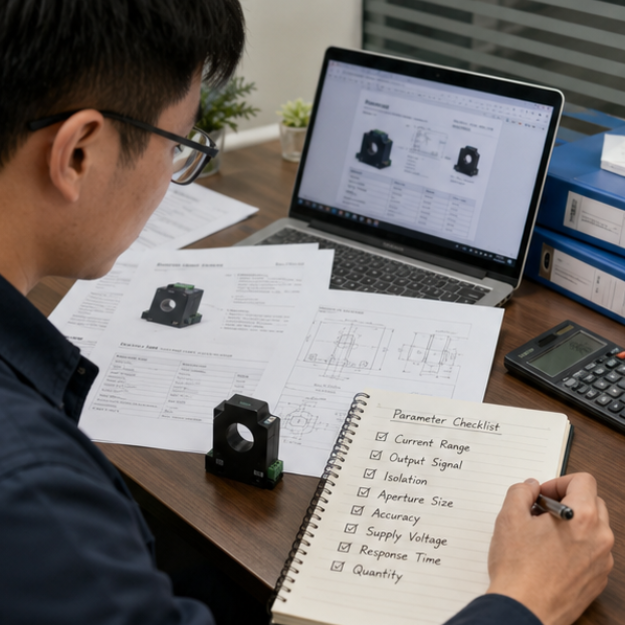
Basic Information Buyers Should Send
Application: EV charger, BESS, solar inverter, motor drive, UPS, welding machine, railway power system, or industrial control cabinet.
Measurement position: battery side, DC bus, phase output, input side, welding output, leakage monitoring, or protection circuit.
Measurement purpose: monitoring, feedback control, protection, display, energy management, or fault diagnosis.
Current type: AC, DC, pulse, leakage, or bidirectional current.
Preferred sensor type if known: open loop, closed loop, split core, leakage current sensor, or custom current sensor.
2. Provide Electrical Parameters For Accurate Model Selection
Rated current is only the starting point. Buyers should also provide peak current, overload current, short-time fault current, and duty cycle if available. This is especially important for motor drives, welding machines, EV chargers, and energy storage systems, where startup current, pulse current, discharge current, or abnormal current may exceed the normal working current.
Accuracy requirements should be matched with the real function of the sensor. For simple monitoring, standard accuracy may be acceptable. For BMS current calculation, inverter control, motor feedback, EV charging current regulation, or high-precision DC measurement, higher accuracy, better linearity, low offset, and low temperature drift may be required.
Response time and bandwidth are important when current changes quickly. Welding machines, servo drives, inverters, UPS systems, and protection circuits may require fast current feedback. If the sensor response is too slow, the system may not detect current changes in time, which can affect control stability or protection reliability.
Isolation voltage should be clearly provided for high-voltage systems. EV chargers, battery energy storage systems, solar inverters, UPS systems, and railway power equipment often require reliable galvanic isolation between the high-current primary side and the low-voltage control side. Buyers should confirm working voltage, isolation voltage, creepage, clearance, and safety requirements when possible.
Output signal and supply voltage must also be confirmed before pricing. A sensor with 0-5V output cannot always replace one with 4-20mA output. A sensor requiring ±15V power supply may not work with a controller that only provides +5V or +24V. Providing these details early can avoid sample testing failure and redesign cost.
| Parameter | Why It Matters | Example To Send |
|---|---|---|
| Rated Current | Determines the basic current sensor range | 100A, 300A, 500A, 1000A, 2000A |
| Peak Current | Prevents saturation during startup, overload, or pulse operation | 600A peak for 1 second |
| Current Type | Determines whether the sensor must measure AC, DC, pulse, leakage, or bidirectional current | Bidirectional DC current for BESS |
| Accuracy Target | Affects model grade, cost, and long-term measurement reliability | ±1%, ±0.5%, ±0.2%, or custom requirement |
| Response Time / Bandwidth | Important for fast control, inverter feedback, and protection | Fast response for motor drive or welding machine |
| Isolation Voltage | Protects controller and low-voltage signal circuits | 2.5kV, 4kV, 6kV, 10kV, or project-specific requirement |
| Output Signal | Must match controller, ADC, PLC, BMS, or PCS input | 0-5V, 0-10V, 4-20mA, ±4V, ±5V, CAN, RS485, or custom output |
| Supply Voltage | Determines whether the sensor can work with the system power rail | +5V, +12V, +15V, +24V, ±15V |
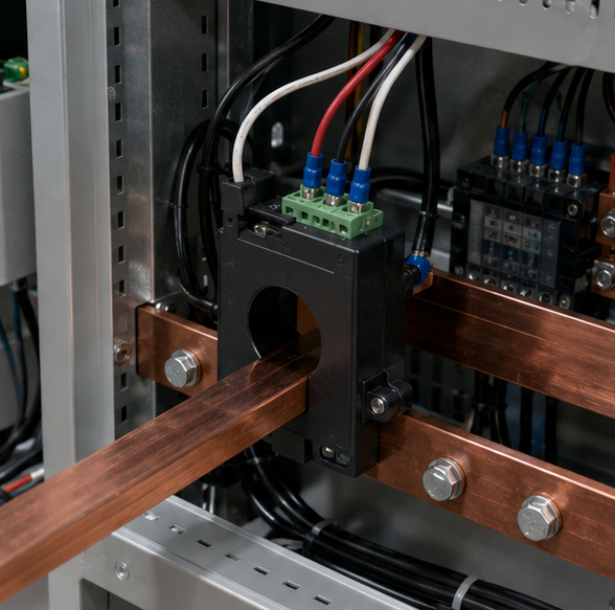
Sample Quote Request Format
Application: EV charging module
Measured current: DC output current
Current range: 500A rated, 800A peak
Output signal: 0-5V
Supply voltage: +15V
Isolation requirement: 4kV or higher
Installation: Busbar type, 40 × 6 mm conductor
Quantity: 20 samples first, estimated annual demand 2000 pieces
3. Do Not Forget Mechanical, Environmental, And Project Details
Mechanical information is often missed in current sensor quote requests, but it directly affects whether the sensor can be installed. Buyers should provide cable diameter, busbar width, busbar thickness, aperture requirement, mounting method, terminal type, and available installation space. If the sensor body does not fit the cabinet, even a correct electrical model cannot be used.
For retrofit projects, buyers should mention whether the cable can be disconnected. If it cannot be disconnected, a split core current sensor may be required. For OEM equipment, a fixed through-hole, PCB-mounted, panel-mounted, or busbar-mounted current sensor may be more suitable depending on the equipment structure.
Operating environment should also be provided. Current sensors used in power electronics may face high temperature, humidity, dust, vibration, electromagnetic interference, and nearby magnetic fields. The supplier needs this information to judge whether the sensor requires wider temperature range, stronger insulation, better EMC performance, or customized structure.
Certification and compliance requirements should be mentioned early. Some customers may require CE, RoHS, REACH, UL/cUL, EMC test reports, insulation test data, ISO 9001 supplier documents, or customer-specific approval documents. If certification requirements are only mentioned after sample testing, the project may need to restart model selection.
Finally, buyers should provide sample quantity, expected order quantity, project stage, delivery schedule, and whether customization is required. This helps the supplier provide a practical quotation instead of only a general reference price.
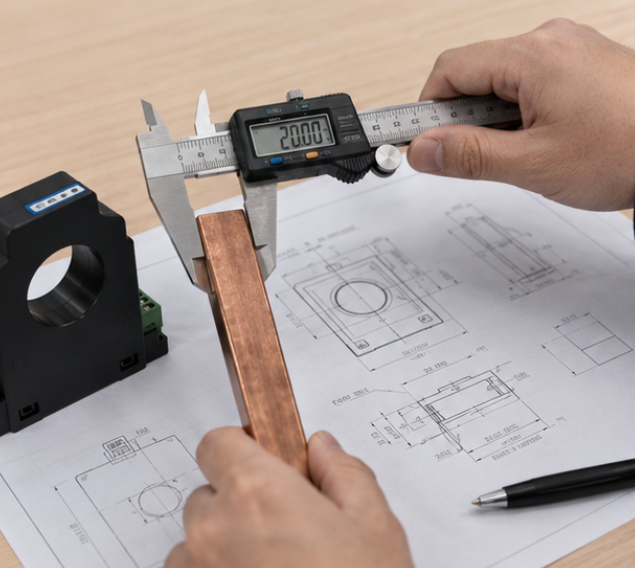
Mechanical And Project Information Checklist
| Category | Information To Provide | Why It Helps |
|---|---|---|
| Conductor Size | Cable diameter, busbar width, busbar thickness | Confirms aperture size and installation fit |
| Mounting Method | PCB mount, panel mount, DIN rail, busbar mount, split core | Helps select the correct structure |
| Installation Space | Available height, width, depth, wiring direction | Avoids model mismatch during installation |
| Working Environment | Temperature, humidity, vibration, dust, EMI, cooling condition | Improves long-term reliability and output stability |
| Certification | CE, RoHS, REACH, UL/cUL, EMC, ISO, test reports | Supports export, customer approval, and final equipment compliance |
| Project Stage | Prototype, sample test, replacement, OEM mass production | Helps supplier recommend practical model and delivery plan |
| Quantity | Sample quantity, trial order, annual demand, forecast | Improves quotation accuracy and production planning |
| Existing Model | Current model number, drawing, datasheet, competitor part number | Speeds up replacement and cross-reference selection |
Common Quote Request Mistakes To Avoid
Only asking for price without providing application and current range.
Providing rated current but not peak current or overload condition.
Not confirming AC, DC, pulse, leakage, or bidirectional current.
Forgetting output signal and supply voltage requirements.
Ignoring aperture size, cable diameter, busbar size, and installation space.
Not mentioning certification or test report requirements before quotation.
Requesting direct replacement without providing original datasheet or real working conditions.

Conclusion
A complete current sensor quote request should include application, measurement position, current type, rated current, peak current, accuracy target, response time, isolation voltage, output signal, supply voltage, aperture size, conductor size, mounting method, working environment, certification needs, quantity, and project stage.
The more complete the information is, the faster the supplier can recommend the correct current sensor model and provide an accurate quotation. For EV chargers, battery energy storage systems, solar inverters, motor drives, UPS systems, welding machines, railway systems, and industrial power electronics, a clear quote request helps reduce wrong model selection, sample testing delays, and unnecessary project cost.
FAQ
1. What is the most important information for a current sensor quote?
The most important information includes application, current type, rated current, peak current, accuracy requirement, output signal, isolation voltage, aperture size, and installation structure.
2. Why does the supplier need peak current?
Peak current helps prevent sensor saturation during startup, overload, pulse operation, welding cycles, or fault conditions. Rated current alone is not enough for accurate model selection.
3. Should buyers provide conductor size?
Yes. Cable diameter, busbar size, and installation space help confirm aperture size and mounting structure. This avoids installation problems after samples arrive.
4. Why is output signal important?
The output signal must match the controller, PLC, ADC, BMS, PCS, or monitoring system. A wrong output type can cause signal mismatch, incorrect readings, or extra conversion cost.
5. Can a supplier quote without full technical information?
A supplier may provide a rough price, but accurate model selection and reliable quotation require complete technical details. Incomplete information increases the risk of wrong model selection.
Request A Current Sensor Quote With Your Parameters
If you need current sensors for EV chargers, battery energy storage systems, solar inverters, motor drives, UPS systems, welding machines, railway systems, or industrial power electronics, send us your application, current range, peak current, output signal, isolation requirement, aperture size, conductor size, and estimated quantity. Our team can help you match a suitable model and provide a practical quotation.
Contact Us Get Quote