How To Choose A Current Sensor For Solar Inverters
How To Choose A Current Sensor For Solar Inverters
Current sensors are essential components in solar inverter systems because they help measure DC input current, AC output current, leakage current, and system operating status. A properly selected current sensor can improve inverter control accuracy, enhance protection performance, support stable power conversion, and reduce long-term reliability risks in photovoltaic systems.
This guide explains how to choose a current sensor for solar inverters, what parameters matter most, how to compare open loop and closed loop Hall effect current sensors, and how to match sensor performance with different inverter applications such as string inverters, hybrid inverters, energy storage inverters, and industrial photovoltaic power systems.
Quick Answer
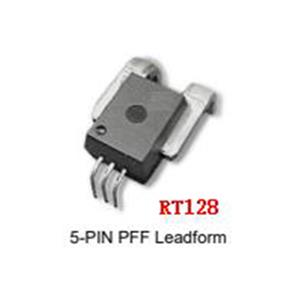
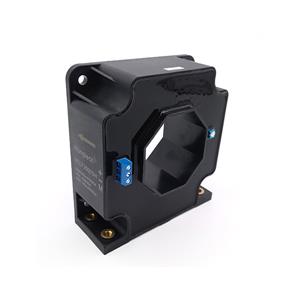
To choose a current sensor for solar inverters, first confirm whether the sensor will measure DC input current, AC output current, leakage current, or battery-side current in a hybrid system. Then check the rated current, peak current, measurement accuracy, isolation voltage, bandwidth, response time, output signal, aperture size, operating temperature, and long-term drift. Open loop Hall effect current sensors are suitable for many standard inverter monitoring applications, while closed loop current sensors are better for higher accuracy, faster response, and demanding control systems.
1. Understand Where The Current Sensor Is Used In A Solar Inverter
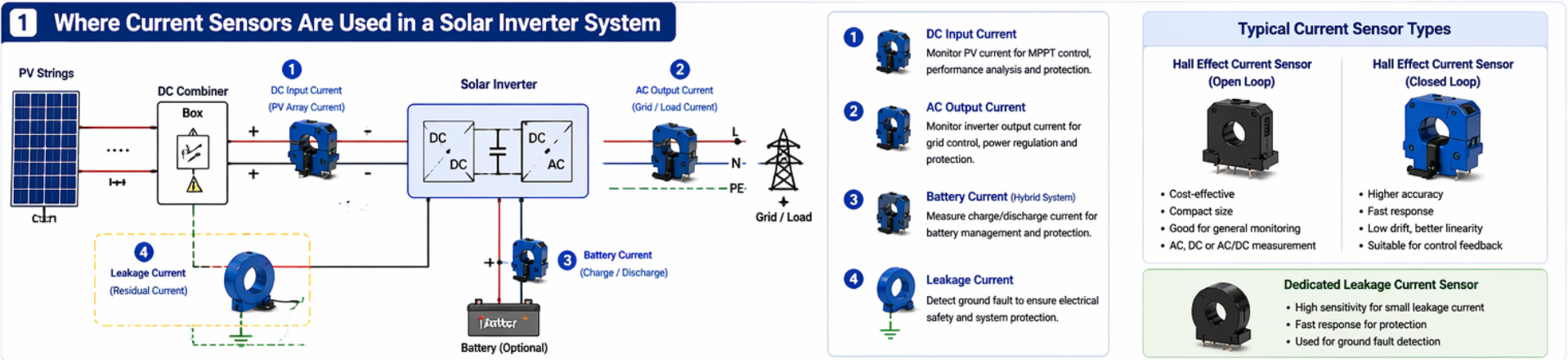
Before selecting a current sensor, it is important to identify its position inside the solar inverter system. Solar inverters may require current sensing on the DC input side, DC bus side, AC output side, battery side, or protection circuit. Each location has different electrical conditions and measurement priorities. A sensor used for basic current monitoring may not require the same performance as a sensor used for real-time control feedback or protection response.
On the DC input side, the current sensor helps monitor photovoltaic array current and supports inverter power tracking and system diagnostics. Stable DC current measurement is important because solar irradiance changes throughout the day, and the inverter must respond to changing input conditions. If the sensor output is unstable or inaccurate, it may affect current monitoring quality and reduce the reliability of operating data.
On the AC output side, current sensors are used to monitor output current, support grid connection control, and detect abnormal load or fault conditions. In grid-tied solar inverters, current measurement can support protection functions and improve system control quality. For hybrid inverters and energy storage inverters, current sensors may also be used to measure battery charge and discharge current, DC bus current, and bidirectional current flow.
Leakage current detection is another important part of solar inverter safety. Photovoltaic systems operate in outdoor environments and may face insulation degradation, humidity, cable aging, or ground fault risks. A suitable leakage current sensor can help improve safety monitoring and fault detection. Therefore, the correct sensor type should be chosen according to whether the system needs power measurement, control feedback, protection, or leakage monitoring.
Key Questions Before Selection
Is the sensor measuring DC current, AC current, leakage current, or bidirectional battery current?
Will the signal be used for monitoring, control feedback, protection, or fault detection?
What are the rated current, peak current, and overload conditions?
What isolation voltage is required for the inverter system?
What output signal does the inverter control board need?
What temperature and humidity conditions will the inverter face?
Is compact installation required inside the inverter cabinet?
2. Compare The Core Parameters That Affect Inverter Performance
For solar inverters, current sensor selection should not be based only on current range. The sensor must match the electrical, mechanical, and environmental requirements of the inverter. Important parameters include measurement type, accuracy, isolation voltage, response time, bandwidth, temperature drift, aperture size, mounting method, and output signal. These factors directly affect inverter control, protection, and long-term stability.
Current range is the first parameter to check. The selected sensor should cover the normal working current and leave enough margin for peak current or transient conditions. If the range is too small, the sensor may saturate during abnormal operation. If the range is too large, the measurement resolution may be poor at lower current levels. A good selection should balance overload capacity and daily operating accuracy.
Accuracy and temperature drift are especially important in solar inverter applications. Solar inverters often operate for long hours and may be installed outdoors, in electrical rooms, or inside compact enclosures where temperature can vary significantly. A current sensor with poor temperature stability may produce inconsistent measurement data over time. For applications where the current signal supports power conversion control, battery management, or protection logic, higher accuracy and lower drift are preferred.
Isolation voltage is another key selection factor. Solar inverter circuits involve high voltage and high current, so the current sensor must provide safe isolation between the primary conductor and the low-voltage control circuit. Proper isolation helps protect the control board, reduce safety risks, and improve system reliability. Buyers should match the sensor isolation rating with the inverter voltage level and safety design.
Response time and bandwidth should be selected according to how the signal is used. If the sensor is only used for slow monitoring, ultra-fast response may not be necessary. If the sensor is used for dynamic control, protection, or fast fault detection, response speed becomes much more important. Output signal compatibility also matters. The sensor output must match the inverter controller input, whether it uses voltage output, current output, or another signal format.
| Selection Parameter | Why It Matters In Solar Inverters | Recommended Checkpoint |
|---|---|---|
| Current Type | Different positions may require DC, AC, leakage, or bidirectional current sensing | Confirm the exact measurement point before model selection |
| Current Range | Determines whether the sensor can handle rated and peak inverter current | Leave practical margin for overload and transient current |
| Accuracy | Affects power monitoring, control feedback, and protection reliability | Use higher accuracy for control-critical inverter circuits |
| Temperature Drift | Solar inverters often work under long operating hours and changing temperatures | Choose low-drift sensors for outdoor or enclosed systems |
| Isolation Voltage | Protects the low-voltage controller from the high-voltage power circuit | Match isolation rating with inverter voltage and safety design |
| Response Time | Supports fast control response and fault protection | Use faster sensors for protection and dynamic control applications |
| Output Signal | Determines compatibility with the inverter control board | Confirm voltage output, current output, or custom signal requirement |
| Aperture And Mounting | Affects installation around cable, busbar, or PCB structure | Check conductor size and available cabinet space |

Open Loop Or Closed Loop For Solar Inverters?
Open loop Hall effect current sensors are often suitable for standard solar inverter monitoring applications because they are compact, cost-effective, and practical for AC/DC current measurement. Closed loop current sensors are better when the inverter requires higher accuracy, faster response, lower temperature drift, and more stable current feedback. For high-performance inverters, hybrid energy storage systems, or control-critical power conversion circuits, closed loop sensors may provide a stronger long-term solution.
3. Match The Current Sensor With Different Solar Inverter Applications
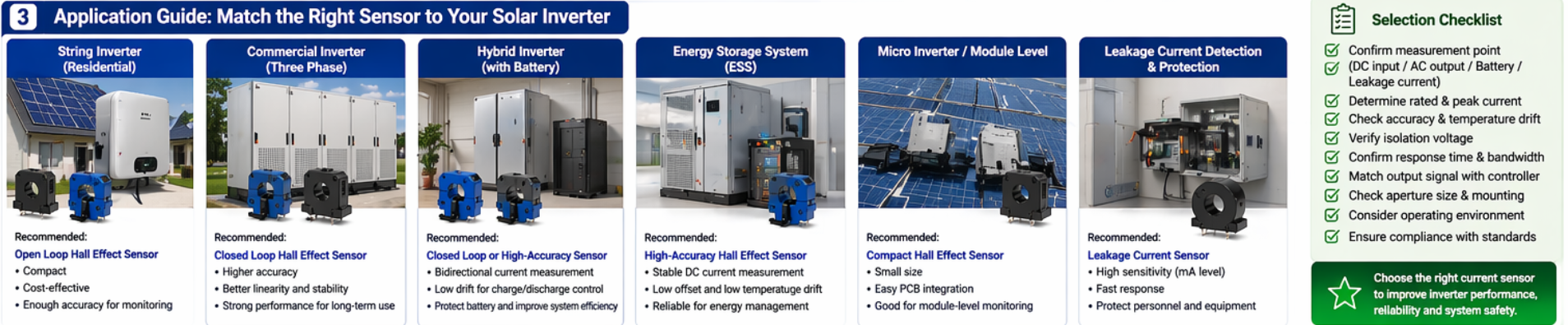
Different solar inverter systems have different current sensing requirements. A residential string inverter may require compact, reliable current sensing for DC input and AC output monitoring. A commercial inverter may require stronger thermal stability, higher current range, and better protection performance. A hybrid inverter connected with battery storage may need bidirectional current sensing and stable DC measurement for charging and discharging control.
For string inverters, the current sensor should provide stable DC input measurement and reliable AC output monitoring. Since space inside the inverter housing may be limited, compact sensor design and simple installation are important. For central or industrial solar inverters, higher current capacity, strong isolation, and reliable operation under continuous load are more important. The sensor must handle larger conductors or busbars and maintain stable output under long working cycles.
For hybrid inverters and energy storage systems, the current sensor may need to measure battery current and bidirectional power flow. This requires good DC measurement stability and accurate feedback during both charging and discharging. In these systems, current sensor performance can affect battery protection, power management, and system safety. A higher accuracy sensor with low offset and low temperature drift is often preferred.
For leakage current detection and safety monitoring, a dedicated leakage current sensor should be selected based on the system protection requirement. Leakage monitoring is not the same as normal load current measurement. Buyers should confirm leakage detection range, response requirement, installation position, and compatibility with inverter protection logic before choosing the sensor.
For procurement teams, the best approach is to provide the supplier with the inverter type, current range, conductor size, output signal, installation structure, operating temperature, and measurement purpose. With these details, it becomes much easier to match a suitable current sensor and reduce the risk of wrong model selection.
Typical Matching Reference
| Solar Inverter Application | Current Sensing Priority | Sensor Selection Direction |
|---|---|---|
| String Inverter | DC input monitoring, AC output monitoring, compact design | Open loop Hall effect current sensor for practical monitoring |
| Commercial Solar Inverter | Higher current range, thermal stability, reliable protection | High-current Hall effect or closed loop current sensor |
| Hybrid Inverter | Battery current, bidirectional current, charge/discharge control | Closed loop or high-accuracy AC/DC current sensor |
| Energy Storage Inverter | DC bus current, battery protection, long-term stability | Low-drift, high-accuracy current sensor |
| Leakage Current Protection | Ground fault detection, electrical safety, protection response | Dedicated leakage current sensor matched to protection circuit |
Common Selection Mistakes To Avoid
Choosing a sensor only by rated current and ignoring peak current or overload conditions
Using a general current sensor where leakage current detection is required
Ignoring temperature drift in outdoor or enclosed inverter environments
Selecting a current range that is too large and losing useful measurement resolution
Not confirming isolation voltage for high-voltage inverter circuits
Overlooking response time in control and protection applications
Failing to match output signal with the inverter control board
Conclusion
Choosing the right current sensor for solar inverters requires a clear understanding of the measurement point, current type, system voltage, accuracy requirement, response speed, operating environment, and installation structure. A suitable current sensor can improve inverter monitoring, control feedback, protection response, and long-term reliability.
For standard inverter monitoring, open loop Hall effect current sensors often provide a good balance of cost and performance. For high-performance solar inverters, hybrid energy systems, energy storage inverters, and control-critical power electronics, closed loop or high-accuracy current sensors may offer better stability and precision. The final choice should always match the real inverter design and application requirement.
FAQ
1. What type of current sensor is commonly used in solar inverters?
Hall effect current sensors are commonly used because they can measure AC and DC current, provide isolation, and support reliable monitoring and control in inverter systems.
2. Should I choose open loop or closed loop current sensors for solar inverters?
Open loop sensors are suitable for standard monitoring and cost-sensitive inverter applications. Closed loop sensors are better for high-accuracy control, faster response, lower drift, and demanding power conversion systems.
3. Why is temperature drift important in solar inverter current sensing?
Solar inverters may operate outdoors or inside compact cabinets where temperature changes are common. Low temperature drift helps maintain stable current measurement over long operating periods.
4. Can one current sensor measure both AC and DC current?
Many Hall effect current sensors can measure AC and DC current, but the final choice depends on the sensor design, current range, accuracy, response time, and output signal requirement.
5. What information should I provide when requesting a current sensor quote?
You should provide the inverter type, measurement point, current type, rated current, peak current, isolation voltage, accuracy target, output signal, mounting method, aperture size, and operating environment.
Contact Us For Solar Inverter Current Sensor Selection Support
If you are selecting current sensors for solar inverters, hybrid inverters, energy storage systems, or photovoltaic power equipment, send us your current range, measurement point, accuracy target, output signal, aperture size, and installation requirements. Our team can help you match a suitable current sensor solution.
Contact Us Get Quote