Custom Hall Current Sensor Supplier For Busbar And Cable Installation
Custom Hall Current Sensor Supplier For Busbar And Cable Installation
Custom Hall current sensors are widely used in EV chargers, battery energy storage systems, PCS cabinets, solar inverters, UPS systems, motor drives, welding machines, railway power systems, and industrial DC cabinets. In many projects, standard current sensor models cannot fully match the real busbar size, cable diameter, mounting direction, output signal, or controller interface.
For OEM buyers and power electronics engineers, choosing a custom Hall current sensor supplier means more than comparing rated current and price. Buyers should confirm current range, aperture size, busbar or cable dimensions, output signal, supply voltage, isolation voltage, response time, accuracy, drift, connector direction, mounting method, and batch consistency before ordering samples or mass production.
Quick Answer
To choose a custom Hall current sensor supplier for busbar and cable installation, buyers should provide the application, rated current, peak current, measured current type, busbar width, busbar thickness, cable outer diameter, aperture shape, output signal, supply voltage, isolation voltage, accuracy target, response time, mounting method, connector direction, sample quantity, and annual demand. A suitable supplier should help match both the electrical parameters and the real mechanical installation structure.
1. Why Custom Hall Current Sensors Are Needed
Standard Hall current sensors are useful for many power electronics applications, but real equipment designs often have different installation requirements. Some projects use flat copper busbars. Some use thick round DC cables. Some use laminated busbars, parallel cables, compact power modules, or narrow cabinet spaces. In these cases, a standard aperture may not fit the conductor properly.
A custom Hall current sensor can be designed or modified to match the actual busbar size, cable diameter, output signal, connector direction, mounting holes, cable length, label, and packaging requirement. This is especially useful for OEM projects where the sensor must fit an existing cabinet layout without redesigning the whole power system.
Custom current sensors are often required in EV charger modules, BESS cabinets, PCS converters, industrial inverters, welding power supplies, railway power equipment, and high-current DC cabinets. A good supplier should help buyers reduce installation risk, signal mismatch, and sample testing delays.
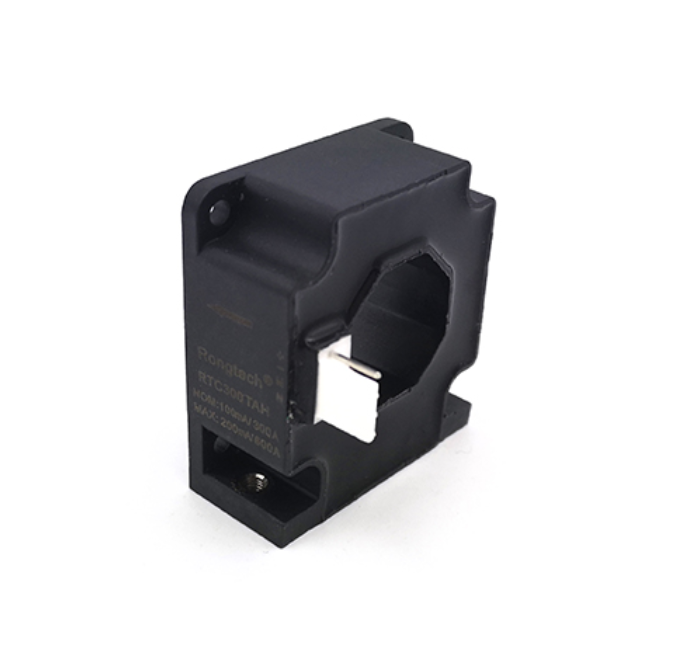
Common Customization Needs
Custom aperture size for flat copper busbars.
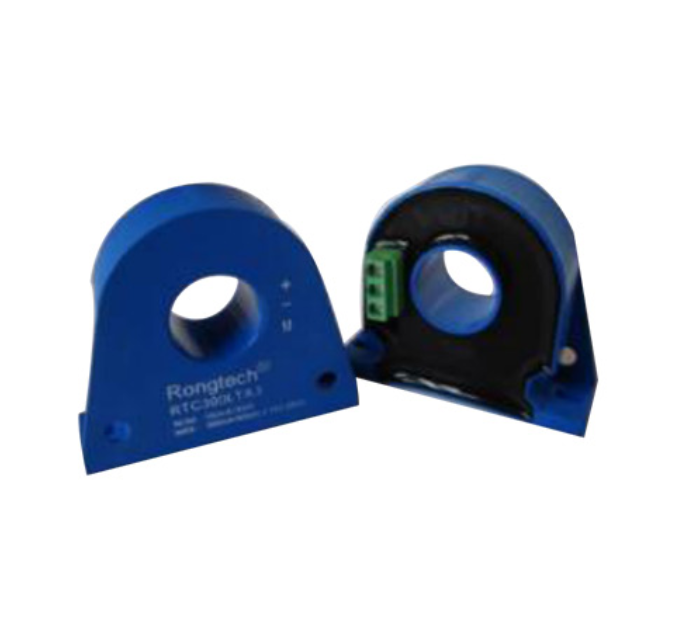
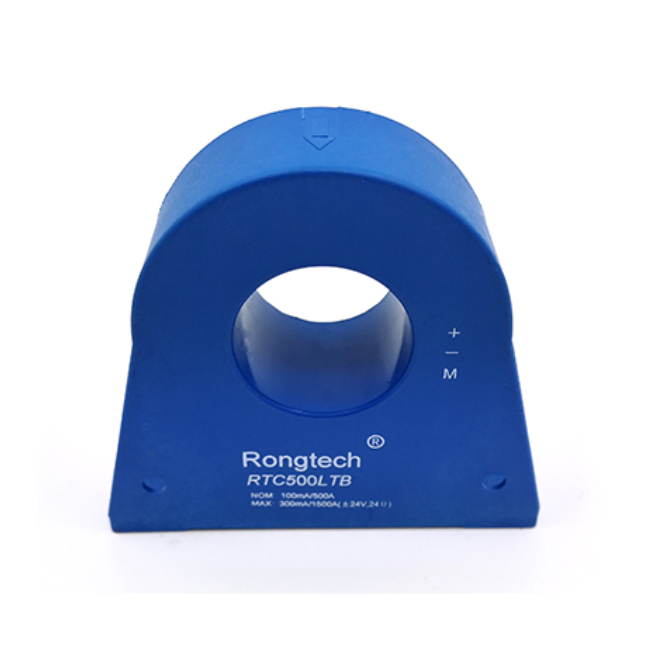
Round aperture for thick DC cable installation.
Rectangular window for busbar-mounted current measurement.
Custom output signal for existing controller input.
Special connector direction or cable length for compact cabinets.
Custom label, housing color, mounting holes, and packaging for OEM projects.
2. Confirm Busbar Size Or Cable Diameter First
Mechanical matching is the first step when selecting a custom Hall current sensor for busbar or cable installation. If the aperture is too small, the conductor cannot pass through. If the aperture is too large, the conductor position may affect measurement consistency. Buyers should provide real conductor dimensions before requesting a quote.
For busbar installation, buyers should provide busbar width, busbar thickness, insulation layer thickness, coating condition, installation direction, and available cabinet space. For cable installation, buyers should provide the full cable outer diameter, not only the conductor cross-section. If multiple parallel cables pass through one sensor, the total conductor layout should also be provided.
For high-current equipment, mechanical clearance is also important. The sensor body, connector, output cable, mounting screws, and nearby components should not interfere with busbar supports, terminals, contactors, fuse holders, cooling channels, or cabinet walls.
| Installation Item | Why It Matters | Buyer Should Provide |
|---|---|---|
| Busbar Width | Determines required aperture width | Example: 30mm, 40mm, 60mm, 80mm or custom width |
| Busbar Thickness | Determines required aperture height and clearance | Example: 5mm, 6mm, 8mm, 10mm or custom thickness |
| Cable Outer Diameter | Determines whether cable can pass through the sensor | Full cable diameter including insulation layer |
| Aperture Shape | Flat busbar and round cable need different structures | Round aperture, rectangular aperture, split core, or custom window |
| Installation Direction | Affects connector direction and wiring route | Horizontal busbar, vertical busbar, cable entry direction and cabinet photo |
| Available Space | Prevents interference with nearby components | Height, width, depth, mounting position and nearby parts |
3. Match Current Range, Peak Current And Current Type
A custom Hall current sensor should be selected according to real working current, not only nominal equipment power. Buyers should confirm rated current, maximum continuous current, peak current, overload duration, fault current, and whether the measured current is AC, DC, pulsed DC, leakage current, or bidirectional DC current.
For EV chargers and BESS projects, DC current measurement is often required. For PCS cabinets and battery systems, bidirectional DC measurement may be required because current flows during both charging and discharging. For motor drives and inverters, dynamic current and response time may be more important.
If the sensor range is too small, it may saturate during peak current. If the range is too large, normal measurement resolution may become poor. A good supplier should help buyers balance current margin, measurement accuracy, and controller input resolution.
| Electrical Parameter | Why It Matters | Buyer Should Confirm |
|---|---|---|
| Rated Current | Defines normal measurement range | 100A, 300A, 500A, 1000A, 2000A or custom range |
| Peak Current | Prevents sensor saturation during overload or transient conditions | Peak current value and duration |
| Current Type | Different current types require different sensor designs | AC, DC, pulsed DC, leakage current, or bidirectional DC |
| Current Direction | Important for BESS and PCS charge/discharge current | Unidirectional or bidirectional measurement |
| Measurement Purpose | Different functions require different performance levels | Monitoring, feedback, protection, diagnosis, or precision measurement |
4. Customize Output Signal For Controller Compatibility
Output signal customization is one of the most common reasons buyers choose a custom Hall current sensor. The sensor output must match the controller, ADC input, PLC, BMS, PCS controller, inverter control board, EV charger controller, or monitoring system.
Common output signals include 0-5V, 0-10V, ±5V, 4-20mA, CAN, RS485, relay output, switch output, or customized voltage and current outputs. For bidirectional DC current measurement, buyers should confirm zero-current output. Some systems need 2.5V midpoint output. Some need bipolar output. Some need customized scaling according to controller software.
If the output signal does not match the controller input, the system may show wrong current, calculate wrong direction, or require additional signal conversion. For OEM production, it is better to confirm signal definition during sample design, not after cabinet assembly.
| Output Signal | Typical Use | Buyer Should Confirm |
|---|---|---|
| 0-5V | ADC input, BMS, EV charger controller, compact control board | Input range, scaling, zero point and signal ground |
| 0-10V | Industrial PLC or control cabinet input | PLC compatibility and voltage tolerance |
| ±5V | Bidirectional DC current feedback | Bipolar input and current direction logic |
| 4-20mA | Long-distance industrial signal transmission | Loop power, load resistance, wiring distance and scaling |
| CAN / RS485 | Digital monitoring and smart equipment | Protocol, baud rate, address and data format |
| Custom Output | OEM controller or replacement project | Output range, connector, pin definition, scaling and zero point |
5. Check Isolation Voltage, Accuracy And Response Time
Custom Hall current sensors are often used in high-voltage power electronics systems. The sensor should provide proper isolation between the high-current conductor and the low-voltage signal circuit. Buyers should confirm working voltage, isolation voltage, creepage distance, clearance distance, and insulation requirements.
Accuracy and drift should match the measurement purpose. If the sensor is used for general monitoring, standard accuracy may be enough. If it is used for PCS feedback, EV charger current control, BESS charge and discharge calculation, or motor drive feedback, higher accuracy and lower drift may be required.
Response time should be confirmed if the signal is used for overcurrent protection or fast control. EMC performance should also be considered because high-power cabinets contain switching power modules, contactors, relays, fans, high-voltage cables, and control wiring.
| Performance Item | Why It Matters | Buyer Should Confirm |
|---|---|---|
| Isolation Voltage | Protects controller and low-voltage signal circuit | 2.5kV, 4kV, 6kV, 10kV or project-specific requirement |
| Accuracy | Affects current feedback and monitoring quality | General monitoring or high-accuracy feedback requirement |
| Offset Drift | Affects zero-current stability in DC measurement | Temperature drift and zero output stability |
| Response Time | Important for protection and control response | Monitoring, feedback or fast shutdown requirement |
| EMC Performance | Switching power systems may create signal noise | Grounding, shielding, wiring layout and cabinet environment |
6. What Buyers Should Send Before Requesting A Quote
To receive an accurate quote for a custom Hall current sensor, buyers should provide application, current range, peak current, measured current type, output signal, supply voltage, isolation requirement, aperture size, busbar or cable dimensions, installation space, accuracy target, response time, connector direction, sample quantity and annual demand.
If the project is a replacement request, buyers should also provide the original current sensor model, datasheet, wiring definition, output scaling, product photos and installation dimensions. This helps the supplier evaluate whether a standard model, modified model or fully customized Hall current sensor is required.
Example Custom Quote Request:
Application: EV charger and BESS cabinet current monitoring
Current range: 500A rated, 800A peak for short-time operation
Measured current: Bidirectional DC current
Output signal: 0-5V with midpoint zero-current output or custom output
Supply voltage: +15V or project-specific requirement
Aperture requirement: Copper busbar 40 × 6 mm or DC cable outer diameter provided
Isolation requirement: 4kV or higher
Customization: Aperture size, connector direction, cable length and label
Quantity: 20 samples first, estimated annual demand 3000 pieces
Final Custom Sensor Checklist
Confirm application and measurement position.
Provide rated current, peak current and current direction.
Confirm AC, DC, pulsed DC or bidirectional DC measurement.
Provide busbar width, busbar thickness or cable outer diameter.
Confirm aperture shape and available installation space.
Match output signal with controller, ADC, PLC, BMS or PCS input.
Confirm supply voltage and pin definition.
Check isolation voltage, working voltage, creepage and clearance.
Review accuracy, drift, response time, EMC and operating temperature.
Confirm sample quantity, annual demand and customization details.
Conclusion
A custom Hall current sensor can help buyers solve installation and signal matching problems in real power electronics projects. Instead of forcing a standard model into an unsuitable cabinet layout, buyers can customize aperture size, output signal, connector direction, cable length, mounting structure and label according to busbar or cable installation requirements.
For EV chargers, BESS cabinets, PCS systems, inverters, UPS equipment, motor drives and industrial DC cabinets, a complete parameter list helps the supplier recommend the right custom Hall current sensor faster, reduce sample testing risk and support stable OEM production.
FAQ
1. What can be customized in a Hall current sensor?
Common customization items include current range, aperture size, output signal, connector direction, cable length, mounting holes, housing structure, label and packaging.
2. Why is aperture size important?
Aperture size determines whether the current sensor can fit the busbar or cable. Buyers should provide busbar width, busbar thickness or cable outer diameter before requesting a quote.
3. Can output signal be customized?
Yes. Output signal can often be customized to match 0-5V, 0-10V, ±5V, 4-20mA, CAN, RS485 or special OEM controller requirements.
4. What applications need custom Hall current sensors?
Custom Hall current sensors are often used in EV chargers, BESS cabinets, PCS systems, inverters, UPS equipment, motor drives, welding machines and industrial DC cabinets.
5. What should buyers provide before requesting a quote?
Buyers should provide application, current range, peak current, output signal, supply voltage, isolation requirement, busbar or cable dimensions, aperture requirement, installation photos, sample quantity and annual demand.
Request A Custom Hall Current Sensor Quote
If you need custom Hall current sensors for busbar or cable installation in EV chargers, BESS cabinets, PCS systems, inverters, UPS equipment, motor drives or industrial DC cabinets, send us your current range, peak current, output signal, isolation requirement, aperture size, busbar or cable dimensions, installation photos, sample quantity and annual demand. Our team can help you match a suitable custom current sensing solution.
Contact Us Get QuoteRelated Rongtech Sensor Pages
For current sensor selection and OEM project matching, buyers often compare rated current or voltage, aperture size, output signal, insulation level, response time, drift, installation space and project documentation in the same RFQ. The following Rongtech pages connect this article with related sensor categories and quotation paths on the same website.
- Products
- Open Loop Current Sensor
- Close Loop Current Sensor
- Voltage Sensors
- Flux Gate Current Voltage Sensors
- Sensor ICs
- Leakage Current Sensors
- High Precision Shunt Resistor
- High Voltage Current Voltage Transformers
- Contact Rongtech
Inquiry Information To Prepare
A clear inquiry should include rated current or voltage, power supply, output signal, aperture or package size, accuracy class, insulation requirement, working temperature, connector preference, expected quantity and the target equipment type. This makes the article more useful for technical buyers and gives the sales team a stronger route from reading to inquiry.