How Water-Cooling Capacitors Meet the Demands of Medium/High-Frequency Induction Heating
How Water-Cooling Capacitors Meet the Demands of Medium/High-Frequency Induction Heating
1. The Crucial Role and Harsh Environment of Capacitors in Induction Heating
In medium/high-frequency induction heating systems, capacitors are not merely auxiliary components; they are fundamental elements of the resonant tank circuit. Their primary function is to work in conjunction with the induction coil to create a oscillating circuit that generates the high-frequency magnetic field necessary for heating conductive materials. This role subjects them to extreme conditions, including very high ripple currents—often reaching thousands of amperes—and operating frequencies that can range from several kHz to hundreds of kHz. At these frequencies, the power loss within the capacitor, primarily due to Equivalent Series Resistance (ESR), becomes a critical factor. This loss is dissipated as intense heat, which, if not effectively managed, leads to rapid temperature rise, degradation of the dielectric material, premature aging, and ultimately, catastrophic failure. Therefore, the ability to handle immense thermal stress is the single most important requirement for capacitors in these demanding applications.
2. The Water-Cooling Solution: Direct and Efficient Heat Exhaustion
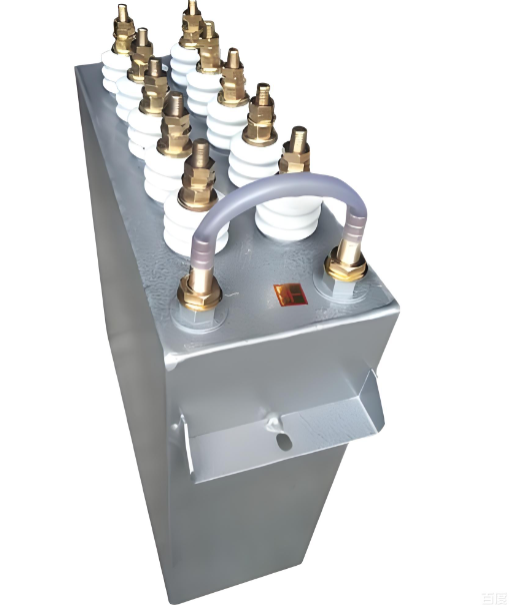
Water-cooling technology provides a direct and highly efficient solution to the thermal management challenge that standard air-cooled capacitors cannot address. The design of a water-cooling capacitor, such as those in Rongtech's series, incorporates a dedicated cooling channel or jacket that allows deionized water to circulate in close proximity to the capacitor's internal elements, particularly the metalized film windings where heat is generated. Water's high specific heat capacity enables it to absorb a massive amount of thermal energy with minimal temperature increase. This system facilitates the direct transfer of heat from the source to the cooling medium, bypassing the slower process of conduction through the case and convection to the air. This efficient heat dissipation allows the capacitor to maintain a stable and safe internal temperature even under continuous, high-current, high-frequency operation. This directly translates to a significantly longer operational lifetime and enhanced reliability, preventing unscheduled downtime in industrial heating processes.

3. Enabling Higher Power Density and System Reliability
The implementation of water-cooling in capacitors has a profound impact on the overall induction heating system's performance and design. By effectively removing the thermal bottleneck, water-cooling capacitors enable the construction of more compact and powerful induction heating power supplies. Designers can push the system to higher power levels without the need to drastically increase the physical size of the capacitor bank to enhance surface area for air cooling. This leads to greater power density. Furthermore, the stable thermal environment preserves the capacitor's key electrical parameters, such as capacitance and ESR, over time. This stability is crucial for maintaining the precise resonance of the tank circuit, which ensures efficient power transfer to the workpiece and consistent heating results. The robust construction of these capacitors, designed to withstand the pressure and conditions of a cooling circuit, makes them an integral part of a highly reliable and high-performance induction heating system for applications like metal melting, forging, and heat treatment.
Summary
In conclusion, water-cooling capacitors are not a luxury but a necessity for modern medium/high-frequency induction heating technology. They directly address the paramount challenge of heat dissipation posed by extreme ripple currents and high frequencies. By enabling efficient thermal management, they unlock higher power density, ensure system stability, and guarantee the long-term reliability required for continuous industrial operation, solidifying their role as a critical component in high-power electronic systems.