What Is Galvanic Isolation In Current And Voltage Sensors
What Is Galvanic Isolation In Current And Voltage Sensors?
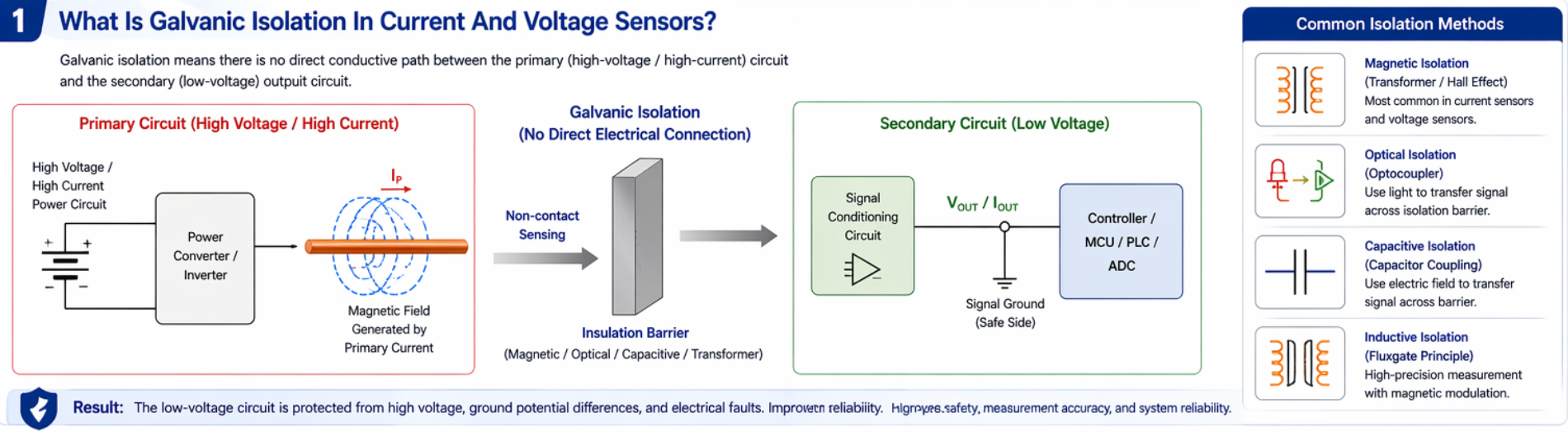
Galvanic isolation is one of the most important safety and performance features in current sensors and voltage sensors. It separates the high-power measurement side from the low-voltage signal and control side, allowing industrial equipment to measure current or voltage without creating a direct electrical connection between dangerous power circuits and sensitive electronics.
This guide explains what galvanic isolation means, why it matters in current and voltage sensors, how it affects safety and signal reliability, and what buyers should check when selecting isolated sensors for power electronics, EV charging, solar inverters, UPS systems, motor drives, energy storage systems, and industrial automation equipment.
Quick Answer
Galvanic isolation means there is no direct conductive path between the primary power circuit and the secondary signal circuit. In current and voltage sensors, this isolation protects controllers, PLCs, signal boards, and operators from high voltage or high current circuits. It also helps reduce ground loop problems, improve noise immunity, and support safer measurement in industrial power systems. When selecting a sensor, buyers should check isolation voltage, working voltage, creepage distance, clearance distance, insulation structure, and application environment.
1. What Galvanic Isolation Means In Sensor Measurement
In industrial power electronics, current and voltage sensors often need to measure signals from high-power circuits. These circuits may involve high voltage, high current, switching noise, transient surges, and dangerous fault conditions. If the measurement circuit were directly connected to the control board, a fault on the power side could damage electronic components or create safety risks. Galvanic isolation solves this problem by separating the power side from the signal side.
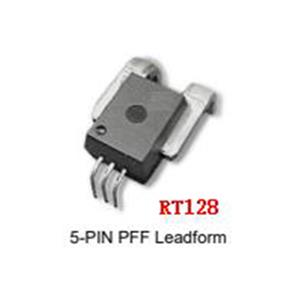
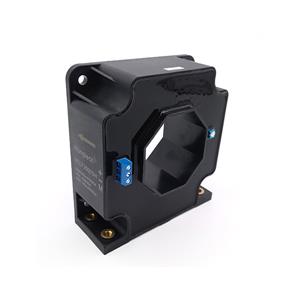
In a current sensor, galvanic isolation is often achieved through non-contact magnetic measurement. For example, a Hall effect current sensor measures the magnetic field generated by the primary conductor without requiring direct electrical contact with the conductor. The high-current path remains separated from the low-voltage output circuit. This allows the sensor to measure AC, DC, or pulse current while protecting the control system from the primary circuit.
In a voltage sensor, isolation can be achieved through magnetic, optical, capacitive, or transformer-based methods depending on the sensor design. The goal is the same: measure the voltage signal accurately while keeping the low-voltage output side electrically separated from the high-voltage input side. This is especially important in solar inverters, railway systems, EV chargers, energy storage systems, industrial drives, and UPS equipment.
For buyers and engineers, galvanic isolation should not be viewed as a small specification. It directly affects equipment safety, system reliability, electromagnetic compatibility, and long-term performance. A sensor with insufficient isolation may work under normal conditions but fail under surge, fault, humidity, contamination, or high-voltage stress.
Simple Explanation
The primary side connects to the high-power circuit being measured.
The secondary side provides a safe signal output to the controller.
Galvanic isolation prevents direct electrical conduction between these two sides.
Isolation helps protect electronics and personnel from dangerous voltage or current.
It also helps reduce ground loops and improves measurement reliability.
2. Why Galvanic Isolation Matters In Industrial Applications
The first reason galvanic isolation matters is safety. In power electronics systems, the measured current or voltage may come from a DC bus, inverter output, battery system, grid connection, motor drive, or charging module. These circuits can carry dangerous energy. An isolated current or voltage sensor helps ensure that the control board, monitoring device, communication system, and operator interface remain separated from the high-energy circuit.
The second reason is equipment protection. Sensitive electronics such as microcontrollers, PLCs, ADCs, communication modules, and monitoring circuits usually operate at low voltage. Without proper isolation, electrical faults, spikes, or ground potential differences may damage these components. A sensor with suitable isolation performance helps reduce the risk of expensive system failures.
The third reason is signal quality. In industrial systems, different parts of the equipment may have different ground potentials. If a sensor creates an unwanted conductive path between circuits, ground loop current may appear and cause measurement noise or unstable readings. Galvanic isolation helps break this unwanted path and supports cleaner signal transmission.
Isolation is also important in systems with switching devices such as IGBT modules, MOSFETs, SiC devices, and high-frequency power converters. These systems can generate strong electrical noise and fast voltage transitions. A well-designed isolated sensor can help maintain signal reliability while reducing the influence of switching noise on the control circuit.
| Why Isolation Matters | Impact On System | Typical Application |
|---|---|---|
| Electrical Safety | Separates high-power circuits from low-voltage control circuits | EV chargers, solar inverters, UPS systems |
| Control Board Protection | Protects PLCs, MCUs, ADCs, and monitoring electronics | Industrial drives, automation systems, power supplies |
| Ground Loop Reduction | Improves measurement stability and reduces unwanted noise | Distributed control cabinets, long cable systems |
| Noise Immunity | Helps maintain signal quality in switching power systems | Inverters, motor drives, welding machines |
| Fault Tolerance | Reduces damage risk during abnormal voltage or current events | Battery systems, railway power, high-voltage equipment |

Key Isolation Terms Buyers Should Know
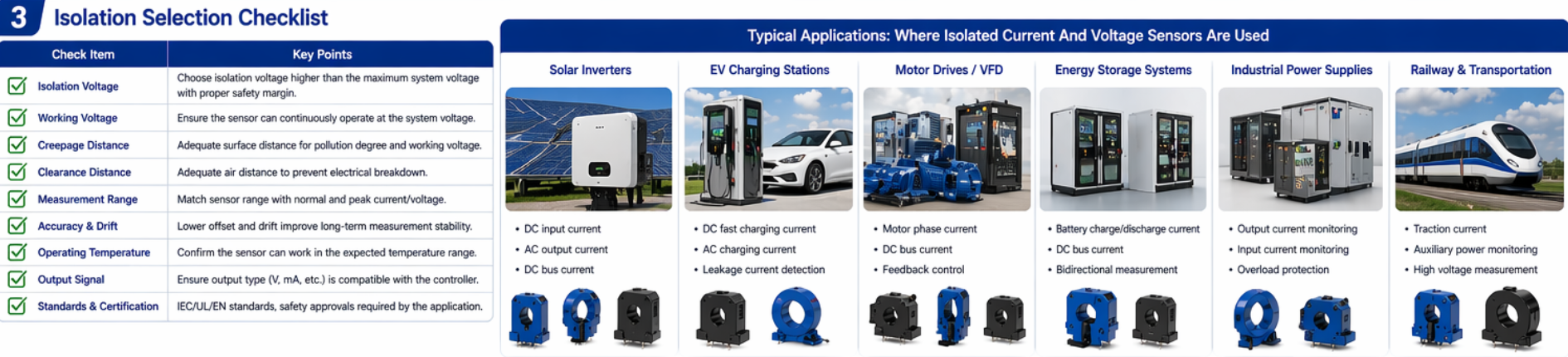
When comparing isolated current sensors or voltage sensors, buyers should pay attention to several technical terms. Isolation voltage refers to the voltage level the insulation barrier can withstand under specified test conditions. Working voltage refers to the continuous voltage the sensor can safely handle during normal operation. Creepage distance is the shortest path along the surface of the insulating material between conductive parts. Clearance distance is the shortest air distance between conductive parts. These parameters affect real safety performance, especially in high-voltage or polluted environments.
3. How To Select Isolated Current And Voltage Sensors
When selecting an isolated current sensor or voltage sensor, the first step is to define the system voltage and measurement point. A sensor used on a low-voltage control line does not need the same isolation performance as a sensor used on a DC bus, grid-connected inverter, high-voltage battery system, or railway power circuit. The isolation rating should match the actual voltage stress and safety design of the equipment.
The second step is to confirm whether the sensor measures current, voltage, or both. Current sensors are often selected for load monitoring, power conversion feedback, motor control, battery charge and discharge monitoring, and fault protection. Voltage sensors are selected for DC bus monitoring, grid voltage measurement, battery voltage detection, and high-voltage system feedback. Both sensor types may need galvanic isolation, but the structure and selection requirements are different.
The third step is to check the application environment. In outdoor solar inverters, EV charging stations, industrial cabinets, railway systems, and energy storage equipment, the sensor may face temperature changes, humidity, dust, vibration, or electrical noise. The sensor should provide not only sufficient isolation voltage but also stable output, suitable operating temperature range, good insulation structure, and reliable long-term performance.
Finally, buyers should confirm output signal compatibility. The isolated sensor output must match the controller, PLC, ADC, or monitoring system. Common outputs may include voltage output, current output, or other conditioned analog signals. Even if the isolation performance is strong, the sensor still needs to match the control circuit properly to deliver useful and accurate data.
Selection Checklist
| Selection Item | What To Confirm | Why It Matters |
|---|---|---|
| Isolation Voltage | Maximum insulation withstand level | Protects control circuits under high-voltage stress |
| Working Voltage | Continuous operating voltage condition | Ensures safe long-term operation |
| Creepage Distance | Surface insulation distance between conductive parts | Important in humid or polluted environments |
| Clearance Distance | Air distance between conductive parts | Helps prevent electrical breakdown |
| Output Signal | Voltage output, current output, or custom signal | Ensures controller compatibility |
| Measurement Range | Current or voltage range to be measured | Prevents saturation and improves measurement resolution |
| Operating Environment | Temperature, humidity, dust, vibration, EMI | Affects long-term safety and signal stability |
Common Selection Mistakes To Avoid
Choosing a sensor only by current or voltage range and ignoring isolation voltage
Confusing test isolation voltage with continuous working voltage
Ignoring creepage and clearance in high-voltage or humid environments
Using a non-isolated sensor in a high-power system where isolation is required
Not checking output signal compatibility with the control board
Overlooking temperature, humidity, and electrical noise conditions
Failing to match the sensor insulation level with the equipment safety design
Conclusion
Galvanic isolation is a key feature in current and voltage sensors because it separates high-power circuits from low-voltage control circuits. It improves safety, protects sensitive electronics, reduces ground loop problems, supports cleaner signal transmission, and helps industrial power systems operate more reliably.
When selecting isolated current sensors or voltage sensors, buyers should review isolation voltage, working voltage, creepage distance, clearance distance, measurement range, output signal, temperature range, and application environment. A properly selected isolated sensor can improve system safety, measurement reliability, and long-term performance in EV charging, solar inverters, UPS systems, motor drives, energy storage, and industrial automation applications.
FAQ
1. What does galvanic isolation mean in a current sensor?
It means the high-current primary conductor is electrically separated from the low-voltage output circuit. The sensor measures current without creating a direct conductive connection between the two sides.
2. Why is isolation important in voltage sensors?
Voltage sensors may measure high-voltage circuits while sending signals to low-voltage controllers. Isolation helps protect control electronics and improves safety in high-voltage power systems.
3. Is isolation voltage the same as working voltage?
No. Isolation voltage is often a test withstand value, while working voltage refers to the continuous operating voltage the sensor can safely handle. Both should be reviewed during selection.
4. What applications require isolated current or voltage sensors?
Common applications include EV charging stations, solar inverters, UPS systems, energy storage systems, motor drives, railway power systems, welding equipment, and industrial automation control systems.
5. What information should I provide when requesting an isolated sensor quote?
You should provide the application, current or voltage range, system voltage, isolation requirement, output signal, mounting method, operating temperature, conductor size, and safety requirement.
Contact Us For Isolated Current And Voltage Sensor Selection Support
If you are selecting current sensors or voltage sensors for high-voltage power electronics, EV chargers, solar inverters, UPS systems, energy storage systems, or industrial drives, send us your measurement range, isolation requirement, output signal, and application details. Our team can help you match a suitable sensor solution.
Contact Us Get Quote