Open Loop vs Closed Loop Current Sensors: Key Differences For Power Electronics
Open Loop vs Closed Loop Current Sensors: Key Differences For Power Electronics
Choosing between open loop and closed loop current sensors is one of the most common questions in power electronics design and procurement. Both technologies are widely used for current measurement, monitoring, feedback control, and protection, but their structure, performance level, response behavior, and cost are different. The right choice depends on how the current signal will be used in the actual system.
This guide explains the key differences between open loop and closed loop current sensors, compares their advantages and limitations, and shows how to choose the right type for motor drives, solar inverters, EV charging systems, UPS equipment, industrial automation, welding machines, and other power electronics applications.
Quick Answer
Open loop current sensors are usually more compact, cost-effective, and suitable for general industrial measurement and control. Closed loop current sensors offer higher accuracy, faster response, better linearity, and lower temperature drift, making them a better choice for demanding power electronics systems. If the application mainly requires standard current monitoring and cost control, open loop is often enough. If the application needs precision feedback, dynamic performance, or high stability, closed loop is usually the better option.
1. What Are Open Loop And Closed Loop Current Sensors?
Both open loop and closed loop current sensors are widely used to measure current in electrical and electronic systems. They are especially common in power electronics because they provide isolation, support AC and DC current measurement, and help control systems operate more safely and accurately. However, the way they work internally is different, and that difference directly affects performance, response, and application suitability.
An open loop current sensor measures the magnetic field generated by the primary conductor and converts it into an output signal through a Hall element and internal signal conditioning circuit. This design is relatively simple, which is one reason open loop sensors are typically smaller, lighter, and more affordable. Because of this, they are often used in industrial applications where cost, size, and standard monitoring performance are more important than very high precision.
A closed loop current sensor, sometimes called a compensation type current sensor, also detects the magnetic field created by the primary current. However, instead of measuring it directly only once, the sensor uses a feedback compensation circuit to generate an opposing magnetic field that balances the original field. The output is based on this compensation current. This working principle improves accuracy, linearity, and response time, making closed loop sensors especially valuable in more demanding control and measurement systems.
In practical terms, open loop sensors are often selected for standard industrial control, energy systems, or power monitoring tasks where budget and installation convenience matter. Closed loop sensors are more commonly selected when the current signal directly influences control quality, conversion efficiency, or measurement precision, such as in servo systems, high-end inverters, test equipment, and advanced energy conversion systems.
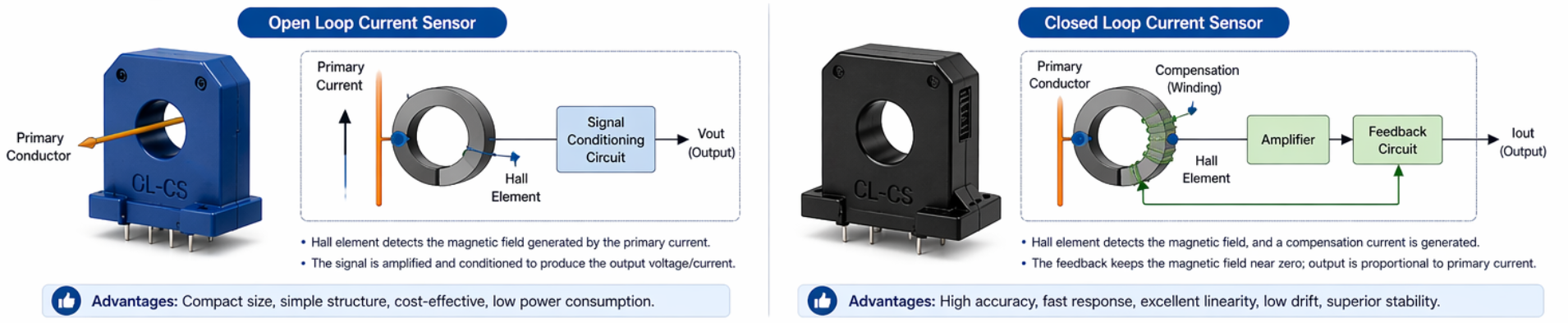
Main Functional Difference
Open loop sensors use a direct Hall measurement structure
Closed loop sensors use a Hall element plus a compensation feedback circuit
Open loop designs are simpler and more economical
Closed loop designs are more precise and more stable in demanding conditions
Both types support isolated current sensing in power electronics systems
2. Key Differences In Performance, Cost, And Application Fit
The most important question for buyers and engineers is not which technology is “better” in general, but which technology is better for the actual application. Open loop and closed loop current sensors each have clear strengths. The selection should be based on the operating environment, measurement target, accuracy requirement, dynamic behavior, and system budget.
Open loop current sensors are widely appreciated for their compact size, lower cost, and simpler circuit structure. They are very practical in applications where current measurement is needed for standard monitoring, rough control, or basic protection. Their cost advantage makes them attractive in projects that need volume production or where overall component budget is a major concern. In many inverters, power supplies, industrial automation systems, and general equipment, open loop sensors can deliver sufficient performance with good practicality.
Closed loop current sensors provide a higher performance level. Because the compensation circuit improves the magnetic measurement process, these sensors typically offer better accuracy, better linearity, faster response, lower offset drift, and stronger temperature stability. This makes them highly suitable for high-performance motor control, servo systems, precision power electronics, test and measurement equipment, high-end renewable energy systems, and advanced industrial drives. Their limitations are usually higher cost, larger size in some cases, and a somewhat more complex design.
Response speed is another major difference. In power electronics, especially where the current signal is part of the control loop, fast and accurate response is very important. Closed loop sensors usually perform better in this area, which can improve control precision and dynamic system stability. On the other hand, if the sensor is mainly used for status monitoring or standard protection, open loop may already provide enough performance without the added cost of closed loop technology.
| Comparison Item | Open Loop Current Sensor | Closed Loop Current Sensor |
|---|---|---|
| Working Principle | Direct Hall effect measurement | Hall effect measurement with compensation feedback |
| Accuracy | Good for standard industrial use | Higher accuracy for demanding applications |
| Linearity | Moderate | Better linearity |
| Response Time | Suitable for many general applications | Faster, better for dynamic control systems |
| Temperature Drift | Higher than closed loop | Lower drift, better long-term stability |
| Size | Usually more compact | May be larger depending on design |
| Cost | Lower cost | Higher cost |
| Best Fit | General monitoring, standard industrial control | Precision control, high-performance power electronics |

When Open Loop Is A Good Choice
Open loop current sensors are a strong choice when the project needs practical performance with good cost control. They are especially suitable for applications such as standard industrial power supplies, general-purpose inverters, battery monitoring, industrial automation, basic EV charging systems, and many types of equipment where the current signal supports monitoring, protection, or standard control functions. Their simpler design often makes them easier to integrate into compact systems and large-volume projects.
When Closed Loop Is A Better Choice
Closed loop current sensors are a better choice when the system depends on high-quality current feedback. This includes servo drives, precision motor control, renewable energy converters, UPS systems, test equipment, welding systems with tighter control requirements, and advanced industrial power electronics. In these situations, better measurement quality can directly improve system efficiency, response precision, and operational stability.
3. How To Choose The Right Type For Power Electronics Applications
When choosing between open loop and closed loop current sensors, buyers should start with the role of the current signal inside the equipment. If the current sensor is used mainly for rough monitoring, overload detection, or standard feedback where small deviations are acceptable, open loop sensors may be completely sufficient. If the current signal is directly related to fine control quality, conversion performance, efficiency optimization, or protection precision, then closed loop sensors are often more suitable.
Application environment is also important. In systems with temperature variation, electrical noise, fast switching, or demanding response requirements, the stability advantage of closed loop technology becomes more valuable. In projects with limited space, tight cost targets, or less demanding performance conditions, open loop designs may offer a better balance between function and budget. Neither type is universally correct; the right decision depends on system priorities.
Procurement teams should also check practical factors before ordering. These include current range, peak current, isolation requirement, output signal, power supply, mounting method, aperture size, operating temperature, and compatibility with the control board or end system. If the supplier can help confirm model matching based on the real application, the selection process becomes more efficient and less risky.
For many power electronics projects, a simple decision rule works well: choose open loop when cost, compactness, and standard performance matter most; choose closed loop when accuracy, speed, and control quality are more important. This approach helps align the sensor choice with the real commercial and technical needs of the equipment.

Common Selection Mistakes To Avoid
Choosing open loop only because it is cheaper, without reviewing accuracy requirements
Choosing closed loop for a simple monitoring task where high precision is unnecessary
Ignoring temperature drift in outdoor or industrial high-temperature environments
Not checking whether fast response is required in switching or control applications
Overlooking installation space, aperture size, and conductor structure
Failing to confirm signal compatibility with the controller or PCB design
Not matching sensor performance to the real function of the power electronics system
Conclusion
Open loop and closed loop current sensors both play important roles in power electronics, but they serve different priorities. Open loop current sensors are valued for their lower cost, compact design, and practical performance in general industrial applications. Closed loop current sensors are preferred when the application requires higher accuracy, faster response, better linearity, and stronger long-term stability.
The best choice depends on the real purpose of the current measurement inside the system. When cost and standard monitoring performance are the main targets, open loop is often the right solution. When control precision, response quality, and measurement reliability are critical, closed loop is usually the better investment. A correct selection helps improve system performance, safety, and long-term operational consistency in power electronics applications.
FAQ
1. What is the main difference between open loop and closed loop current sensors?
The main difference is the measurement method. Open loop sensors use a direct Hall effect measurement structure, while closed loop sensors use a Hall element plus a compensation feedback circuit, which improves accuracy and dynamic performance.
2. Are open loop current sensors accurate enough for industrial use?
Yes. Open loop current sensors are accurate enough for many industrial monitoring, protection, and standard control applications. They are widely used where moderate accuracy and cost efficiency are both important.
3. Why are closed loop current sensors more expensive?
Closed loop current sensors include an internal compensation circuit and a more advanced structure, which improves accuracy, linearity, and response. This higher performance level is one reason they typically cost more.
4. Which type is better for motor drives and servo systems?
Closed loop current sensors are usually better for demanding motor drives and servo systems because they provide more precise and stable current feedback, which supports better control performance.
5. Which type is better for cost-sensitive projects?
Open loop current sensors are usually the better choice for cost-sensitive projects because they are more economical and still provide strong practical value for many industrial power electronics applications.
Contact Us For Current Sensor Selection Support
If you are choosing between open loop and closed loop current sensors for your power electronics project, send us your current range, application, accuracy target, output requirement, and installation details. Our team can help you match a suitable solution more efficiently.
Contact Us Get Quote