How To Compare Fast Recovery Diodes For Different Power System Designs
Fast recovery diodes may look similar on a shortlist, but they do not behave the same way in different power system designs. In real applications, the right comparison depends on whether the diode is used for output rectification, freewheeling, clamping, or as a companion device for an IGBT or MOSFET. Official materials from ST, Vishay, Infineon, and onsemi all show that FRD selection is shaped by topology, switching mode, recovery behavior, thermal limits, and packaging rather than by voltage and current rating alone.
Compare FRDs By Circuit Role And Real Electrical Stress
The first comparison point should always be the circuit role. ST’s ultrafast-diode application note separates two common cases: a diode working in rectifying mode and a diode working in a switching cell together with a MOSFET or IGBT. Vishay also describes different FRD module uses such as output rectification, freewheeling, and clamping, while some 1200 V HEXFRED parts are positioned specifically as companion diodes for IGBTs and MOSFETs. That matters because a diode used at the output of a converter does not face the same stress as a diode working in a hard-switched inverter leg.
Voltage and current stress should then be compared against the real waveform, not only the nominal bus value. In one onsemi design example, a 600 V / 8 A ultrafast diode is selected not just from the calculated voltage and current stress, but also by considering voltage overshoot caused by stray inductance. That is a useful reminder that FRD comparison should include repetitive reverse voltage, RMS or average current, surge current, and the extra stress created by layout inductance and switching transients. In practical terms, a diode that looks sufficient on paper may still be too close to its limit once overshoot and startup conditions are included.
Application environment also changes the comparison logic. Infineon lists string and micro inverters, datacenter UPS, residential and industrial UPS, residential air conditioning, and welding among the target applications for one of its 650 V fast-recovery diode families. Vishay’s power-module guide lists single- and three-phase rectification, industrial welding, switch-mode power supplies, motor drives, and UPS for its diode and FRD module portfolio. This means the “best” FRD is rarely universal. The right choice depends on whether the design is mainly rectification-focused, inverter-based, high-frequency, high-current, or mechanically constrained.
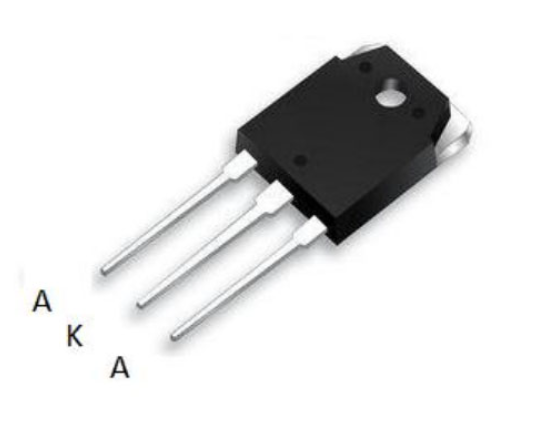
Compare Reverse Recovery, Switching Loss, And Forward Voltage Trade-Offs
Once the application type is clear, the next comparison should focus on recovery behavior. ST explains that ultrafast-diode turn-off losses are driven by recovery parameters and their temperature dependency, and in a switching cell it explicitly links diode-related losses to reverse recovery charge, noting that lower peak reverse recovery current leads to lower switching losses. Vishay makes the same practical point from the product side: its HEXFRED line highlights ultrafast recovery, very low peak recovery current, no snap-off tendency, lower noise, and lower switching losses in both the diode and the switching transistor. For high-frequency converters, hard-switched inverters, and fast freewheeling paths, these recovery parameters often matter more than a simple trr headline alone.
This is where different power-system designs start to separate. In a high-speed switching design, Qrr, IRRM, recovery softness, and temperature behavior usually deserve more weight because they directly influence turn-on loss in the companion switch, snubber needs, EMI behavior, and thermal stress. In a more rectification-oriented design, those parameters still matter, but average current capability, surge handling, and conduction loss may carry more weight. That prioritization is an inference from ST’s distinction between rectifying mode and switching-cell mode, combined with Vishay’s emphasis on lower switching loss and reduced snubbing for HEXFRED devices.
Forward voltage should be compared together with recovery behavior, not separately. Infineon highlights low and temperature-stable forward voltage, very soft and fast recovery, and low reverse recovery current in one of its recent 650 V families, while Vishay’s higher-current 1200 V SOT-227 module lists both forward-voltage figures and dynamic recovery parameters in the same datasheet. That combination is important because a diode with very fast recovery but an unfavorable VF can reduce switching loss while increasing conduction loss, and the opposite can also happen. A strong comparison therefore looks at the whole operating point: current, switching frequency, duty cycle, and expected junction temperature.
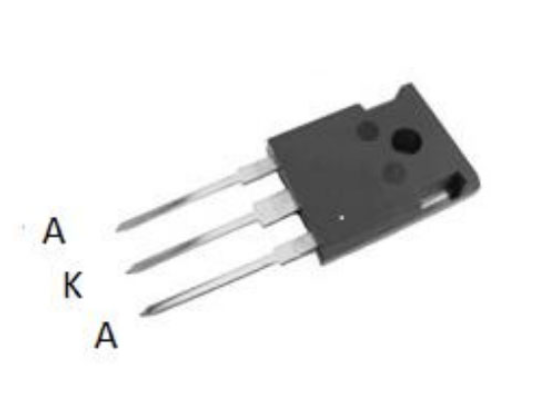
Compare Thermal Path, Package Style, And Reliability In Real Equipment
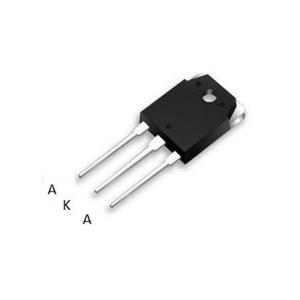
The third comparison point is thermal and mechanical fit. Infineon’s discrete 650 V diode example combines 175 °C maximum junction temperature, low junction-to-case thermal resistance, 380 A non-repetitive surge current, humidity robustness, and cosmic-ray ruggedness in a TO-247 package. Vishay’s 220 A / 1200 V SOT-227 module adds an electrically isolated base plate, large creepage distance, rapid assembly, 2500 V isolation, and applications such as high-voltage power supplies, welders, motor control, and inverters. Those are not minor packaging details. They directly affect heatsink choice, assembly complexity, creepage strategy, surge robustness, and long-term durability.
At a broader portfolio level, Vishay’s current power-module selector guide emphasizes wide package options, direct heatsink mounting, fast-recovery diode modules, high isolation voltage, low thermal resistance, and applications including rectification, welding, SMPS, motor drives, and UPS. Based on those documented differences, it is reasonable to infer that discrete FRDs are often easier to use in lower- or medium-power compact designs, while FRD modules become more attractive when current is higher, isolation is important, or thermal and mechanical integration needs to be simplified. That is an inference, but it is grounded in the package, current, isolation, and application data given in the vendor documents.
The final comparison should always be lifecycle reliability, not only initial electrical fit. Infineon explicitly promotes improved reliability, humidity robustness, cosmic-ray ruggedness, and JEDEC qualification for industrial targets in its recent FRD family. Vishay’s module materials stress industrial qualification, UL approval, high isolation voltage, and consistency of mechanical and electrical characteristics. For real equipment, that means FRD comparison should end with a practical question: which part is most likely to keep its electrical behavior, thermal margin, and assembly robustness under the actual environment of the finished product?
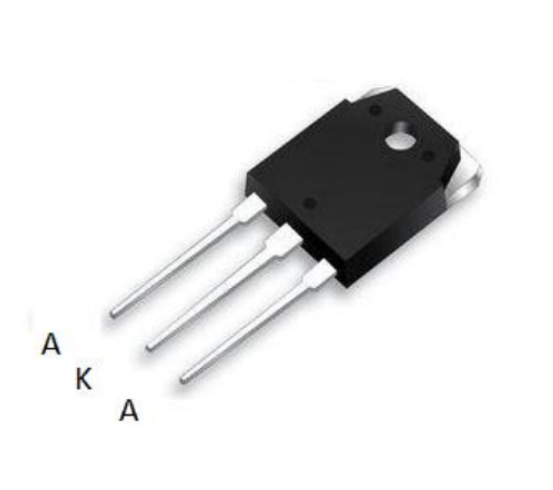
The best way to compare fast recovery diodes is to start from the power-system design itself. First compare the diode’s real job in the circuit, then compare recovery behavior and conduction trade-offs at the actual switching condition, and finally compare thermal path, package style, isolation, and reliability in the finished equipment. When FRDs are compared that way, the selection becomes much more accurate than simply matching VRRM and current from a catalog table.