Hall Effect vs Fluxgate Current Sensors: Which One Should You Choose
Hall Effect vs Fluxgate Current Sensors: Which One Should You Choose?
Hall effect current sensors and fluxgate current sensors are both widely used for isolated current measurement, but they are designed for different performance levels and application needs. Hall effect sensors are practical, cost-effective, and suitable for many industrial power electronics applications. Fluxgate sensors provide much higher precision, lower offset, better stability, and excellent low-current measurement performance.
This guide explains the key differences between Hall effect and fluxgate current sensors, compares their working principles, accuracy, cost, response, stability, and application fit, and helps engineers and procurement teams choose the right current sensor for industrial equipment, EV charging, solar inverters, energy storage, motor drives, power supplies, and precision measurement systems.
Quick Answer
Choose a Hall effect current sensor when you need a practical, isolated, and cost-effective solution for general AC/DC current measurement in industrial power electronics. Choose a fluxgate current sensor when the application requires very high accuracy, low offset, excellent linearity, low temperature drift, and reliable measurement of small DC currents. For most industrial control, inverter, EV charger, and motor drive applications, Hall effect sensors are usually sufficient. For precision testing, high-end energy measurement, battery analysis, and advanced power conversion systems, fluxgate sensors may be the better choice.
1. Understand The Working Principle Difference
Hall effect current sensors measure current by detecting the magnetic field generated around a primary conductor. When current flows through the conductor, it creates a magnetic field. A Hall element senses this magnetic field and converts it into an electrical signal. Because the measurement is contactless and isolated from the primary current path, Hall effect current sensors are widely used in industrial electronics, power conversion, motor control, charging equipment, and automation systems.
Hall effect current sensors are available in open loop and closed loop designs. Open loop Hall sensors are usually compact and cost-effective, making them suitable for general monitoring and standard control. Closed loop Hall sensors use a compensation feedback structure, offering better accuracy, faster response, lower drift, and improved linearity. This makes them suitable for more demanding current feedback applications.
Fluxgate current sensors use a different magnetic detection method. They typically use a magnetic core driven into alternating saturation, and the measured current changes the magnetic behavior of the core. By detecting this change, the sensor can measure current with very high sensitivity and stability. Fluxgate technology is especially strong in precision DC current measurement, low offset, low noise, and long-term measurement consistency.
In simple terms, Hall effect sensors are a strong choice for broad industrial use, while fluxgate sensors are designed for applications where measurement quality is the top priority. The right choice depends on whether the project needs practical performance at a reasonable cost or very high precision at a higher component cost.
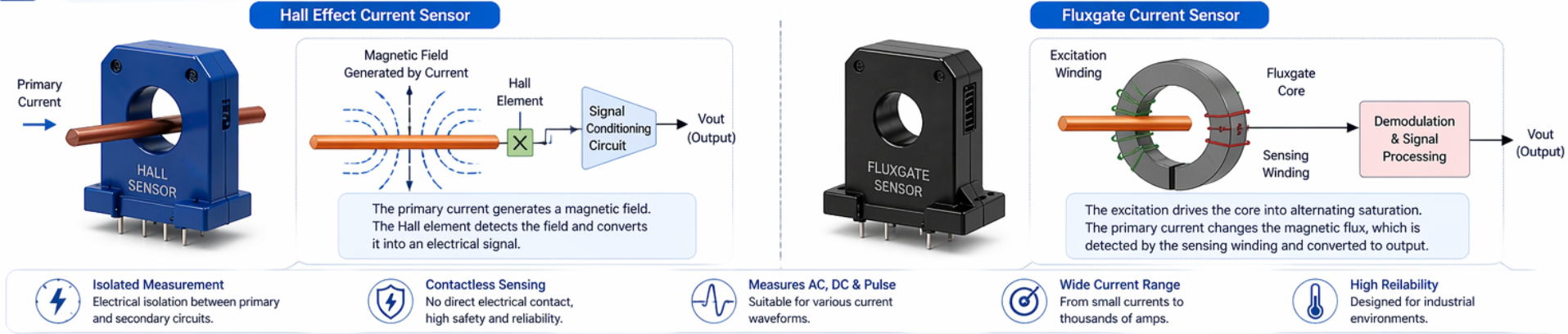
Basic Technology Difference
Hall effect sensors measure current by detecting the magnetic field created by the conductor.
Fluxgate sensors measure current by detecting magnetic core saturation changes with very high sensitivity.
Hall effect sensors are widely used for standard industrial current measurement.
Fluxgate sensors are preferred for precision DC measurement and low-current accuracy.
Both technologies can provide isolated current sensing for power electronics systems.
2. Compare Accuracy, Stability, Cost, And Application Fit
The biggest difference between Hall effect and fluxgate current sensors is measurement performance. Hall effect current sensors can provide reliable accuracy for many industrial applications, especially when the sensor is used for monitoring, control feedback, overload detection, or general power measurement. They offer a good balance of performance, size, cost, and availability.
Fluxgate current sensors are designed for higher precision. They usually provide lower offset, better zero-current stability, lower noise, better linearity, and lower temperature drift. This makes them useful when small current changes must be measured accurately, or when DC current measurement quality is critical. For example, battery testing, precision power analyzers, laboratory measurement systems, high-end energy storage testing, and advanced power electronics development may benefit from fluxgate technology.
Cost is another important difference. Hall effect sensors are usually more economical and easier to apply in large-volume industrial equipment. Fluxgate sensors normally cost more because the internal structure and signal processing are more complex. For procurement teams, this means fluxgate technology should be selected when the application truly needs its higher performance. Otherwise, a Hall effect sensor may provide a better total cost-performance balance.
Response and bandwidth should also be reviewed. Some Hall effect sensors, especially closed loop Hall sensors, can offer fast response suitable for motor drives, inverters, and dynamic control systems. Fluxgate sensors can deliver excellent precision and stability, but the final response performance depends on the sensor design. Buyers should always compare datasheet specifications based on the real application rather than assuming one technology is always superior in every parameter.
| Comparison Item | Hall Effect Current Sensor | Fluxgate Current Sensor | Selection Advice |
|---|---|---|---|
| Working Principle | Magnetic field detection using Hall element | Magnetic core excitation and flux detection | Choose based on required measurement precision |
| Accuracy | Good for general industrial applications | Very high accuracy for precision measurement | Fluxgate is better for high-precision systems |
| Offset Stability | Acceptable for standard measurement | Excellent low-offset performance | Fluxgate is preferred for small DC current measurement |
| Temperature Drift | Depends on open loop or closed loop design | Usually lower drift and better stability | Fluxgate is better for temperature-sensitive measurement |
| Cost | More cost-effective | Higher cost | Hall effect is better for cost-sensitive projects |
| Size And Integration | Compact options widely available | May be larger or more complex depending on design | Check cabinet space, PCB layout, and mounting method |
| Typical Applications | Motor drives, EV chargers, inverters, UPS, industrial automation | Precision testing, battery analysis, high-end DC measurement | Match sensor type to measurement purpose |

When Hall Effect Is A Better Choice
Hall effect current sensors are often the better choice when the application needs reliable isolated current measurement with good cost control. They are suitable for motor drives, industrial inverters, EV charging stations, UPS systems, welding machines, power supplies, solar inverters, and general automation equipment. If the project does not require ultra-low offset or laboratory-level precision, Hall effect technology usually offers a practical and economical solution.
When Fluxgate Is A Better Choice
Fluxgate current sensors are better when the system requires very high precision, excellent zero-current stability, low noise, and accurate DC measurement. They are especially useful for battery testing systems, precision current measurement, high-end power analyzers, laboratory equipment, advanced energy storage testing, and systems where small current deviations must be detected reliably.
3. Match The Sensor Technology To The Application
The best way to choose between Hall effect and fluxgate current sensors is to start with the measurement purpose. If the current signal is mainly used for equipment monitoring, overload protection, system feedback, or general power control, a Hall effect current sensor may meet the requirement well. If the current signal is used for precision analysis, calibration, high-accuracy DC measurement, or small-current detection, a fluxgate current sensor may provide better value despite the higher cost.
For EV charging stations, Hall effect current sensors are commonly used for AC and DC current monitoring, protection, and charging control. In many charging piles and charging modules, a Hall effect sensor provides enough accuracy, isolation, and response performance. However, in high-precision test platforms for EV batteries or charger validation, fluxgate sensors may be selected because measurement accuracy and offset stability are more critical.
For solar inverters and energy storage systems, Hall effect sensors are practical for DC bus current, AC output current, and general control measurement. Closed loop Hall effect sensors can provide stronger performance when higher accuracy and faster response are needed. Fluxgate sensors may be used in advanced energy testing, battery current analysis, or high-end DC measurement systems where small errors can affect system evaluation.
For motor drives and industrial automation, Hall effect sensors are usually the more common choice because they provide a good balance of accuracy, speed, isolation, and cost. Fluxgate sensors are less common in standard motor drive applications unless the system requires extremely precise current feedback or specialized measurement capability.
Procurement teams should also consider total project value. A fluxgate sensor may offer higher performance, but that performance only creates value when the system can use it. If the control board, signal processing, installation method, and system design do not support high-precision measurement, a more expensive sensor may not improve the final result. The best current sensor is the one that matches the complete system requirement.

Application Matching Reference
| Application | Main Requirement | Recommended Direction |
|---|---|---|
| Industrial Motor Drives | Fast feedback, isolation, reliable control | Hall effect current sensor, closed loop for higher performance |
| EV Charging Stations | AC/DC current monitoring, safety, control feedback | Hall effect current sensor for most charging applications |
| Solar Inverters | DC bus and AC output current measurement | Hall effect sensor, closed loop when higher accuracy is required |
| Energy Storage Systems | Battery current monitoring, charge/discharge measurement | Hall effect for standard systems, fluxgate for precision analysis |
| Battery Testing Equipment | Low offset, high DC accuracy, stable small-current measurement | Fluxgate current sensor |
| Precision Power Measurement | Very high accuracy, low noise, calibration-level data | Fluxgate or precision closed loop current transducer |
Common Selection Mistakes To Avoid
Choosing fluxgate technology only because it is more accurate, even when the application does not need it
Choosing Hall effect technology for precision DC measurement without checking offset and drift requirements
Ignoring the difference between open loop Hall and closed loop Hall sensor performance
Comparing sensor accuracy without checking temperature drift, offset, and linearity
Selecting a sensor range that is too large for the normal operating current
Forgetting to confirm output signal compatibility with the controller or measurement system
Ignoring total system design, installation method, and signal processing capability
Conclusion
Hall effect and fluxgate current sensors are not direct replacements in every situation. Hall effect current sensors are suitable for most industrial current measurement applications because they provide reliable performance, isolation, cost efficiency, and broad application coverage. Fluxgate current sensors are better suited for precision measurement, low-offset DC sensing, battery testing, and advanced systems where very small current errors matter.
For most EV charging stations, motor drives, solar inverters, UPS systems, welding equipment, and industrial automation applications, Hall effect current sensors are usually the practical choice. For precision testing, high-end energy storage analysis, laboratory equipment, and advanced power measurement, fluxgate current sensors can provide stronger measurement quality. The final decision should be based on accuracy needs, current range, offset tolerance, temperature stability, response requirement, installation space, and project budget.
FAQ
1. What is the main difference between Hall effect and fluxgate current sensors?
Hall effect current sensors measure the magnetic field generated by the conductor using a Hall element. Fluxgate current sensors use magnetic core excitation and detection to provide much higher sensitivity, lower offset, and better DC measurement stability.
2. Are fluxgate current sensors always better?
No. Fluxgate sensors usually offer higher precision, but they also cost more and may be unnecessary for standard industrial applications. Hall effect sensors are often the better choice when the project needs reliable performance and cost efficiency.
3. Which sensor is better for EV charging stations?
Hall effect current sensors are commonly used in EV charging stations because they support AC/DC current measurement, isolation, compact installation, and practical accuracy. Fluxgate sensors may be used for charger testing or precision battery measurement systems.
4. Which sensor is better for battery testing?
Fluxgate current sensors are often better for battery testing because they provide very low offset, high DC accuracy, low noise, and stable measurement of small current changes.
5. What information should I provide before choosing between Hall effect and fluxgate sensors?
You should provide the application, current type, rated current, peak current, accuracy target, offset requirement, response requirement, operating temperature, output signal, installation method, and project budget range.
Contact Us For Current Sensor Selection Support
If you are choosing between Hall effect and fluxgate current sensors, send us your current range, accuracy target, offset requirement, application, output signal, and installation details. Our team can help you match a suitable current sensor solution for your project.
Contact Us Get Quote